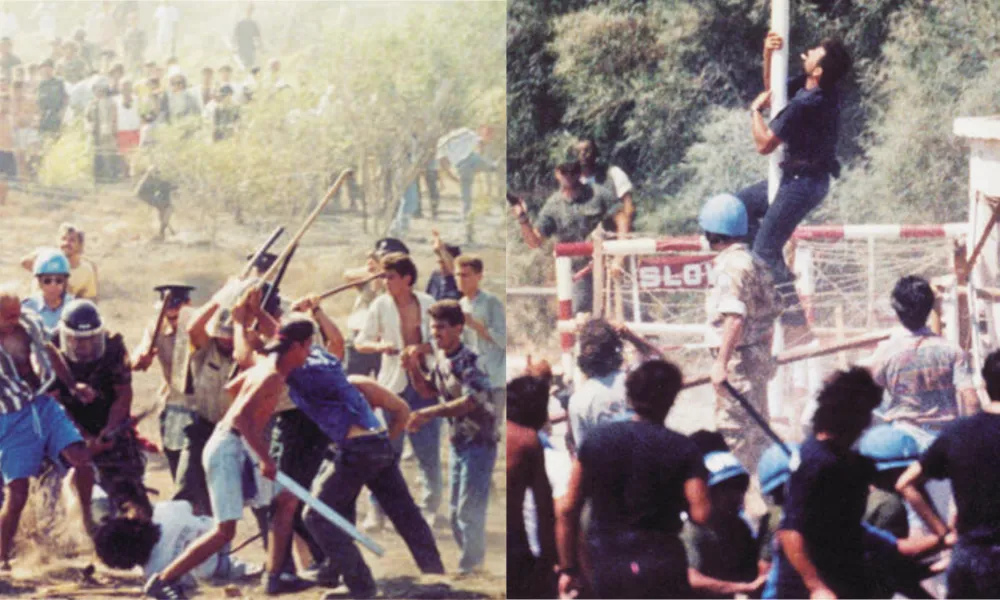

Tassos Isaac was brutally murdered on 11 August 1996 during an anti-occupation motorcycle rally, organised by Cypriot and European bikers to condemn the Turkish invasion and the continuing occupation. He was beaten to death in the buffer zone at Deryneia by Turkish Cypriots and Turkish soldiers and paramilitaries, among them members of the Grey Wolves. The killing was carried out in front of UN peacekeepers, who stood by and watched without intervening. Isaac's wife was pregnant at the time and, a few weeks after his death, on 17 September 1996, gave birth to their daughter Anastasia, named after her father.
Three days after Isaac's murder, on 14 August 1996, during his memorial service at Deryneia, fresh clashes broke out in the buffer zone. Solomos Solomou, also from Paralimni and Isaac's cousin, entered the buffer zone and tried to take down the Turkish flag from a post at a watchtower inside the occupied area. As he climbed the post, he was shot in the neck and killed.
Those responsible were caught on television footage and in photographs. Among them were Kenan Akin, then agriculture "minister" of the north, and Attila Sav, then head of the north's "police." The Republic of Cyprus has issued international arrest warrants against them, and they remain wanted to this day.
In total, the Cypriot authorities issued eight arrest warrants over Isaac's murder and five more over Solomou's. Interpol itself later cancelled three Red Notices issued against individuals allegedly involved in Solomou's death, following representations and pressure from Turkey, which, with striking audacity, demanded the cancellation of all warrants and Red Notices that had been issued.
Interpol Red Notices are international alerts used to locate and arrest individuals wanted by police or judicial authorities for the purpose of extradition or surrender. They are not, however, international arrest warrants in themselves.
Thirty years on, the killers of Isaac and Solomou remain uncaught. Last November, the Ministry of Justice gave Parliament a detailed account of the status of the arrest warrants, following a question from former MP Stavros Papadouris.
The killing of Isaac
In its briefing letter to Parliament, dated 4 November 2025, the Ministry of Justice informed MPs of the following. In connection with the murder of Anastasios Isaac, a total of eight people are wanted, against whom Red Notices were originally issued in 1996.
Specifically, five of the eight are sought internationally at the request of the Cypriot authorities. Wanted Person Diffusions were issued against them on 26 May 2013 for the offence of premeditated murder. For the remaining three, at the request of the Cypriot authorities, Interpol issued Red Notices on 14 October 2015, also for premeditated murder.
It should be noted that on 18 January 2013, then Attorney General Alecos Markides gave instructions to cancel the national arrest warrants originally issued against the 13 people implicated in the killings of Isaac and Solomou, to issue new warrants, and subsequently to register them as internationally wanted on the basis of the new warrants.
After the new warrants were issued, and in line with the Attorney General's instructions, the relevant forms were sent to Interpol's General Secretariat requesting new Red Notices. However, under Interpol's updated regulations, additional personal details of the wanted individuals were required, which police did not have available. As a result, Diffusions were issued against them instead. Later, following efforts by the relevant authorities, additional details on the wanted individuals were obtained, and Red Notices were issued against them in 2015.
The wanted men
The individuals wanted by the Republic of Cyprus for the murder of Tassos Isaac are as follows;
- Hasim Yilmaz, a Turkish settler and former member of the Turkish intelligence service (MIT), who in 1996 ran a café in Kyrenia.
- Neyfel Mustafa Ergun, a Turkish settler, 26 years old at the time, and a "police officer" of the north.
- Polat Fikret Koreli, a Turkish Cypriot, 17 years old at the time, and a resident of occupied Famagusta.
- Mehmet Mustafa Arslan, a Turkish settler, 41 years old at the time, and "leader" of the Grey Wolves in the occupied areas.
- Erhan Arikli, 40 years old at the time, originally from the former Soviet Union and a permanent resident of the north since 1986.
Solomou's killers
In connection with the murder of Solomos Solomou, the Ministry of Justice informed Parliament that a total of five people are wanted, against whom Interpol issued Red Notices in 1996. In this case, the Law Office of the Republic had requested the arrest of five people in total on 30 October 1996. They are as follows;
- Kenan Akin, then agriculture "minister" of the north.
- Erdal Haciyali Emanet, then commander of the Special Forces of the Turkish occupation army.
- Hasan Kundakci, a former commander of the occupation army.
- Attila Sav, then "chief" of the north's police.
- Mehmet Karli, then a "general" in the Turkish occupation army.
The cancelled Red Notices
On 14 April 1997, Interpol's General Secretariat asked to be briefed on the involvement of three of the wanted individuals in Solomou's murder. On 5 June 1997, it informed the Cypriot authorities that, after reviewing the Red Notices issued against those specific individuals, it had decided to cancel them. According to Interpol's General Secretariat, the involvement of those individuals in Solomos Solomou's murder had not been sufficiently substantiated.
In its briefing letter to Parliament, the Ministry of Justice does not disclose the names of the three individuals whom Interpol found there was insufficient evidence to link to the murder.
It should be noted that the issuing of the Red Notices provoked a strong reaction from Turkey, which demanded the cancellation of all Red Notices, including those relating to the individuals wanted for the murder of Anastasios Isaac.
Following the cancellation of the Red Notices, and on the instructions of the Republic's Attorney General, a Diffusion Message was sent on 14 November 2000 to Interpol's 196 member states, informing them that the three individuals in question were wanted internationally for arrest and extradition to the Republic of Cyprus.
On 27 March 2001, Interpol's General Secretariat informed Interpol's National Central Bureau in Nicosia that, following its decision to cancel the Red Notices against the three individuals, the Diffusion Messages sent on 14 November 2000 for those cases would be deleted from the organisation's databases.
An arrest for smuggling
On 9 October 2004, following press reports of the arrest in Turkey of one of the individuals allegedly involved in Solomou's murder, on a smuggling charge, a message was sent to both Interpol's General Secretariat and Interpol Ankara requesting confirmation of the reports and information for the Cypriot authorities on the reasons for the arrest. Despite repeated reminders from the General Secretariat, Interpol Ankara never responded.
The death of one killer
On 14 December 2021, a new national arrest warrant was issued against one of the five individuals named above, after he admitted in a press interview that he had given the order to shoot Solomos Solomou. At the same time, the Attorney General's consent was secured for the issuing of a Red Notice.
On 20 December 2021, Interpol's National Central Bureau in Nicosia entered that individual's details into Interpol's system with a view to issuing a Red Notice. However, Interpol's General Secretariat did not proceed with the issuing, citing the case's history and an extensive review of the Cypriot authorities' request. On 19 January 2023, following confirmation of that individual's death, which occurred on 16 January 2023, the request for a Red Notice against him was cancelled.
In the end, of the five individuals wanted at national level for the murder of Solomos Solomou, only two remain listed in Interpol's databases as internationally wanted under Red Notices.
The ECtHR's rebuke
A significant milestone in the Isaac case was the 2008 ruling of the European Court of Human Rights. The Court found Turkey in violation both over Isaac's death and over the Turkish occupation authorities' failure to properly investigate the case. Yet despite the ECtHR ruling and the existence of international arrest warrants, those alleged to be responsible remain unpunished to this day, as Turkey has not acted to enforce the warrants.