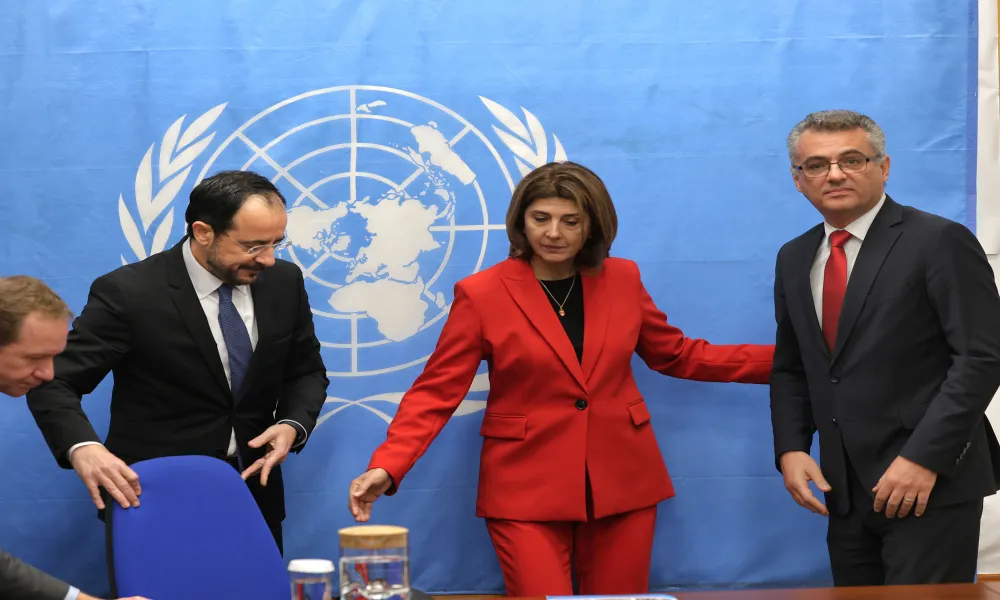

Today's trilateral meeting in Nicosia, involving the two leaders and the personal envoy of the United Nations Secretary-General, María Ángela Holguín, is taking place in an exceptionally dense diplomatic environment, where the primary objective is not an immediate deepening of discussions on the substance of a Cyprus settlement but rather the preservation of the process itself through a tangible agreement on confidence-building measures (CBMs).
The UN envoy arrives at the table with a clear tactical objective: to secure the final approval of both sides for a package of measures centred on the opening of four new crossing points across the buffer zone. Based on information that emerged in recent days, these include the Athienou-Pyroi-Aglantzia, Mia Milia, Louroujina-Lympia and Kambos-Karavostasi crossings.
It is worth noting that the issue of Kokkina has been definitively removed from the agenda after the Turkish Cypriot side made clear that it was never considered an option, forcing the Greek Cypriot side to submit alternative proposals.
The objective
Holguín's focus on crossing points is not coincidental. She appears fully aware that the prolonged deadlock has generated deep public fatigue in both communities, making it essential to achieve decisions that directly and positively affect people's daily lives.
Through this approach, the Secretary-General's envoy hopes to generate new momentum and provide the necessary political "energy" to sustain dialogue.
Alongside the crossing points, the package under discussion includes an agreement to clear approximately 70,000 square metres of minefields within the buffer zone, as well as targeted environmental cooperation initiatives focusing on cultural heritage protection and the establishment of a bicommunal rapid-response team for natural disasters.
Methodology and substance
At the same time, Holguín is attempting to overcome the long-standing deadlock surrounding methodology, where the positions of the two sides remain entrenched.
The four-page proposal submitted by Turkish Cypriot leader Tufan Erhürman, which sets conditions including rotating presidency and guarantees against any return to the current status quo, has complicated efforts to find common ground.
Because of this, the envoy is promoting a different approach aimed at bypassing preconditions and avoiding another cycle of debates over hundreds of pages of past convergences, a process that previously created serious friction, including during the Downer exercise.
Instead, the two leaders are expected to focus exclusively on procedural steps.
These include establishing a clear timetable, preparing an agenda based on the six key points of the Guterres Framework, and adopting mechanisms for overcoming deadlocks.
A catalyst for today's meeting
A key factor shaping the atmosphere ahead of the trilateral meeting was the unexpected visit by Turkish Foreign Minister Hakan Fidan to the north just days beforehand.
His 80-minute meeting with Erhürman, as well as contacts with figures including Ünal Üstel and Tahsin Ertuğruloğlu, confirmed that Ankara moved quickly to define the framework within which the Turkish Cypriot leadership would operate.
Although Turkey's Foreign Ministry deliberately avoided public statements on the form of a settlement after the meetings, diplomatic sources and commentary in the Turkish Cypriot press suggest that Ankara was not seeking, at least for now, to intensify its two-state rhetoric in a way that would undermine the current effort.
Instead, indications suggest that Turkey approved moving ahead with the CBM process and did not raise major objections to either the proposed crossing points or demining plans.
Behind the scenes, the United Nations views this stance as a development that does not disrupt the positive atmosphere of recent days, although optimism has so far been expressed publicly mainly by the Greek Cypriot side.
Fidan's visit once again underlines Holguín's long-held view that key Cyprus issues, including security, guarantees and the status of Varosha, are ultimately matters on which Turkey holds decisive influence because of its military presence on the island.
A window of opportunity?
The outcome of today's meeting will determine whether the window of opportunity that António Guterres is attempting to keep open before the end of his tenure can produce results.
Should Holguín succeed in securing agreement on the crossing points and the wider CBM package, the next stage would involve a meeting between the two leaders and the UN Secretary-General in a 2+1 format aimed at finalising the procedural framework.
The longer-term objective would be the convening of an informal expanded 5+1 conference involving the guarantor powers.
Such a development would represent the legacy Guterres hopes to leave to his successor.
Holguín, however, remains cautious.
As she indicated in recent interviews, her continuation in the position depends on whether meaningful progress is achieved within the next three to four months.
If negotiations continue at the slow pace seen over the past year, she does not intend to remain indefinitely and reportedly believes Ankara is unlikely to agree to the appointment of another envoy before Cyprus' presidential election in 2028.
For that reason, today's trilateral meeting is considered crucial, as success on the crossing points represents the only currently available means of keeping the political process alive and avoiding a diplomatic deadlock.
Deep concern
Within this fragile environment, Holguín has also expressed a subtle but profound concern.
In interviews with Politis and the Sunday Mail, she warned that another failure of the UN initiative would cause "enormous damage" to the prospects for restarting negotiations.
As she noted, past failures did not narrow differences between the sides but instead widened the gap.
That, she argues, is precisely why the Secretary-General refuses to convene a high-level meeting without thorough and genuine preparation.
Avoiding deadlock
To prevent another breakdown, Holguín advocates a clear methodology.
As she explains, successful negotiations require clear timelines, an agreed agenda and mechanisms capable of resolving crises when talks become stuck.
She proposes that the six points presented by António Guterres at Crans-Montana should serve as the fundamental basis of the agenda.
Referring specifically to the dispute over rotating presidency, she suggests launching negotiations without preconditions while placing the issue at the top of the agenda from the outset, allowing the sides to establish immediately whether common ground exists and avoiding months of discussions that ultimately lead nowhere.