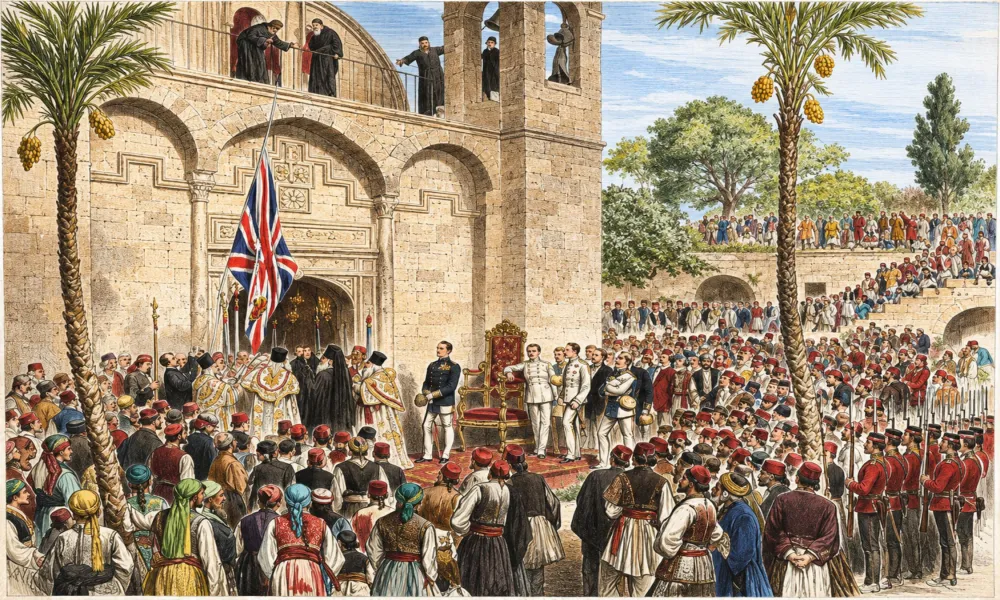

Institutions, personalities and local history converge in a significant research project that explores a lesser-known aspect of Cyprus during the colonial period. Dr Achilleas Charalambous traces the development of the judicial system between 1878 and 1960, while also examining the role of lawyers in Paphos, who not only practised law but also played prominent roles in the social, political and cultural life of the island.
Drawing on archival material, biographical records and historical documentation, the research illustrates how the institutions of justice became intertwined with citizens' everyday lives and contributed to the development of modern Cypriot society.
Institutions and history
An important aspect of Cyprus' modern history, centred on the administration of justice during British rule and the contribution of lawyers in Paphos, is highlighted in the research of Achilleas Charalambous, a doctor of Modern and Contemporary History.
The study, titled "The Justice System during the British Colonial Period in Cyprus (1878-1960), with Special Reference to the Lawyers of the City and District of Paphos Who Practised During This Period", seeks to document and reconstruct the historical development of an institution closely linked to Cyprus' administrative organisation, social evolution and public life under British rule.
Beyond presenting the legal framework and mechanisms of justice, the research places particular emphasis on Paphos. The city and its surrounding rural areas form the focus of a historical account spanning from the establishment of British administration in 1878 until the end of colonial rule in 1960, highlighting individuals and initiatives that helped shape local society.
British administration
The beginning of British administration in Cyprus in 1878 marked a new era in the island's administrative and institutional organisation.
The operation of the courts, the organisation of judicial services and the practice of law formed part of broader institutional changes that gradually shaped the justice system of the period.
This is precisely the system that Charalambous examines, tracing the historical evolution of judicial institutions between 1878 and 1960.
The significance of this approach lies in the fact that the history of justice is not confined to legislation, regulations and court procedures. It is also linked to the functioning of government, the relationship between citizens and authority, and the ability of people to assert their rights through established institutional processes.
Within this context, the study of the colonial-era judicial system is particularly valuable as it provides deeper insight into the institutional environment in which lawyers, judges and other legal professionals operated.
The courts of Paphos
A substantial portion of the research is devoted to the city and district of Paphos, documenting the development of judicial institutions and the presence of legal professionals during a period of significant change.
The study covers the assumption of administration by the British, the establishment and operation of courts in both the town and the wider Paphos countryside, as well as the creation and activities of the local Bar Association.
Particular interest is given to courts operating outside the urban centre.
The administration of justice was not confined to the larger towns but extended into rural communities, where residents regularly faced issues requiring formal legal resolution.
The operation of courts in the district strengthened access to justice and contributed to the development of a more organised administrative structure.
Through this process, the history of Paphos' judicial institutions became closely linked to the broader social and economic development of the region.
The role of lawyers
A central focus of the research is the life and work of lawyers in Paphos who practised during British rule.
According to the researcher's findings, their activities were multifaceted and had a substantial impact on local society.
Their professional role extended beyond representing litigants before the courts and encompassed a wide range of public and social activities.
Many became important servants of justice, defending the interests of citizens and communities and, in some cases, challenging arbitrary actions and practices of the colonial administration.
Lawyers of the period were often respected figures and points of reference within local communities.
Citizens turned to them not only for legal representation but also for advice concerning their dealings with government and public authorities.
Their contribution was not confined to courtrooms.
The research highlights their active presence in the social and cultural life of Paphos. Many participated in the creation and development of associations, clubs and organisations that strengthened social cohesion and promoted cultural activity within the town.
Others took initiatives in the field of education, supporting schools and institutions that played an important role in shaping local identity.
Many lawyers also became involved in political life.
Several were elected to the Legislative Council, served as municipal councillors or participated in other institutions of public representation.
Their legal expertise, combined with their social influence, enabled them to play leading roles in decisions that affected the daily lives of citizens.
The study makes particular reference to lawyers who later served as mayors of Paphos.
Through their tenure, they contributed to improvements in infrastructure, the upgrading of municipal services and the broader development of the town.
A historical legacy
The research by Achilleas Charalambous seeks to connect the history of institutions with the history of the people who served them.
From the operation of the courts and the organisation of the legal profession to the role of lawyers in politics, local government, education and culture, the study highlights a broad spectrum of activities that shaped the course of both Paphos and Cyprus.
By combining biographical documentation of lawyers with an examination of the judicial system, the work goes beyond the boundaries of a purely legal study and becomes a comprehensive historical analysis.
In doing so, it sheds light on lesser-known aspects of social organisation, political participation and collective action during a defining period in Cyprus' history.
As such, it represents an important contribution both to the local history of Paphos and to the study of Cypriot society during the years of British rule, offering valuable material for researchers, historians and readers interested in understanding the institutions and individuals that helped shape modern Cyprus.