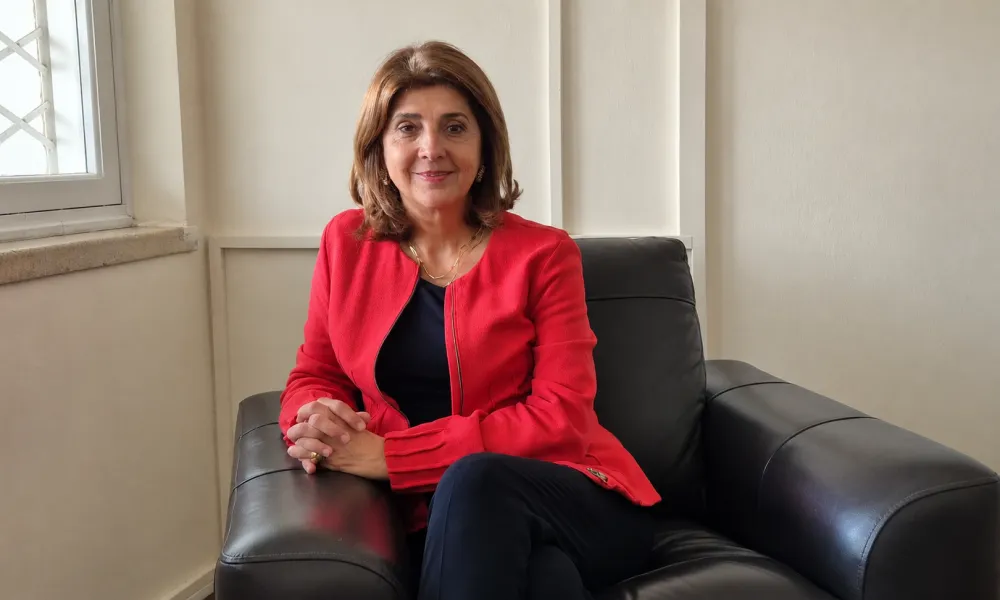

María Ángela Holguín, the personal envoy of the United Nations Secretary-General, has described today's meeting as critical for the future of efforts to revive the Cyprus peace process, warning that failure to secure progress on confidence-building measures (CBMs) could place the continuation of the initiative in doubt.
In an interview with Turkish news agency ANKA, published on Sunday, Holguín said that if no progress is achieved, her report to António Guterres will state that no developments were recorded.
The interview was conducted at the offices of the UN Good Offices Mission at the old Nicosia airport in the buffer zone, following a week of contacts with both sides. At the same time, Turkish Foreign Minister Hakan Fidan was meeting Turkish Cypriot leader Tufan Erhürman in occupied Nicosia.
Referring to the expected outcome of discussions on CBMs, Holguín expressed hope that progress could finally be achieved.
"We will see what happens on Monday. I hope that this time we can take a step forward on confidence-building measures," she said.
She also issued a stark warning about the consequences of another failure.
"If nothing happens, my report to the Secretary-General will say: 'Nothing happened.' Goodbye to everyone. Goodbye to me, goodbye to Guterres."
According to Holguín, if progress is achieved, efforts could continue into next year, even beyond the end of the current UN Secretary-General's term.
"If the process remains alive, we can continue to push forward," she said.
Four crossings and demining plan
Holguín said the package under discussion includes the opening of four new crossing points and the clearance of 70,000 square metres of minefields on each side near UN checkpoint 10 in the Deryneia area.
Asked about the Turkish Cypriot proposal for island-wide demining, she said the process had to start somewhere.
"We have to start somewhere. They will begin with exactly the same area, 70,000 square metres on each side."
She said the ultimate goal remained a mine-free island and stressed that seeking a perfect solution should not prevent a smaller agreement from being reached.
"The perfect is the enemy of the good. We should not delay demining because we want more."
According to ANKA, the Greek Cypriot side argues that the removal of anti-tank mines should be discussed within the framework of security negotiations, given the presence of Turkish military units on the island.
Crossing points under discussion
Regarding new crossing points, Holguín referred to the proposal to replace Kokkina with Kambos.
"I hope that removing Kokkina and including Kambos will help. We will see."
According to ANKA, the package expected to be discussed includes:
- Mia Milia
- Athienou-Pyroi-Aglantzia
- Louroujina-Lympia
- Kambos-Karavostasi
Holguín said both leaders had demonstrated political will on CBMs but expressed disappointment at the limited progress made on how substantive negotiations might resume.
"It may not be what we expected, but it is a start."
She added that after almost two years of efforts, greater convergence had been expected.
"We expected far more common ground on methodology, procedural steps and the framework for future negotiations."
Possible next steps
Holguín said the process should move gradually, stressing that progress comes step by step.
A possible scenario, she explained, would involve a 2+1 meeting between the two leaders and António Guterres, followed by a broader 5+1 meeting involving Turkey, Greece and the United Kingdom.
According to Holguín, both leaders should first prepare proposals regarding the procedures and methodology of new talks.
She described a future 5+1 meeting as the stage at which formal negotiations could begin, although no decision has yet been taken on whether the Secretary-General would first convene a trilateral meeting or move directly to a broader format.
No timetable has been set for either option.
Rotating presidency and political equality
Addressing the issue of a rotating presidency, Holguín said the two sides had previously reached agreement on political equality on 11 December, although the interview did not specify the year referenced.
"The issue concerns the rotating presidency more than anything else."
She said the rotating presidency forms part of political equality but described it as "very difficult" to expect President Nikos Christodoulides to explicitly confirm acceptance of the concept before negotiations begin.
According to Holguín, the details of political equality should be addressed during negotiations rather than determined in advance.
"You need to work out the details during negotiations, not before negotiations."
She added that during talks at Crans-Montana, the issue had been linked to questions of troops and security, concerns that still persist on the Greek Cypriot side.
Holguín also called on Erhürman to translate the four principles he has outlined for restarting negotiations into concrete proposals.
According to ANKA, the Turkish Cypriot side is seeking a predefined timeframe for negotiations and guarantees that there would be no automatic return to the current status quo if talks fail through no fault of its own.
Varosha, direct trade and the EU
Holguín said both sides should consider what would happen if one party walked away from future negotiations and argued that such questions should be addressed before any 2+1 meeting with the Secretary-General.
Discussing potential guarantees sought by the Turkish Cypriot side, she referred to direct trade, direct flights and direct contacts as possible options.
When asked about direct trade with the European Union, she stressed that the EU would need to be involved.
"We need the European Union in this equation."
Holguín also commented on President Nikos Christodoulides' proposal for the resettlement of Greek Cypriots in Varosha under temporary UN administration.
She said she viewed the proposal as an attempt to respond to the four conditions outlined by Erhürman for restarting negotiations.
"There must be irreversible steps. Bringing Varosha under United Nations administration could be one such irreversible step."
However, she expressed doubts as to whether similar guarantees could be provided through arrangements involving the port of Famagusta or direct trade.
Holguín also acknowledged the practical and financial challenges of any UN administration of Varosha.
"The United Nations does not have the resources or logistical capacity to manage a city. This is not a small area. It is an entire city."
She added that even providing security would require significant funding, although the UN could seek support from the UN Security Council if the two sides reached an agreement.
Confidence-building measures should be implemented
Holguín also questioned the principle that "nothing is agreed until everything is agreed", describing it as an approach she encountered during the Colombian peace process.
She argued that certain confidence-building measures should be implemented immediately once agreed, rather than waiting for a comprehensive settlement.
"Only through implementation do people see that something has changed, that the current situation has been overcome and that things are moving forward."
According to Holguín, practical improvements in people's daily lives can strengthen trust in the process.
She also stressed the importance of support from the guarantor powers.
"Whatever the leaders agree, the guarantor powers should be there to support them."
Role of technical committees
Holguín spoke positively about the work of the bicommunal technical committees and cooperation between younger members of the two communities.
She described the committees as a bridge between the communities and highlighted plans for a joint rapid-response mechanism to deal with wildfires and other natural disasters.
The aim, she said, is to allow both sides to act together quickly during emergencies without lengthy chains of communication and approvals.
As she put it, cooperation should be possible without first having to make "15 phone calls".
According to Holguín, practical forms of cooperation can help build confidence between the communities while broader political efforts to restart negotiations continue.
Source: CNA