
The themes of coming of age, identity and a daughter's attempt to reconnect with her estranged father lie at the heart of Hold On To Me, the feature directorial debut of Myrsini Aristidou.
Filmed entirely in Cyprus, the production won the Audience Award at the Sundance Film Festival and has already been shortlisted as one of three finalists for the European Film Academy Young Audience Award. It was screened as part of the official programme of the 67th Thessaloniki International Film Festival.
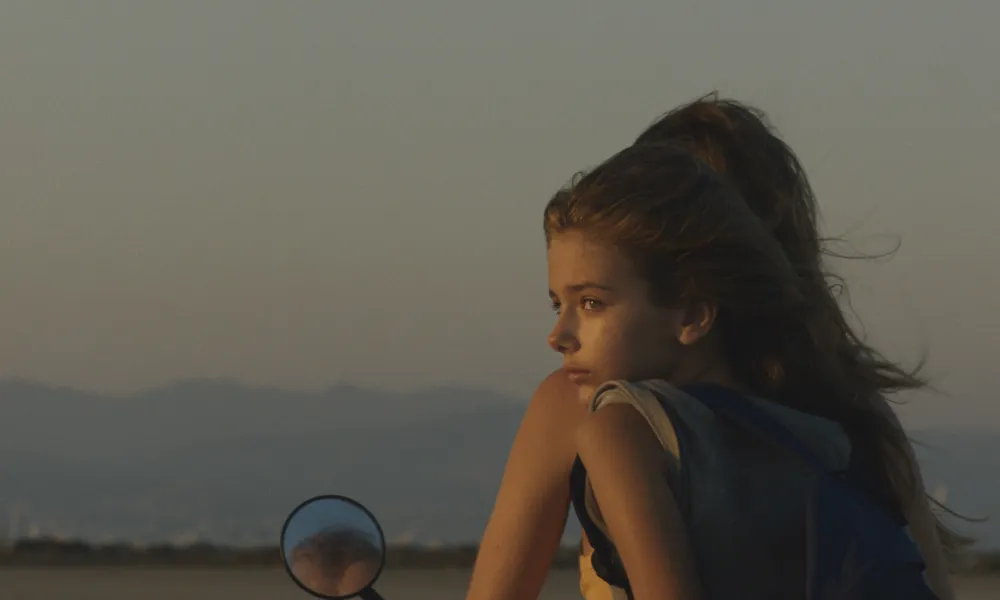
The film follows 11-year-old Iris, a lively and daring girl growing up with little supervision. Her divorced mother appears more interested in her new partner than in her children. During the summer holidays by the sea, Iris spends her time with an older friend, getting into various forms of mischief.
One prank brings her into contact with the police and, ultimately, with her estranged father, Aris, who has returned to Cyprus for her grandfather's funeral. For Iris, who longs to get to know him, it is an opportunity to force her way into his disorganised and troubled life.
She finds him living in an abandoned shipyard, isolated and burdened by debts to members of the underworld, trying to survive and repay what he owes through various scams. Aris initially resists her presence, but Iris persists in following him and eventually begins helping him.
Aristidou captures this fragile period of attempted reconnection with attention to detail and a sense of humour, from Iris pretending to be a distressed daughter to help sell broken items, to father and daughter trying to sell household goods at a market, including a chair repaired by Aris.
Gradually, the film takes on a more dramatic tone as Iris' determination to complete the reconciliation and persuade her father to remain on the island begins placing him in danger.
The screenplay, written by Aristidou herself, features convincing and understated dialogue. Particularly noteworthy are the performances of Christos Passalis as Aris and Maria Petrova, of Bulgarian-Cypriot heritage, as the young Iris.
The cinematography by Lasse Ulvedal Tolbøll makes effective use of close-up shots while highlighting the beauty of the natural landscapes and, where necessary, intensifying the drama.
The sea dominates the film, appearing in both its opening and closing scenes and serving as a powerful symbol.
Spoiler warning: At the end, Aris emerges from the sea as if reborn, renewed and finally ready for the transformation Iris has long hoped for.
Aristidou delivers an outstanding debut feature, made with sincerity and beauty.
Love, grief and the afterlife
Grief as a form of liberation is explored by Turkish director Fatih Akin, who lives in Berlin, in his film Our Last Song, which was screened in the festival's Special Screenings section.
The story follows the sudden and passionate romance between Aris and Farasa, two attractive students from migrant families, whose relationship begins at a graduation party.
When Faris offers to drive Farasa home, the journey ends in a fatal crash. Farasa dies, while Faris survives.
According to Islamic tradition, the dead may visit the living in their dreams for forty days. Farasa therefore begins appearing every night in Faris' dreams, and together they imagine a future in which he eventually follows her into the afterlife.
These scenes recall the celebrated 1935 film Peter Ibbetson by Henry Hathaway, praised by Adonis Kyrou in his classic book Love and Eroticism in Cinema.
During their first dream encounters, Faris remains unable to let go of his great love, while Farasa, separated from him by death, fills the darkness of her afterlife with the light of their romantic meetings.
Akin follows the forty-day Islamic tradition and finds redemption through acceptance and release, transforming the film into a deeply moving fairy tale.
The film is shot in black and white, enhancing its dreamlike atmosphere. The cinematography by Frank Griebe creates an otherworldly environment, particularly through the use of natural locations, while the music and songs further reinforce that quality.
Colour appears only in the title cards marking the passing days spent together in dreams and in the rosy, liberating final scenes.
In the end, Faris is forced to accept reality and move forward into a new life, leaving behind a love that offered him a different, more romantic and more powerful possibility.
Source: CNA / Nino Fenek Mikellides