
In his fables, Aesop had a particular fondness for the fox. He portrayed the animal as cunning, resourceful and capable of devising countless tricks. Yet every so often, he made sure to remind it that cleverness and slyness are not the same thing. And that being able to fool some people for a while does not mean you can fool everyone forever.
In the Cypriot political landscape there is a fox that could claim a leading role in a modern edition of Aesop's fables. For years, it was described as one of the cleverest creatures in the political forest. Many believed it. Naturally, the fox believed it too. So much so that, at some point, it began to think that anyone who disagreed either failed to understand or had simply not grasped the brilliance of its grand design.
Chess
And so politics became an endless game of chess, in which the fox took on every role. It was the player, the referee, the commentator and, of course, the only one who supposedly knew in advance who would win.
The problem was that the others did not always follow the script.
In 2023, for example, the fox set out to capture the highest office in the forest. It had experience, a political machine, a plan, serious financial backers and the conviction that it understood the game better than anyone else.
But when the ballot boxes opened, the fox discovered that voters were not pawns on a chessboard. It failed to reach the second round.
What did it fail to understand?
That beyond the fox there was also the mistress of all the forest's patrons, the one who cuts and carves at will and, generally speaking, knows the game even better.
One might have expected such an experienced fox to use defeat as an opportunity to rethink strategy. After all, even the best chess players analyse their losses.
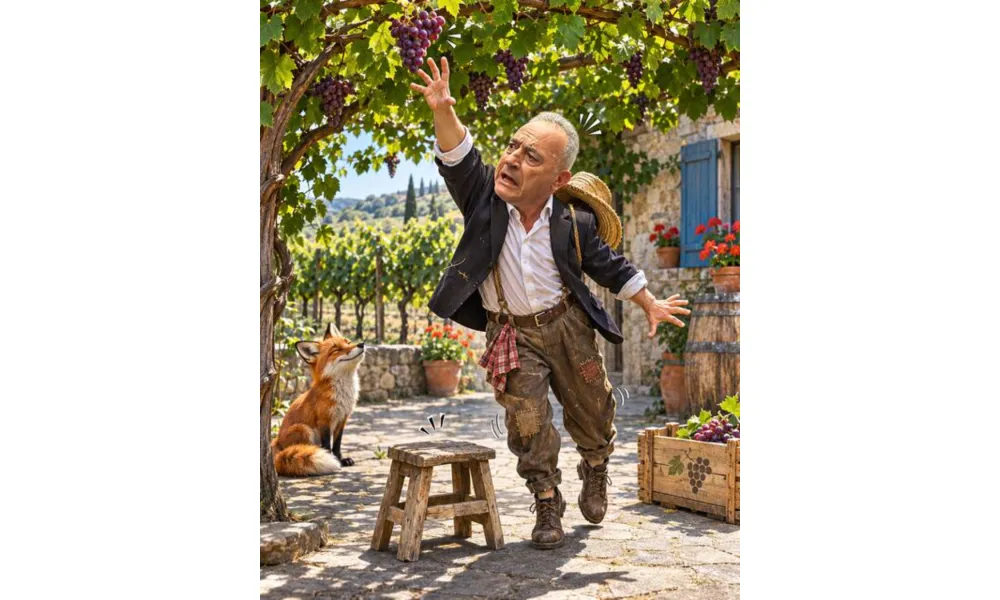
Unfortunately, the fox preferred an old and familiar recipe. The one involving grapes.
It was not the fox's fault, it said, that it could not reach them. The vine was too high, the weather was unfavourable, others failed to help and perhaps the grapes themselves failed to appreciate who was trying to pick them.
Since that day, the grapes of 2023 have continued to hang somewhere in the background of its political thinking.
Here we go again
And so we arrive at 2028. Or rather, at the battle that began in 2026 over who will compete for the grand prize two years later.
The fox returned to the forest carrying five crates filled with signatures from all the animals, even the rats.
An impressive entrance, it must be said. So impressive, in fact, that one almost expected the crates to open and an electoral victory to jump out from inside.
Only signatures are not votes.
And votes in an internal party contest are not automatically a ticket to the Presidential Palace.
For cases like this, Aesop had another fable in mind, the one about the fox and the cat.
The fox boasted that it knew a hundred ways to escape hunters. The cat knew only one.
When the dogs appeared, the cat climbed a tree and saved itself.
The fox, trying to choose the best of its hundred tricks, never had time to use any of them. It hid behind the crates, but the dogs found it and devoured it.
Something similar happens in politics from time to time.
A politician may know a hundred ways to build alliances, organise political machines, count numbers and plan tactical moves. But if that politician forgets the one thing required to keep a party united, the other hundred matter very little.
The rooster
What makes this fox's case particularly interesting is that everyone speaks about unity while preparing for the next internal battle.
And the more they speak about unity, the more one wonders how much of it remains.
This is where the fable of the rooster comes in.
The fox announced that all the animals had decided to live together in peace.
When the rooster replied that two dogs were approaching to celebrate the reconciliation with them, the fox immediately fled.
"Didn't we agree there was peace?" the rooster asked.
"Yes," replied the fox, "but perhaps the dogs haven't been informed yet."
In politics, of course, things are slightly different.
Everyone is informed about unity.
They simply reserve the right to interpret it in whatever way suits them best.
And therein lies the paradox of this story.
The fox may yet win another contest. It may also lose.
No one knows how the fable of 2028 will end.
What will be judged, however, is not only who secures the nomination, but what remains of the forest once the battle is over.
Because there is a victory that is worse than defeat.
It is the one achieved after exhausting allies, turning friends into opponents and convincing oneself that personal survival is synonymous with the survival of the entire forest.
If Aesop were alive today, he might add one final fable to his collection.
He would call it:
"The Fox Who Knew How to Win Every Argument and Lose Elections."
The moral of the story
In this case, the lesson would be simple.
The cleverest person is not always the one who believes they have earned the right to speak the final word.
Sometimes the less clever one is the person who failed to realise that everyone else has stopped listening.