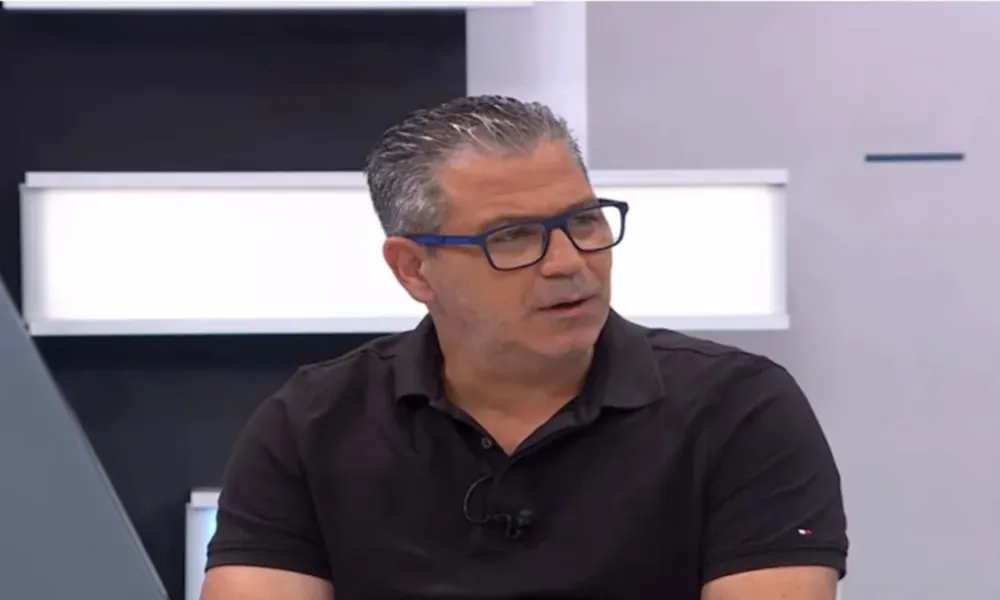
The book Cyprus, the Navel of Surveillance, by journalist Fanis Makrides, is the result of years of research into the surveillance and spyware scandal in Cyprus. It examines the role of spyware companies, state agencies and political figures, presenting documents and evidence which, according to the author, shed light on previously unknown aspects of the case. At the same time, it highlights the connection between developments in Cyprus and the Predator scandal in Greece, providing the context for how Cyprus found itself at the centre of the international debate surrounding wiretapping and digital surveillance. Fanis Makrides previously worked for Politis and is now a member of the editorial team at Phileleftheros.
"Black Van"
Was the story of the notorious "black van" an isolated incident or part of a much larger network of activities?
First of all, let me clarify something regarding the term "black van". In 2019, when everyone in Cyprus became aware of the existence of this particular vehicle that was capable of carrying out interceptions, through a publication/advertisement in Forbes, people began referring to the surveillance affair using the term "black van". It was simply more practical to use that term.
The real scandal concerning surveillance itself, however, was the installation of antennas at Larnaca International Airport. That is made clear in the book.
The book, however, is not only about the "black van".
The surveillance affair more generally, in our view, is not limited to Dilian and Avni, the Forbes vehicle or what happened at the airport.
Our work is titled Cyprus, the Navel of Surveillance because it provides a complete picture of what exactly was happening with these companies and demonstrates how deeply rooted the culture of interceptions is in Cyprus.
First and foremost, the European Parliament adopted the findings of my six-year investigation into the unchecked approval of export licences, describing our island as an uncontrolled export hub.
At the same time, while investigating the issue, we identified political figures and public officials. Husbands who wanted to monitor their wives could turn to private individuals who possessed the necessary technology to accommodate them.
Personally, I experienced prosecution attempts by lawyers, a government official and even the police. Entirely without justification, a friend of mine became the subject of criminal proceedings.
Why did they turn against me when I touched on an issue relating to the protection of human rights — and not national security — and dealt with companies that were mainly linked to businessmen of Israeli origin?
"Special Treatment"
So were we dealing with a network? And why did these companies choose Cyprus as a base?
As far as the substance of the question is concerned, it does indeed appear that we were dealing with something much bigger.
Major surveillance companies chose Cyprus as a base. A characteristic example is NSO and its pioneering Pegasus software.
The company itself admitted that it exported products through Cyprus, notwithstanding the fact that later — as we reveal through documents — the Republic attempted to deny this before the European Parliament in a clumsy manner that left Cyprus exposed.
The Avni and Dilian affair proved something we already knew: that foreign software companies, and Israeli ones in particular, chose our island because it provided direct access to European countries and formal approval for exports to third countries.
They came because they already knew they would enjoy complete freedom, as documented — among other things — by documents from the Department of Commerce that we secured.
At the same time, Avni and Dilian received special treatment from the state.
In Avni's case, in fact, there was blatant protection. We are not the ones saying that; the classified documents that we reveal in full for the first time in the book say so.
It is therefore no coincidence that leading figures in the surveillance industry were present on our island.
Nor is it a coincidence that a request submitted by Mr Avni was granted by the then chief of police following intervention by the Cypriot Ministry of Foreign Affairs.
I think that says a great deal.
Antennas at the Airport
And what exactly was the scandal involving the airport antennas?
Our information indicates that the 2019 scandal involving the interception of mobile phone user data concerns the Larnaca Airport case.
Although equally scandalous issues are covered in the book.
Let me remind you that officials of the Republic of Cyprus adopted a highly questionable stance, which we also document.
But let us turn to the case of the international airport.
This was one aspect of the broader surveillance story in which we once again encounter the same individuals.
According to an admission by the police, the antennas were installed by Go Networks following an agreement with Hermes, the operator of Cyprus' airports, in order to strengthen the network.
Avni and Dilian had presented themselves as acting on behalf of Go Networks.
The former was at the centre of our surveillance-related revelations from as early as 2017, when we first referred to his links with DISY.
We have said that Mr Avni prepared the ground for Mr Dilian, who later became known in Greece through Predator.
And why are we not talking about "innocent" antennas?
The antennas installed at the airport by Go Networks gave their operator access to data from travellers' mobile phones.
That is what the police themselves stated in December 2019.
In fact, when police executed search warrants at premises linked to Avni and Dilian, they found on servers data showing access to more than 9.5 million devices.
We are not talking about something innocent.
Were these antennas installed without the Republic's security services understanding what was happening?
Beyond that, there are many dark areas.
Go Networks was not registered with the Registrar of Companies.
Our investigation into companies bearing that name led us to other countries.
In the indictment filed before the Assize Court there was no natural person listed as a defendant, only a company linked to Mr Dilian.
There are therefore many unanswered questions surrounding the airport affair, even though the journalistic investigation itself was highly revealing.
The Report Left in a Drawer
Does the book shed light on the airport affair?
I believe it does. I think we shed considerable light on the issue in the book.
Although we stick to facts we know and testimony obtained from reliable sources, avoiding the trap of drawing conclusions, we nevertheless believe the overall picture is clear.
What we are certain of, however, is that the report prepared by Elias Stefanou, who was appointed independent criminal investigator in the surveillance affair, will answer all remaining questions.
Mr Stefanou was also tasked with examining the role of public officials in the case.
The issue of publishing the report was raised repeatedly and there was also a relevant request from the European Parliament's committee of inquiry. However, the attorney-general was not in favour.
Elias Stefanou himself, when questioned by Christoforos Christofi during an interview on the programme Legal Matters, delivered what we write in the book was a clear message when asked about the broader issue of publishing investigative reports.
"Transparency never harmed anyone," he said verbatim.
What exactly were the antennas at the airport doing?
We have information from highly credible sources and testimony concerning this matter.
People familiar with the facts told us that the investigation pointed to a classic man-in-the-middle (MITM) case.
Here I will reproduce exactly what I write in the book:
"The term is used for an 'attack' that occurs when someone positions themselves between two computers (for example, a laptop and a remote server). That person monitors communications between the two machines and can intercept information. Experts who have repeatedly analysed this phenomenon state that a malicious user employing this method can even create their own network and trick the target into using it. In the airport case, Go Networks was using its own networks."
I believe the answer contained in that excerpt is clear.
The rest is set out in detail in the book and allows the reader to fully understand every aspect of the airport operation.
The Main Players
Who were the main protagonists in the surveillance affair? Dilian and Avni, or others as well?
Those two individuals are indeed central figures.
Their background, as recorded in the book, helps explain who they were.
At the same time, all of their actions, the labyrinthine routes through companies linked to their interests and their tactics are vividly described through revealing documents.
We come to understand what they came to Cyprus to do, how they did it, who supported them and for what reasons.
But there are also supporting players in the story.
The affair involves wiretappers, the use of surveillance systems by the police and the intelligence service, while during our investigation we also came across Deputy Attorney-General Savvas Angelides and then DISY president Averof Neophytou.
We scrutinised them journalistically on behalf of society, submitted questions to them and, for the first time, published the entire background to the conversations I had with them.
You will also find named references to public officials and civil servants who played a negative role in the affair.
There is a record of names and behaviour that points to a conspiratorial attitude towards the issue of surveillance.
I will never forget the appearance in parliament of a woman who arrived without introducing herself to anyone, spoke cryptically and departed as though she were being chased.
The book Cyprus, the Navel of Surveillance deals primarily with the protection of journalists, politicians and active citizens from wiretappers who abuse their powers, but it offers much more than that.
Many people will come to understand the role played by intelligence officers specialising in telecommunications, and we are certain they will struggle to believe what they are reading.
We even found relatives of intelligence service officials connected to companies with Israeli interests.
Who Was Avni?
What was Avni's role? At the time we were told he was president of the Jewish Community of Cyprus...
The confidential police report of September 2016, which we obtained and are publishing in full for the first time, reveals a great deal about his activities.
We never verified the claim that he was president of the Jewish community in Cyprus.
But we know that he carried out security duties at sites linked to Jewish interests in Cyprus, obtained a firearms licence and a large quantity of ammunition from the Republic, was approached by criminal elements, and that information existed suggesting he helped a suspect wanted in connection with the planning of a felony leave the country, among many other things.
We document how he became a Cypriot citizen, how much he spent to achieve that and, of course, his relationship with the then leadership of DISY and the party itself.
He had a personal relationship with Averof Neophytou and that was well known to Avni's associate, Mr Dilian, who became linked to the surveillance van and the Predator scandal in Greece.
Visible and Invisible
Do you believe Tal Dilian was the central figure in the affair, or simply the most visible face of a much larger ecosystem?
That is a fair question.
It occupied us and is answered in the book.
Indicatively, I would point out that in the book's introduction we note that:
"It appears that a great deal was sacrificed for the sake of our cooperation with friendly Israel."
Were they operating independently, as private professionals, or as employees?
As we write, they served in Israel's security and defence sector.
They served their country and then presented themselves as private individuals and businessmen in the Republic of Cyprus.
Mr Avni appeared out of nowhere and became a Cypriot citizen through participation in a collective investment worth €24 million.
Reports suggest that he had previously been a police officer in Israel.
And what was the most important aspect of this surveillance story in Cyprus?
The most important thing is that the constitutional rights of citizens in Cyprus were not safeguarded, that we facilitated the international circulation of software that could be used by authoritarian regimes, and that our island was deliberately drawn into a scandal that left us exposed.
To arrive at that conclusion, however, we document records, evidence and much more.
And through years of journalistic investigation, many other issues emerge which — at least from a journalistic and ethical standpoint — are problematic for public officials and state functionaries.
"Black Suitcases"
What relationship did the notorious "black suitcases" have — and still have — with the "black van"?
The "suitcase" is a laptop computer which, according to promotional brochures that we saw during the investigation, places itself between a mobile phone and the antenna of a mobile telecommunications provider.
It enables the monitoring of the mobile phone user.
And that is exactly how the investigation began in 2016.
When we obtained information that a "suitcase" — or related services — was available to a political leader who was intercepting conversations involving his own associates.
Inevitably, three years later, we arrived at the black van which used identical technology, and naturally we added new pieces to the puzzle.
Throughout this entire story, was there demonstrable collusion with Cyprus' political and party system?
In the course of the story, we demonstrably identified relationships between well-known businessmen in the sector — whom we name — and a political party, a party official, Averof Neophytou, the Cyprus Police, government officials and other state services.
All of this is documented and described in vivid detail.
It was demonstrably the case that a legal entity linked to a serving public official had ties to a company operating in the sector.
Everything is recorded with names and details.
We even identified the children and relatives of intelligence service officials who had been employed by companies in the sector that are based in Cyprus but owned by foreign interests.
Those references also answer your question.
Pieces of the Puzzle
Are there serious unpublished revelations?
There are, but believe me, all the burning questions relating to wiretappers who seek to target active citizens, journalists and politicians are answered.
We do not directly answer questions for which we do not have substantiation or documentation, although all the pieces of the puzzle combine to form the overall picture.
What we certainly do not answer are questions that touch upon the security of the Republic.
We were aware of the negative role played by intelligence service officers who were connected to businessmen in the sector, but we do not reveal their identities.
Not only because doing so would be illegal, but also because we do not want to reach the point of serving hostile states.
Our investigation served a noble purpose.
We will not harm our country simply to demonstrate that we possess the ability to obtain information.
When we revealed classified contracts of the Cyprus Intelligence Service (KYP) between 2012 and 2014 relating to well-known surveillance systems, we took care to do so in a manner that served the purposes of journalistic investigation without harming the interests of Cyprus.
Was there a source or document that completely changed the direction of your investigation?
The confidential police report on Avni, which we had obtained after we began investigating the "suitcase" and the political leader, was the key to this journalistic investigation.
What does the book present for the first time that had not previously been published in newspapers?
There are many things that were never published in newspapers but are being published for the first time in the book.
In my humble opinion, the most important chapters concern the email sent by Dilian to Averof Neophytou's office seeking assistance with the export of software to the Netherlands, as well as the potential conflict of interest involving Deputy Attorney-General Savvas Angelides.
His brother was a business partner of Mr Avni, having co-founded the company S9S with him.
They planned to open a shop on Athalassas Avenue in Nicosia under the name Spy Shop.
At the same time, S9S had been registered by a corporate services provider linked to Savvas Angelides.
In both the case concerning Averof Neophytou and the one concerning Savvas Angelides, there is information being published for the first time.
There is testimony relating to criminal acts, as well as revealing conversations between the journalist and Mr Neophytou and the Deputy Attorney-General.
Their reactions, their exact responses and much more are included.
In the case of the Spy Shop, we went to Athalassas Avenue ourselves, describing our exact movements and the written testimony we received from an individual who was present at the scene.
The book is also a journalistic story that reveals the methods we employed in order to protect sources.
The Stefanou Report
Why was the Stefanou Report shelved?
That should be answered by Attorney-General George Savvides and Deputy Attorney-General Savvas Angelides.
However, the issue is now taking a different turn.
The Independent Anti-Corruption Authority, which, as became clear last March, is investigating the surveillance affair, will request the Stefanou Report.
There is no doubt about that.
Close Relationships
How close was the relationship between private spyware companies and state agencies, according to the evidence you gathered?
There was a relationship.
Testimony indicates that officers of the Cyprus Intelligence Service maintained close ties with businessmen operating in the sector.
Everything is documented in the book.
A "Hotbed" of Companies
Are there indications that Cyprus was used more as an operational base or as a testing ground for these technologies?
Vice described Cyprus as a hotbed for companies operating in the sector.
In other words, this type of software was being developed and exported here.
We reveal the case of a company that received a temporary six-month licence from the Republic for the export of a surveillance system.
That system was taken to Asia, Latin America and other continents for demonstration purposes.
We know which company it was, we visited its offices, conducted our own inspection and also know that it carried out testing in central Nicosia.
Such a company, which, as we reveal, received export licences with remarkable ease, was able to operate unhindered and conduct tests wherever it wished.
A Different Kind of Interception
After almost a decade of investigations, what do you consider to be the political responsibility for the surveillance affair?
I will share one piece of information that I know.
A state service was carrying out surveillance and interceptions on individuals' mobile phones, but it was not listening only to unlawful actors — that is, criminals.
An officer within that service who possessed a conscience reacted when he realised that fellow wiretappers were carrying out a different type of surveillance and favour-granting.
He stated that he could not be part of such a situation.
The surveillance centre was dismantled as a result of those objections.
The Role of the Foreign Ministry
Which ministry or state agency was involved — perhaps in an unexplained manner — and still has not answered key questions?
The Foreign Ministry played a role in securing a licence that Avni had requested from the police.
The investigations being conducted by the Independent Anti-Corruption Authority will lead to further revelations.
"Attempts to Silence"
Were there attempts to divert public attention away from the issue?
There were attempts to target the journalist speaking to you now.
In the final chapters of the book, readers will see a police chief acting in private interests against the undersigned journalist by sending investigators from Police Headquarters CID to his office.
A friend of mine was made the subject of an investigation during a period when my reporting had caused dissatisfaction.
The head of a government department informed an editor and publisher about me using falsehoods.
Interventions were made behind the scenes against me.
Two independent testimonies, from two different periods, indicated that at a specific point in time I was under surveillance.
They attempted to censor me pre-emptively.
An administrative investigation was requested at the Ministry of Finance concerning the confidential intelligence service contracts revealed by Phileleftheros.
I do not know whether these constituted attempts to divert attention, but they were certainly attempts to silence me.
No Real Oversight
What was the biggest institutional gap exposed by the affair?
The absence of effective oversight of wiretappers, the merely formal presence of the three-member committee that was supposed to supervise them, and the weak framework governing exports of dual-use technologies.
From Cyprus to Greece
Do developments surrounding the Predator case in Greece change the way we should view what happened in Cyprus? Were there common individuals, companies or business networks operating in both countries?
Everything was connected.
Individuals whom we first encountered in 2016 when the investigation began reappeared in 2019 when the black van scandal broke, and later in 2022 following the surveillance cases involving Koukakis and Androulakis.
Everything is documented in the book.
We kept encountering the same people and knew what role they were playing.
A Cover-Up?
Was there a failure by the authorities in Cyprus to properly investigate the affair, or was it essentially covered up? Were pieces of evidence lost because the investigations started too late?
The case was not properly investigated.
Our position is that it may have been sacrificed on the altar of maintaining good relations with neighbouring Israel.
A New Investigation
The Anti-Corruption Authority has launched an investigation into the black van affair. Based on what we know today, do you believe the outcome will be different?
Yes, I do.
I revealed the Sizopoulos-Taxan case in 2021 on my personal website, oparatiritis.com.cy.
It was well known to everyone.
The Attorney-General decided not to bring prosecutions.
When the Anti-Corruption Authority took over the investigation, potential responsibilities were identified on the basis of facts that I had revealed in 2021.
I think that says a great deal.
The Navel of Surveillance
"Cyprus, the Navel of Surveillance." How do you justify the title of your book? Does it contain a degree of exaggeration?
Everything I have said previously explains it.
Cyprus is an island of spies, as described in the title of the book by Kostas Pikramenos, an expert at the European Parliament on Turkey, intelligence services and political Islam.
Spies, therefore, make use of advanced technologies as well.
Our focus is on the way information is extracted and on the violation of constitutionally protected rights.