
An increase in crossings by Greek Cypriots, Turkish Cypriots and foreign nationals, a significant drop in irregular arrivals and a decline in trade are recorded by the European Commission in its 22nd annual report on the implementation of the Green Line Regulation. The report covers the period from 1 January to 31 December 2025 and examines the movement of persons and goods between the government-controlled areas and the areas of the Republic of Cyprus in which the government does not exercise effective control.
According to the Commission, despite the overall increase in mobility between the two sides, trade remained limited due to administrative, banking and technical obstacles.
Crossings on the rise
Based on Cyprus Police data, 1,453,135 crossings by Greek Cypriots from the government-controlled areas to the north were recorded during 2025, compared with 1,346,121 in 2024. In the same direction, 833,786 crossings of Greek Cypriot vehicles took place.
From the north to the government-controlled areas, 1,983,610 crossings by Turkish Cypriots were recorded, compared with 1,814,647 the previous year, along with 748,061 crossings of Turkish Cypriot vehicles.
Crossings by European citizens other than Cypriots and by third-country nationals also increased, with a total of 2,053,958 crossings in both directions, compared with 1,777,946 in 2024. These figures do not include crossings through the Pergamos and Strovilia crossing points, which fall under the jurisdiction of the British Bases.
The report notes that high prices and inflation in the north appear to have limited shopping trips by Greek Cypriots, while encouraging more Turkish Cypriots to cross to the government-controlled areas.
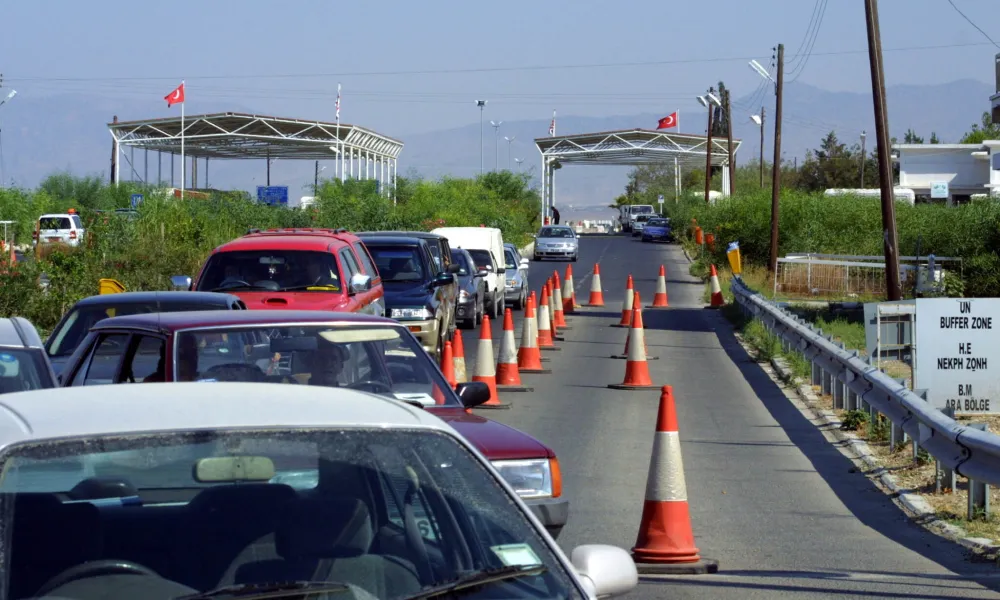
Queues persist at Agios Dometios
Long queues at the Agios Dometios crossing point continued to pose a problem during 2025. The authorities of the Republic of Cyprus informed the Commission that additional personnel were allocated to facilitate crossings. In December 2025, works also began to increase the number of traffic lanes, funded through the EU aid programme for the Turkish Cypriot community.
The expansion of the crossing point and its reinforced staffing were among the 14 confidence-building measuresannounced in 2024 by President of the Republic Nikos Christodoulides.
Significant drop in irregular migration
The continued downward trend in irregular migrant crossings via the Green Line is considered particularly significant. In 2025, 2,433 irregular crossings from the north to the government-controlled areas were recorded, compared with 3,319 in 2024, 6,793 in 2023 and 16,627 in 2022.
Despite the positive development, the Commission warns that irregular migration via the Green Line remains a serious issue requiring constant vigilance, adequate staffing and enhanced surveillance. It also underlines that those crossing irregularly into the government-controlled areas must have access to procedures for applying for international protection.
Just 33 irregular migrants were detected through the British Bases areas. All 33 applied for asylum and were handed over to the authorities of the Republic of Cyprus.
Trade falls 5.3%
Trade from the north to the government-controlled areas moved in the opposite direction. The total value of goods crossing the Green Line with the necessary accompanying documents fell by 5.3%, from €15.23 million in 2024 to €14.43 million in 2025.
Data from the Turkish Cypriot Chamber of Commerce show an even greater decrease, of 12.9%, in the value of goods for which accompanying documents were issued, from €18.22 million to €15.87 million.
Building and construction materials remained the most significant category of goods, followed by furniture, plastics, scrap metal and waste. There was a notable decline in trade in fruit and vegetables, while no transactions in potatoes took place via the Green Line during 2025.
By contrast, trade from the government-controlled areas to the north increased by approximately 13.5%, reaching €1.49 million. However, this corresponded to just 10.3% of the value of trade in the opposite direction.
Banks and bureaucracy hold back transactions
The Commission finds that trade between the two communities continues to be hampered by a series of practical and administrative problems. These include difficulties in transferring money between banks in the government-controlled areas and the north, as well as problems faced by Turkish Cypriots in opening bank accounts.
Although the Central Bank of Cyprus clarified in 2023 that Turkish Cypriots holding a Cypriot passport or identity card are entitled to open a basic payment account, the report states that only a very limited number ultimately managed to do so. At the same time, Turkish Cypriot businesses cannot open bank accounts in the government-controlled areas.
The issue of Turkish Cypriot commercial vehicles over 7.5 tonnes also remains unresolved. These vehicles can cross into the government-controlled areas only if they carry documents fully harmonised with the EU acquis. The Commission considers that resolving this issue would significantly facilitate the transport of goods and help strengthen trust and economic relations between the two communities.
Fewer seizures of contraband
During 2025, the authorities of the Republic of Cyprus carried out 2,870 seizures of contraband goods, compared with 3,170 in 2024, a decrease of 9.5%. In total, 721,024 cigarettes, around 199 kilos of rolling tobacco, 232,136 e-cigarette capsules and more than 267 tonnes of waterpipe tobacco were seized.
Other products detected included vehicles, fuel, drugs, medicines, pesticides and agricultural products. 35 criminal prosecutions for smuggling cases were filed before District Courts, while cases involving small quantities of cigarettes were usually handled with administrative fines and confiscation of the goods.
Room for greater trade
The Commission concludes that trade via the Green Line has significant room for growth, provided the obstacles that continue to limit transactions are addressed. It also welcomes the cooperation between the Cyprus Chamber of Commerce and Industry and the Turkish Cypriot Chamber of Commerce, expressing the hope that their efforts will lead to closer contacts between the business communities and stronger economic ties.
The Commission notes that it will continue to monitor the implementation of the Regulation and to work with the Republic of Cyprus, the British Bases and the Turkish Cypriot community.