
With global warming now "more than evident" and record temperatures sweeping Europe in recent weeks, citizen participation and commitment to urban biodiversity and green spaces in neighbourhoods is the key to adapting to the climate crisis. This is the argument put forward by Enrique Salvo, director of the Chair of Climate Change at the University of Malaga, in an interview with Spanish news agency Efe, in which he maintains that residents "can do a lot" if they unite against global warming.
Heat varies street by street
"In the past, we discussed whether there was a heat island, and it seemed that this heat island had a more or less similar spread across the entire city area. However, we now see that this is not the case. It differs by neighbourhood, literally. So there are neighbourhoods where this heat exceeds the limits of even physical and psychological comfort, and others where it does not reach those levels," he explains.
Salvo points out that biodiversity is an ally against climate change and that, if it is protected and promoted in neighbourhoods, the benefits are many. It not only reduces the heat island effect but also improves mental health, physical wellbeing and the social environment.
The 3-30-300 rule
He believes that green living must start in the neighbourhood, and that the quality of these urban units should be measured by the 3-30-300 rule: "that is, when looking out of the window, every resident can see three trees, that 30 percent of the neighbourhood is green space, and that within 300 metres they can find a park."
All of this, he explains, "significantly improves" mental health, but also strengthens the social community within the neighbourhood, creating the social principles of coexistence that are "so necessary at this moment" and that make "the neighbourhood strong."
Planning and public awareness
To reopen the doors of neighbourhoods to the biodiversity that is so essential in combating climate change, Salvo identifies "two key issues at this moment": urban planning and public awareness.
"Urban planning must be more sensitive than it has been until now. Green and blue infrastructure is essential to integrate into the city, both because of the need for water and because of the need for green spaces, which is what will bring us biodiversity," he notes.
Another goal is to encourage citizen participation and to ease public concern about certain organisms that will inhabit these green spaces or about the implementation of nature-based solutions.
The University of Malaga professor believes that, for this type of solution to be applied, those responsible for urban planning must recognise the benefits that biodiversity generates, and politicians must abandon short-term thinking.
He also focuses on citizens themselves, urging them to protect biodiversity, promote environmental education at home and get involved in their neighbourhoods, so that every community has "neighbourhood representation that can contribute effectively to this effort."
A summer of records across Europe
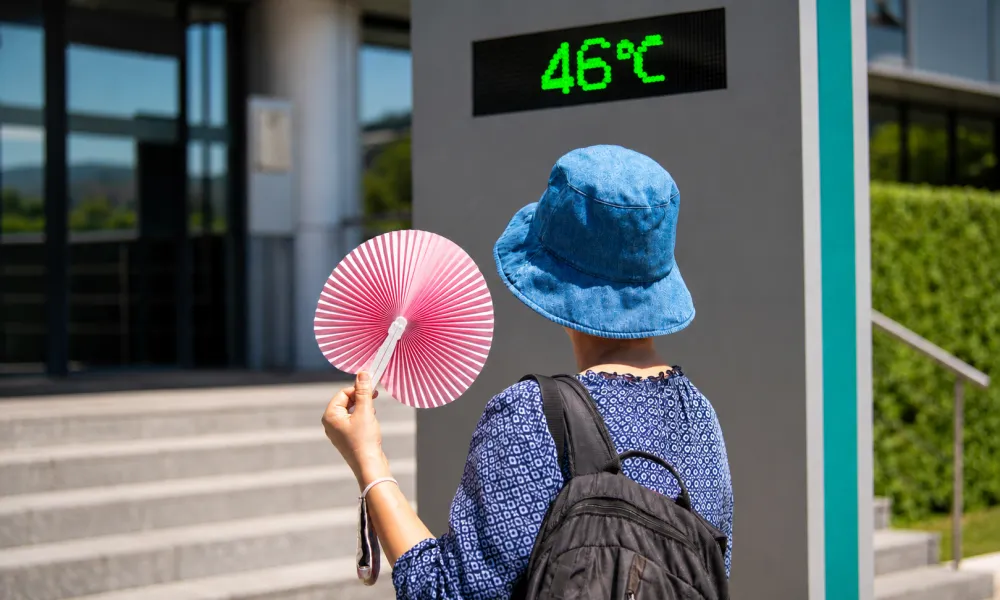
Salvo's comments come as Europe endures one of its most severe summers on record. Since late May, temperature records have been broken in Austria, Belgium, Czechia, Denmark, France, Germany, Hungary, Italy, the Netherlands, Poland, Romania, Spain and the United Kingdom. France recorded its hottest day ever on 24 June, with a national average of 30.0 degrees Celsius, while a top-level red alert was issued for 58 departments. The United Kingdom shattered its June record when Lingwood in Norfolk reached 37.7 degrees Celsius, and the heat then pushed east, with western Poland hitting 40.5 degrees, breaking a national record that had stood since 1921.
The World Health Organization reported more than 1,300 excess deaths linked to the extreme heat since 21 June, with over 150 million people affected across the continent. WHO Director-General Tedros Adhanom Ghebreyesus warned that Europe is the fastest-warming continent on Earth, heating at twice the global average, and described heat stress as the "silent killer", noting that European homes, workplaces and schools were not built for these temperatures.