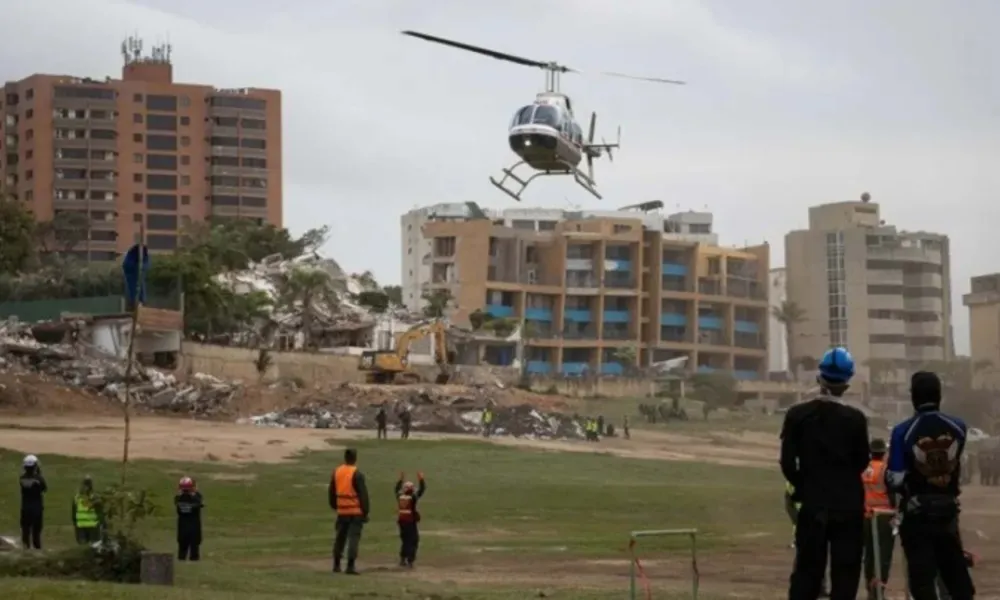

International search and rescue teams are beginning to withdraw from Venezuela as recovery operations enter a new phase following the devastating earthquakes that struck the country on 24 June. Heavy machinery continues to clear vast volumes of rubble, while families of missing persons remain at collapsed buildings hoping to recover their relatives.
The disaster, caused by twin earthquakes measuring 7.2 and 7.5 magnitude occurring 39 seconds apart, has left more than 3,500 people dead according to the latest provisional official toll. Tens of thousands of people are still reported missing.
Families continue searching
For Raul Alvarado, the search is far from over.
His mother, father and older sister remain beneath the ruins of the 16-storey ELE 26 apartment building in Caraballeda, one of the areas most severely affected by the earthquakes.
Their third-floor apartment has been reduced to rubble beneath crushed concrete slabs.
Twelve days after the disaster, many families continue searching for their loved ones despite diminishing hopes of finding survivors.
Mr Alvarado said the last time he saw his relatives, they were together in a neighbouring apartment after the first earthquake struck.
“They were all three together, embracing each other,” he said.
The second and more powerful earthquake caused the building to collapse.
“The building was full of people. My neighbour had five young children. They are all down there,” the 31-year-old said.
Scale of the destruction
The ELE residential complex was among approximately 200 properties destroyed in the disaster.
While some apartment blocks suffered only facade damage, others collapsed completely, in some cases falling onto neighbouring structures.
In several locations, towers of rubble are all that remain.
Appliances, mattresses and personal belongings remain visible among the debris, while excavators continue demolition and clearance work at unstable structures.
Missing persons concern
The United Nations has estimated that as many as 50,000 people may be missing following one of the most destructive disasters in Latin American history.
The interim government has declined to provide an estimate of the number of missing persons.
Families continue searching through collapsed buildings, while volunteers and firefighters dig through concrete using hand tools, drills and improvised tunnels in an effort to reach lower floors.
In some locations, bodies remain trapped beneath the debris.
Volunteer recovery efforts
Alni Pacheco, a volunteer working at one of the rescue sites, said he had participated in the recovery of 12 bodies from collapsed buildings.
“Today we hope to recover our first survivor,” he said, while acknowledging that the chances of finding people alive have become extremely remote.
Volunteers continue working alongside emergency responders despite increasingly difficult conditions.
Online registries of the missing
Following the earthquakes, online platforms were created to help families locate missing relatives.
One database titled Missing Persons of the Venezuela Earthquake contains more than 31,400 names.
Another platform, titled Venezuela Is Looking for You, lists 18,200 missing people and records approximately 25,000 individuals who have been located, either alive or deceased.
Jens Laerke, Deputy Spokesperson for the United Nations Office for the Coordination of Humanitarian Affairs (OCHA), said the high number of missing persons reported through digital platforms appeared credible.
“This does not mean they are all beneath the rubble,” he said, but added that the figures reflect the scale of the disaster and the despair facing affected families.
Estimates from authorities
National Assembly President Jorge Rodriguez said information collected through drone imagery, official lists and family reports indicated that approximately 30,000 people were present in La Guaira when the earthquakes struck.
According to him, around 19,800 people either escaped on their own or were rescued.
Experts examine collapse patterns
Katsu Goda, a professor in the Department of Earth Sciences at Western University in Canada, said the combination of two powerful earthquakes occurring within less than a minute and the vulnerability of reinforced concrete buildings may have contributed significantly to the death toll.
According to Professor Goda, the first earthquake likely weakened structural columns in many buildings, while the second triggered successive floor collapses.
He said reinforced concrete buildings often produce large volumes of debris, making rescue operations exceptionally difficult and dangerous.
Professor Goda added that some buildings appeared to have experienced so-called "pancake collapses", in which floors collapse onto one another, trapping occupants between compressed layers of debris and making both rescue operations and victim identification extremely challenging.
Fears over debris removal
Some relatives fear that collapsed structures could be cleared before all victims are recovered.
Daniela Alvarez, who is searching for her sister, nieces and brother-in-law, expressed concern about plans to level damaged buildings.
“How can they think about demolishing everything without knowing whether people are still underneath? Our families will come out in pieces,” she said.
At the ruins of the ELE 27 building, Clemente Canisales said he still hopes the bodies of his son and grandson will be recovered.
“Many lives were lost here. How many people are still inside? We do not know,” he said.