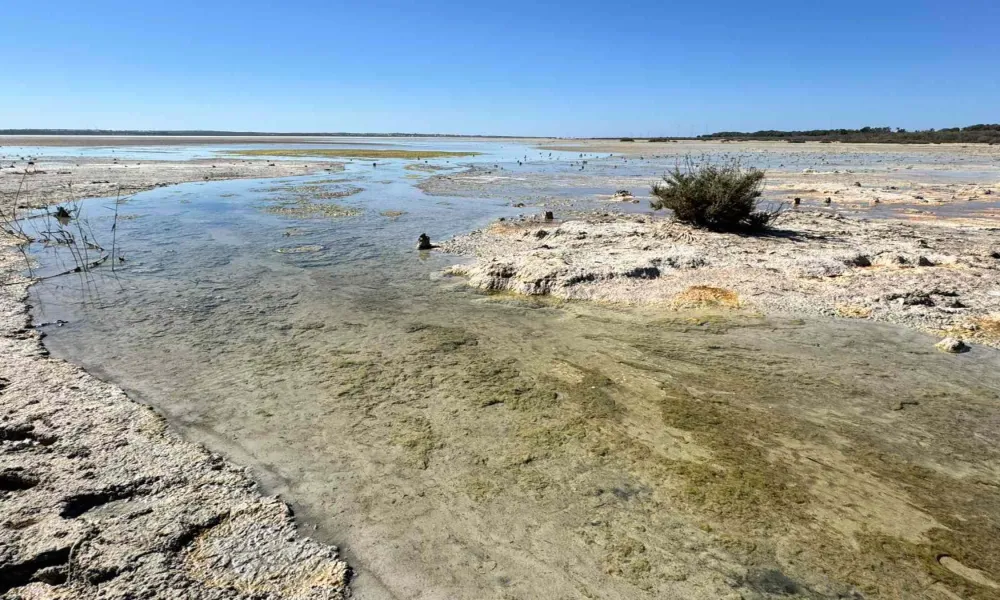

Preparations are under way for restoration projects at parts of the Akrotiri wetlands that have been affected by years of pollution and environmental degradation linked to surrounding development. BirdLife Cyprus has secured funding from two private-sector donors and plans to begin work in September on interventions at Makria Lake and wetlands in the Lady’s Mile area.
The organisation says the project aims to restore degraded habitats and improve conditions for bird species, while also encouraging authorities to take more effective action to address the continuing flow of polluted water into the wetland system.
Restoration works planned for wetlands
According to BirdLife Cyprus, the project will include two separate actions.
The first involves restoration work at Makria Lake, also known as Zakaki Lake, where pollution has caused eutrophication and excessive reed growth. As a result, parts of the wetland, including the birdwatching observatory, have become overwhelmed by vegetation.
The second action involves the creation of small islands in lakes in the Lady’s Mile area to provide more favourable nesting conditions for bird species that are considered important to the local ecosystem.
BirdLife Cyprus Director Melpo Apostolidou told Politis that both the Game and Fauna Service of the Republic of Cyprus and the Environment Department of the British Bases have been informed about the project.
“Both actions have been communicated to the relevant authorities responsible for bird and nature conservation in the area, while once the project begins there will be contact with all stakeholders, including Kourion Municipality and the Limassol District Local Government Organisation, for consultation and information sharing,” she said.
Pollution at Makria Lake
Environmental organisations have drawn attention in recent months to Makria Lake's role in the pollution affecting Akrotiri Salt Lake.
The lake, which is connected to the salt lake, has been identified as one of the entry points through which polluted water reaches the protected wetland system.
According to information previously publicised following interventions by non-governmental organisations, contaminated water from nearby developments has been flowing into the lake for several years. The water contains, among other pollutants, coliform bacteria.
The polluted water subsequently enters Akrotiri Salt Lake, contributing to a gradual decline in wildlife populations because food sources within the ecosystem are being destroyed.
Decline in flamingo numbers
The environmental pressures affecting the wetland are reflected in flamingo population figures recorded in recent years.
In 2020, approximately 13,000 flamingos were recorded at Akrotiri Salt Lake. The figure fell to around 6,000 in 2021 and has continued to decline each year since then.
In 2025, only about 200 flamingos were recorded at the site.
At the same time, flamingo populations increased at Larnaca Salt Lake and Paralimni Lake.
Ms Apostolidou said that meaningful restoration cannot be achieved while pollution continues to enter the system.
“As long as the pollution problem continues, we cannot speak of substantial restoration, but we hope this effort will also act as a catalyst to encourage the authorities to tackle the problem of polluted water flowing into Makria Lake,” she said.
Studies under way to address pollution
Authorities and public bodies are currently carrying out studies aimed at identifying ways of addressing the environmental problems affecting the area.
In February 2025, following an initiative by Kourion Municipality and the British Bases Administration, a technical committee was established to monitor and address the issue.
The British Bases Administration has administrative responsibility for Akrotiri Salt Lake, although not for the surrounding area.
The committee's mandate is to examine the problem over a 36-month period and identify the projects and actions required to address it. The objective is to reach conclusions by early 2028 on the so-called "hard interventions" that should be implemented.
Responsibility for carrying out those works will rest with the authority that has jurisdiction over each intervention.
Institutions participating in the committee
The technical committee includes representatives from:
- Kourion Municipality
- Limassol Municipality
- Limassol District Local Government Organisation
- Department of Environment
- British Bases Administration
- Geological Survey Department
- Water Development Department
- Department of Forests
- Ministry of Agriculture Directorate-General for Environment
Cost and implementation timetable
According to Ms Apostolidou, the restoration works planned for Makria Lake alone are estimated to cost between €20,000 and €25,000.
The project is currently at the stage of preparing specifications, conducting consultations with stakeholders and carrying out surveys, including assessments of potential impacts.
Fieldwork is expected to begin between the end of the summer and the start of autumn.
Recruitment of personnel for the project is already under way.
Planned interventions at Makria Lake
Under the project, sections of reed growth will be removed from part of Makria Lake directly in front of the birdwatching observatory.
A small island will also be created in another section of the lake to provide nesting opportunities for birds.
At the same time, two permanent earth corridors will be constructed through the lake. These will allow machinery to access the area in the future for reed management and removal.
Ms Apostolidou explained that such maintenance is currently not possible because machinery cannot enter the wetland due to the presence of water.
Role of NGOs and private funding
Ms Apostolidou said the project demonstrates the role that non-governmental organisations can play in attracting private funding and helping to initiate practical environmental solutions.
“Now we must talk about restoration. We cannot allow the damage to remain,” she said.
The first donor is the UK-based John Ellerman Foundation, which previously funded a BirdLife Cyprus project that produced recommendations on measures required across the wider Akrotiri wetland area.
“With the next project we are building on the previous one by implementing some of its recommendations,” Ms Apostolidou said.
The second donor is an organisation established by a company operating in the agritourism and birdwatching sector.