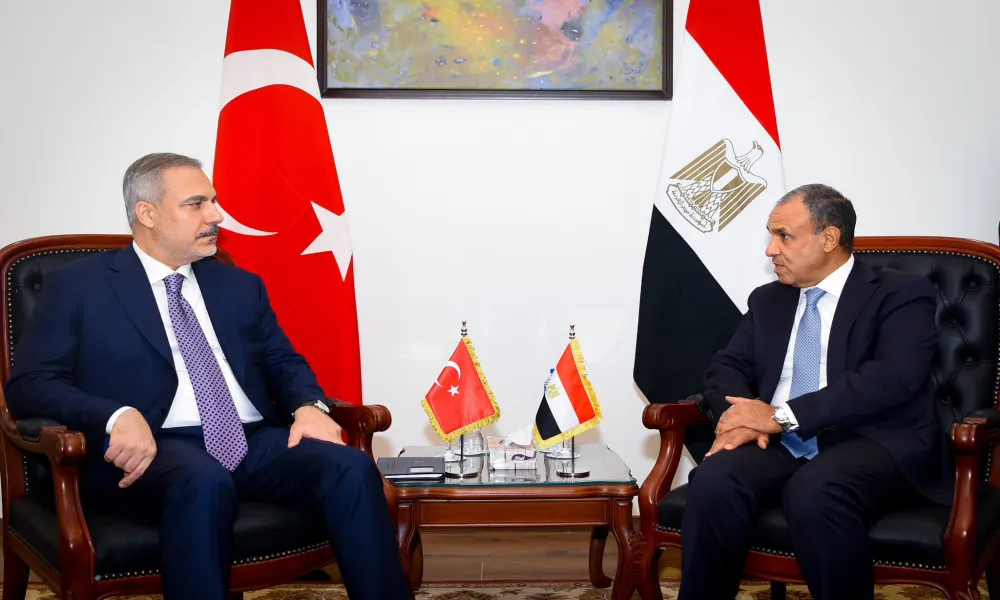

Members of the DIKO Secretariat will climb the hill of the Presidential Palace on Friday morning for a second meeting with the President of the Republic Nikos Christodoulides, with three central issues on the table: the reshuffle of the Council of Ministers, the upcoming appointments to the boards of semi-governmental organisations, and the cooperation between the government and the party of Nicolas Papadopoulos. In essence, DIKO is seeking to increase its participation in the government with more than two ministers and, above all, to secure the right to be consulted before every appointment, so that decisions are not taken unilaterally by the Presidential Palace.
According to Politis' information, the previous meeting at the Presidential Palace took place in a tense climate, with the DIKO president insistently raising the issue of strengthening the party's participation in the government, citing the fact that it is the only co-governing party in parliament after the elections. The President of the Republic avoided committing to anything, setting a new meeting for Friday 10 July in order to respond to DIKO's demands.
Ministry of Agriculture
DIKO is trying to cash in politically on the result of the parliamentary elections, capitalising on the new landscape on the party scene. The other two co-governing parties, EDEK and DIPA, failed to enter parliament, leaving DIKO to carry the entire weight of supporting the government's work and securing the passage of government bills. Consequently, the party of Nicolas Papadopoulos believes the President of the Republic needs DIKO more than ever and must therefore increase the number of ministers from the centrist party.
DIKO appears to be showing particular interest in agricultural affairs, as evidenced by Nicolas Papadopoulos' participation in the relevant parliamentary committee. It was an unprecedented move by a party president that did not go unnoticed, sparking conversations in the corridors of parliament. It is therefore most likely that DIKO has its eye on the Ministry of Agriculture, following the decision of Agriculture Minister Maria Panayiotou to accept an appointment in public education in September. This is the reason the reshuffle discussion arose in the first place.
Of course, Maria Panayiotou represents EDEK in the cabinet, and President Christodoulides cannot ignore the socialist party with the presidential elections in view. An EDEK figure may be placed at the Deputy Ministry of Tourism, if the information holds that Deputy Minister Costas Koumis will not be in the next Council of Ministers.
Tactics and presidential elections
Officially, DIKO participates in the cabinet with Health Minister Neophytos Charalambides and Energy Minister Michalis Damianou. These are not two bureaucrats from the broader DIKO sphere but two of the party's three vice-presidents. As such, the previous reshuffle in December 2025 was closer to DIKO's logic than to that of President Christodoulides, who did not seriously take the co-governing parties into account when appointing the first members of his government after the 2023 presidential elections.
The feeling of discontent within DIKO remains alive, however, because President Christodoulides insists on operating unilaterally, choosing individuals without prior consultation with the parties. The result is the creation of a guard of pro-Christodoulides cadres within DIKO who do not appear willing to faithfully follow party decisions. This increases the chances of an internal rupture if DIKO chooses a different path in the 2028 presidential elections.
It is no coincidence that the name of former DIKO MP Christos Senekis is being mentioned prominently for the Ministry of Agriculture in the upcoming reshuffle. He is considered a figure close to the Presidential Palace but failed to win re-election. Another example of the conditions of political hostage-taking the President of the Republic creates for DIKO is the statement by Energy Minister Michalis Damianou in a recent interview with Kathimerini, in which he said that DIKO has a candidate for 2028. If President Christodoulides decides to seek re-election, he added, then DIKO should support him.
Leaks to the press
After the meeting at the Presidential Palace, a new session of the DIKO Secretariat will follow to take stock of the outcome of the contacts with President Christodoulides, and the next moves will be decided accordingly.
On Thursday 9 July, there were leaks to the press regarding President Christodoulides' intention to offer DIKO one more ministry, a deputy ministry (Tourism or Culture) and a Commissioner post. If the information is confirmed, it becomes clear that the President of the Republic is taking seriously the risk of DIKO allying with DISY in the upcoming presidential elections.
The schools of thought within DIKO
President Christodoulides' stance of keeping his distance from the parties and presenting himself as above party lines is causing irritation among several DIKO cadres. On more than a few occasions, party officials have publicly stressed that the President of the Republic does not consult DIKO and that the party learns of government decisions from the press. President Christodoulides is trying to maintain ties with DISY voters, and this need drives him to keep a distance from the co-governing parties of the Centre.
Nikos Christodoulides was elected President of the Republic with the support of DISY cadres and a portion of the party's voters. He knows he cannot be re-elected solely with the backing of the parties of the middle ground and is constantly making efforts to utilise figures from the DISY sphere in the government. However, President Christodoulides' tactic of presenting himself as a DISY man creates the problem of alienation from DIKO.
Today there appear to be three schools of thought within DIKO. One favours continuing the cooperation with President Christodoulides, the second sees a way out towards AKEL, and the third looks favourably on DISY. The majority tendency in the party's collective bodies, however, does not want a political divorce from the government. Yet a shift in the climate within DIKO cannot be ruled out, and some believe this is why Nicolas Papadopoulos visited the Presidential Palace with the members of the Secretariat. They interpret the DIKO president's move as an attempt to demonstrate to the Secretariat members the dismissive manner in which the President of the Republic treats the parties of the co-government.
The DISY cooperation scenario
The DIKO president publicly states that the party is not to be taken for granted by anyone and that it never gave the President of the Republic a blank cheque. During the election campaign, he particularly emphasised the cooperation with DISY within parliament and signalled that it would continue after the elections. DISY's positions were along similar lines, as the party prepares for the presidential elections and needs a strong ally in the Centre.
However, DIKO did not choose to leave the government in order to win DISY's support for the presidency of the House. Apart from the fact that such a move would not pass through the party's collective bodies at this point, the DIKO president appears to believe it is still too early for such a decision. Besides, participation in executive power carries greater weight than the presidency of the legislature. Yet the political flirt with Pindarou is being kept alive.
Nicolas Papadopoulos appears to fully understand that his party will be the apple of discord between DISY and President Christodoulides, and he is trying to reap political benefits from this contest over who will manage to ally with DIKO in the 2028 presidential elections.