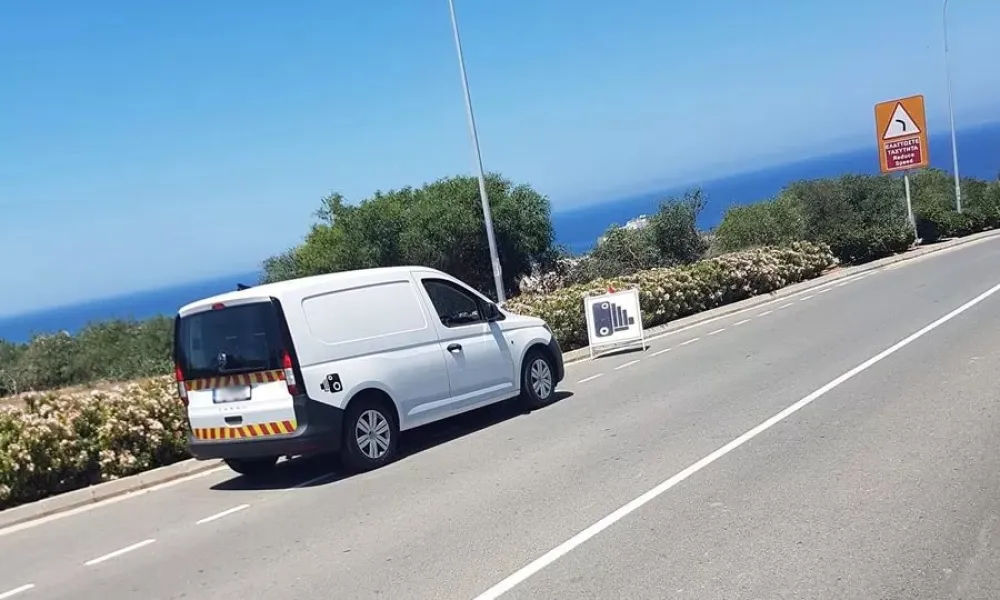

The headache created by undelivered out-of-court fines from portable and mobile traffic cameras will not be resolved easily. Thousands of fines that were never served on offenders have already piled up, and the burden of delivering them has now been transferred to the police. At the same time, voices are growing louder that the procedure being followed is not covered by the provisions of existing legislation.
Discontent within the force
There is strong dissatisfaction among police officers over the decision to shoulder this task as well, with officers arguing that serving the fines is the responsibility of the management company, under the contract it has signed.
Police units were informed at the beginning of last month that they would begin serving the camera fines. According to the relevant internal circular, obtained by Politis, the police proceed as of 4 June 2026 with the service of out-of-court fines to offending drivers, since this could not be carried out by the contractor company by post or through personal servers.
The circular states that the decision was deemed necessary both to make possible the service of traffic camera fines that were not delivered at the first stage by the contractor, and to improve the effectiveness of the system. It also notes that, under certain conditions, service may be carried out even for fines still in the process of being served by the contractor.
No legal basis specified
Notably, the police circular does not clarify on the basis of which legislation the decision was taken, an issue that became the subject of intense debate at the House Legal Affairs Committee last Wednesday, with MPs so far unconvinced by the answers they received.
How the new system works
The circular informs members of the force that the procedure will be carried out through the electronic system of the Cyprus Police, for which a manual describing the process has been prepared. A new function named "undelivered traffic camera fines" has been added to the system's menu.
According to the circular, these functions can be managed by all police stations and traffic units, as well as any other police premises with this capability. A search can be conducted by entering a person's identity card number, and if the check reveals pending undelivered fines for any person registered in the police system, the fine must then be served.
Officers who print and serve the fines are urged to be particularly careful and absolutely certain of the personal details of the offender, since once the fine is printed and served, the 105-day payment deadline begins to run, comprising 90 days without surcharge and 15 days with surcharge. In the event of non-payment, a criminal file will be prepared for registration before the District Court.
The Legal Service opinion
The Ministry of Justice and the police invoke an opinion by the Legal Service, according to which the service of the fines by police officers is lawful. The opinion, submitted to parliament, states among other things that no restriction is identified on the possibility of fines being served by a police officer at crossing points. On the contrary, it finds that under article 46 of Cap. 155, to which article 6(2) of Law 55(I)/2001 refers, any written notice or summons may be served anywhere in the Republic by a police officer and/or a person authorised in writing by the responsible officer to perform relevant duties on their behalf.
What the law provides
The debate and the criticism voiced, mainly by AKEL MPs, centre on article 6 of the Road Traffic Offences (Use of Photo-Labelling Devices and Other Related Matters) Law of 2001, which sets out the procedure for serving the fines. Specifically, the law provides that in cases of recording based on the use of traffic camera devices, the owner of the vehicle shown in the photograph of the violation is served with the device's finding, including an explanation of the code number of the device's installation location, and a notice in accordance with the provisions of the Out-of-Court Settlement of Offences Law.
These documents are served personally, in accordance with article 46 of the Criminal Procedure Law, or sent by personal registered letter to the owner of the vehicle. The law further provides that personal service may also be carried out by a person authorised in writing by the responsible officer to perform relevant duties on their behalf.
Are the fines invalid?
Meanwhile, lawyer Antonis Demetriou, in a post on the platform X, argues that any fines served six or twelve months after the offence was committed, that is, after the traffic camera recorded the violation, are invalid. According to Mr Demetriou, no one can be charged with minor criminal offences after the lapse of six or twelve months from the recording by traffic cameras, and he refers to article 88 of the Criminal Procedure Law.