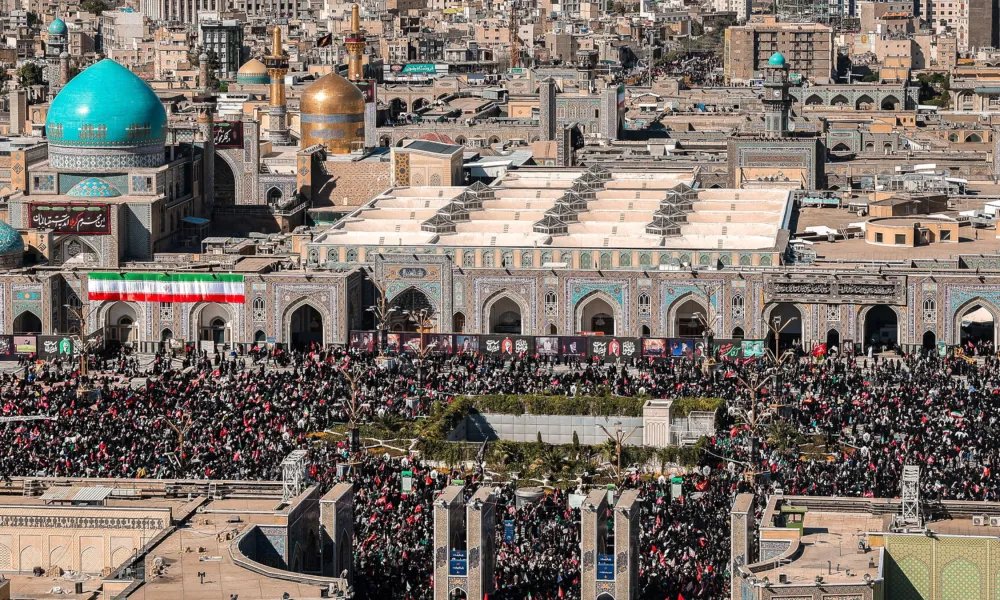

Iran's former supreme leader Ali Khamenei, who lost his life at the age of 86 in the opening hours of the American-Israeli attack against the Islamic Republic on 28 February, was buried in the early hours of the morning in Mashhad, state television reported. The burial followed days of ceremonies held against the backdrop of the resumption of hostilities between the United States and Iran.
The burial took place in the absence of his son and successor, Mojtaba Khamenei, at least according to the footage broadcast by the IRIB network. The images showed Ali Khamenei's coffin, draped in the colours of the Islamic Republic's flag, being carried into the shrine of Imam Reza, the holiest site of Shia Islam in Iran. A huge crowd had gathered under the scorching sun in Mashhad, the city in the northwestern part of the country where the shrine is located. In a sign of the tense climate, a fighter jet escorted the aircraft carrying the former supreme leader's body to Mashhad.
Ceasefire declared over
The final act of the days-long ceremonies came amid the reignition of hostilities between the American and Iranian armed forces, the worst since the signing on 17 June, by the presidents of the two states, of an initially fragile agreement, the "Islamabad protocol of understanding", which ratified the ceasefire in place since April.
US President Donald Trump said this week that the truce was "over" and called Iran's leaders "sick", saying he no longer wanted to "deal" with them. Nevertheless, he left the door ajar to a possible continuation of negotiations by his team.
The office of Benjamin Netanyahu announced for its part that the Israeli prime minister spoke by telephone with the American president last night, adding that Donald Trump briefed him on the "latest moves" by the US in the Gulf. Meanwhile, according to a report in the Wall Street Journal, the Israeli government shared intelligence with the American administration according to which Iran "is planning to assassinate" Donald Trump.
Bombardments
On the night of Wednesday into Thursday, the American armed forces once again launched massive bombardments, striking some 90 targets in Iran, according to their announcement.
The Islamic Republic accused the US of also targeting civilian infrastructure in order to overshadow the funeral and prevent the faithful from attending. Bridges and railway lines connecting Tehran with Mashhad were hit, according to the Iranian authorities.
Last night, a military installation near Bushehr, a city in the southwestern part of the country that hosts the only nuclear power plant still in operation in the Islamic Republic, was targeted in a bombardment, an Iranian official told the official news agency IRNA. Shortly afterwards, however, the US Department of War denied to AFP that any American strike had taken place in Iran "during the last few hours".
"The past two nights the explosions have been very loud," Badrieh, a 44-year-old resident of Bandar Abbas on Iran's Gulf coast, told the French agency. The American raids killed 17 people and wounded another 93, according to an official toll issued by the Iranian authorities.
The Strait of Hormuz at stake
The flare-up began on Tuesday in the Strait of Hormuz, which has become the central stake of the war. Washington blamed Tehran for attacks against at least three merchant vessels. Traffic through the strait has since shown a dramatic decline, according to data from Kpler, the specialised maritime traffic monitoring platform.
Iran took control of this sea passage, of strategic importance for global hydrocarbon trade, during the war, and insists there will be no return to the status quo ante, the pre-war situation when passage was free. It says transit fees will be imposed on merchant vessels and is permitting only a single route, along its own coastline.
In retaliation for the American bombardments, the Iranian armed forces once again targeted neighbouring Gulf monarchies: Kuwait, where at least one injury was reported; Bahrain; and Qatar, even though the emirate is among the mediators in efforts to end the conflict. Sirens also sounded in Jordan, where missiles were intercepted for the first time since 11 June.
The resumption of hostilities sent oil prices rebounding on Wednesday. Brent crude, the international benchmark, nevertheless remained at around 77 dollars a barrel.
"Everyone wants to avenge him"
The renewed fighting did not dampen the zeal of the many faithful who made the journey, following gatherings of millions of citizens in Tehran and Qom at the start of the week, and later in Shia areas of neighbouring Iraq.
"Everyone here wants to avenge him," commented Mohammad Afsharian, a 41-year-old trader, stressing that diplomatic efforts have been "all but buried". "Even if we struck a deal with the US, we would still always have problems with Israel," he said.
The government of the Jewish state, sworn enemy of the Islamic Republic since its founding in 1979, signalled yesterday, Thursday, that it is ready to attack Iran "for a third time if necessary", striking it "even harder", through its Defence Minister Israel Katz.
Source: AFP