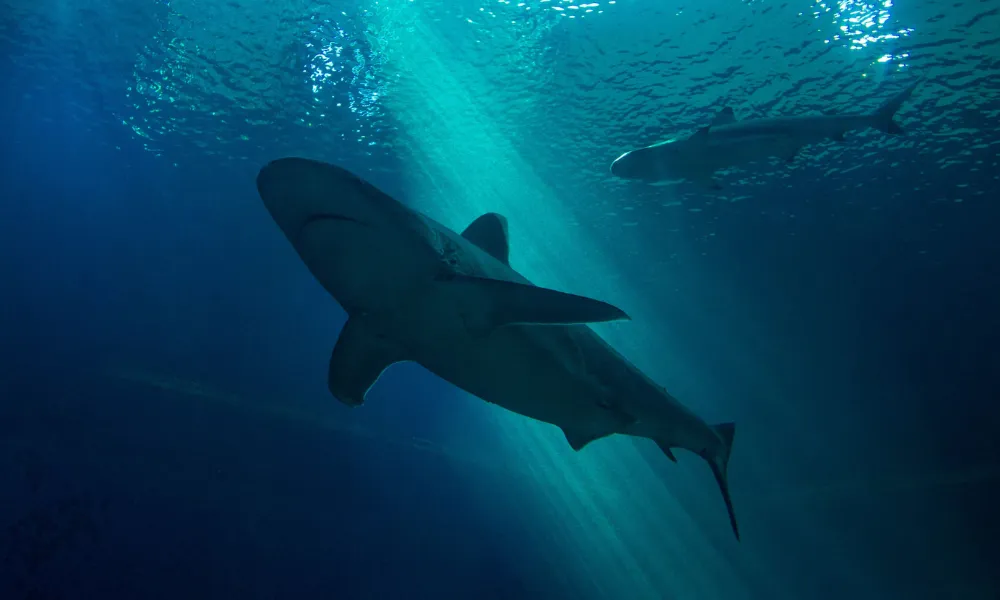

Sharks are among the oldest vertebrate predators on Earth. They, or their close ancestors, survived all five of the planet's major mass extinctions, including the largest and most devastating, the Permian extinction, also known as the "Great Dying." That catastrophic climate event wiped out most life on Earth, including around 90% of marine life.
Sharks survived. Today they are found in nearly every part of the world's oceans and, after hundreds of millions of years of evolution, have developed several striking and unexpected traits.
Mathematical minds
Sharks are often seen as mindless predators driven purely by instinct and hunger, but science suggests they are considerably more intelligent and capable of learning than commonly assumed. They can distinguish sounds with small differences, as well as different abstract patterns and coloured geometric shapes.
In one well-known experiment, young grey bamboo sharks showed they could remember information about shapes and visual illusions for almost a year. They can also carry out basic maths, distinguishing between quantities such as three and five, and four and seven, though not finer differences such as four and five.
A preference for jazz
For Port Jackson sharks, it seems that without rhythm and swing, it is not worth their attention. Specimens of this species, which lives mainly in Australia and moves along the seabed, were tested by being trained to swim to a specific point in an aquarium when music played, with food given as a reward.
The study, carried out by researchers at Macquarie University in Sydney, found that the sharks preferred the location where they were fed when jazz was playing, but could not make the same association when classical music played instead. "It was clear the sharks understood they had to do something when the classical music played, but they could not work out that they had to go to a different location," researcher Culum Brown said in a press release.
Sharks have belly buttons
While some sharks lay eggs, many others carry their young in the womb and nourish them through an umbilical cord, much as happens in humans. Because of this, for a few weeks or months after birth, these young sharks have a belly button, until the scar from the umbilical cord heals.
Other sharks neither lay eggs nor develop their young in the womb like mammals: instead, embryos develop inside eggs that hatch while still inside the mother. These young are then also born live.
Shark pups eat each other in the womb
The young of sand tiger sharks enter a survival contest from the very start of life, while still inside their mother. Female sand tiger sharks have two uteruses, and up to five pups can develop in each. However, the embryos feed on their siblings until only one remains in each uterus. This is known as intrauterine cannibalism, or adelphophagy, meaning "eating one's brother."
After consuming their siblings, the surviving sand tiger shark pups gain exclusive access to a steady supply of unfertilised eggs that their mother continues to release. This allows them to grow strong and healthy until the moment of birth.
Sharks have close friends
Sharks are not the solitary hunters they are often portrayed to be. Grey reef sharks tend to spend time with the same group of companions for up to four years. They split into smaller groups, follow different paths, and later reunite depending on the season.
Young lemon sharks also prefer to live in groups and, notably, learn new skills from one another through these social interactions, such as how to find food or avoid predators. They prefer to associate with other lemon sharks of a similar size and those they have encountered before.
Even great white sharks may have close companions. Although usually considered solitary animals, two great white sharks named Simon and Jekyll were observed travelling together for 6,000 kilometres without ever separating.
Source: BBC