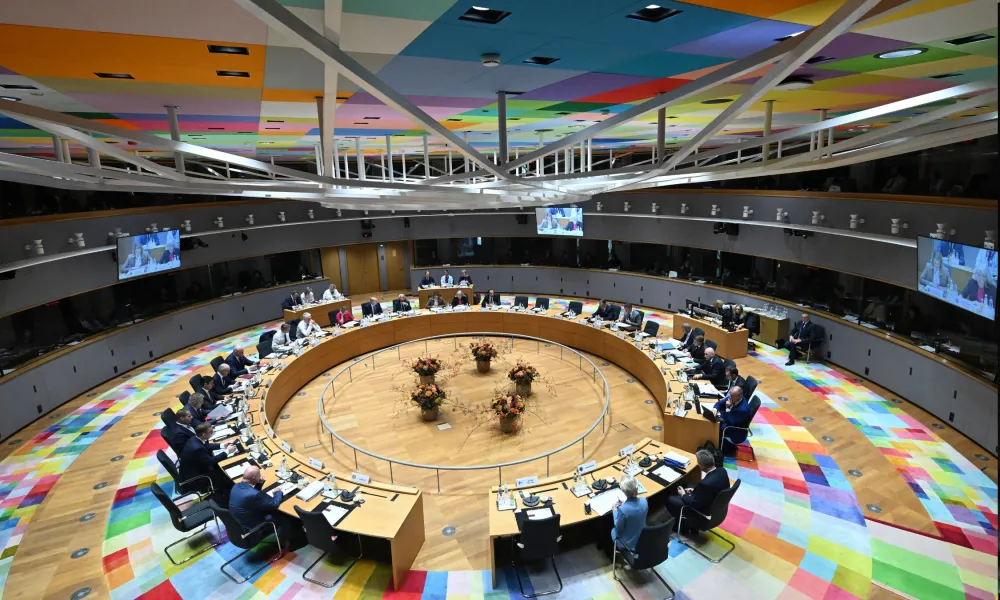
The two-day European Council summit in Brussels, despite differences among member states, resulted in political guidance to the European Commission to submit proposals for new measures to reduce energy costs. While the wording of the conclusions is general, it outlines the framework of measures that member states expect.
Specifically, the European Council’s conclusions on competitiveness refer to the need to consider additional targeted and temporary measures to address high energy prices. They also refer to the differing conditions in member states, recognising the need to take national specificities into account.
The Commission will present new short-term measures
As the European Council text states, “the European Council invites the Commission to examine and, where necessary, propose further measures to address the surge in energy prices in the short term, taking into account the specific circumstances of member states, including differences in electricity prices”.
This wording aligns with Cyprus’s demands. Finance Minister Makis Keravnos had raised at ECOFIN meetings the issue of further cuts to excise duties, a change in the way VAT is calculated on electricity bills and, above all, granting spending flexibility to countries with a strong fiscal record, such as Cyprus. Cyprus does not oppose the idea of postponing the new Emissions Trading System (ETS2) in order to avoid additional charges on liquid fuels. ETS2 is scheduled to become fully operational in 2028.
President Nikos Christodoulides expressed satisfaction with the outcome. On ETS2, he said: “As it stands, the wording satisfies us, and I believe the Commission has also understood the importance of this, so that there can be a further postponement, particularly in the implementation of ETS2.” He argued that citizens and businesses should not be asked to pay “at a time when there are so many challenges due to energy costs, and indeed from a crisis that no one can know when it will end”.
A difficult discussion
The discussion on energy was not easy and, according to international media reports, there were moments of tension, particularly over ETS2.
ETS2 extends carbon pricing to transport and buildings, which are not fully covered by the existing ETS. Its aim is to make the use of fossil fuels that emit carbon dioxide more expensive, in order to encourage the transition to cleaner forms of energy.
The request by some member states to postpone ETS2 did not pass. Italy, Hungary, Poland, the Czech Republic and Slovakia pushed for a delay, citing the burden on consumers. Germany, France, Spain, Portugal, the Nordic countries and the Netherlands insisted on maintaining the framework. The dispute caused tension between German Chancellor Friedrich Merz and Italian Prime Minister Giorgia Meloni. Negotiations were interrupted several times and the conclusions had to be rewritten four times.
The wording of the conclusions matches Cyprus’s demands
In the end, the 27 asked the Commission only for an updated impact assessment, particularly regarding its design and safeguards. On the existing ETS, they called for limiting the volatility of carbon prices and its impact on electricity costs, while preserving the system’s central role in the green transition. They also called on the European Parliament to speed up the legislative process on the Market Stability Reserve, with the aim of curbing excessive price volatility.
The outcome partly addresses both demands. Italy did not secure a postponement of ETS2, but the reassessment requested from the Commission keeps the issue open, and it may return once the results are presented. As for the additional measures requested by Greece to protect vulnerable households and businesses, the text contains no specific fiscal provision. It does, however, recognise the need for immediate action and refers to the Commission’s proposals.
The budget
The major issue at stake at the summit was progress on the next Multiannual Financial Framework (MFF). No progress was made, and the discussion will continue at a new summit in November. The aim is to reach agreement by the end of the year and avoid extending the discussion into 2027, when elections are due in several countries, including France, Italy and Poland.
European Council President António Costa announced that he will convene an additional meeting on 26 November, in an effort to overcome disagreements and lay the groundwork for a final agreement in December. To bring the sides closer to a deal, he will present new budgetary figures ahead of the meeting.
Addressing the 27, Mr Costa warned that missing the end-of-year deadline would delay EU payments to farmers and researchers beyond 1 January 2028, the date on which the new budget is due to take effect. If leaders fail to reach agreement in December, elections in member states could postpone a deal until May or even October 2027, Mr Costa warned leaders in his closing remarks, according to two EU diplomats briefed on the discussions.