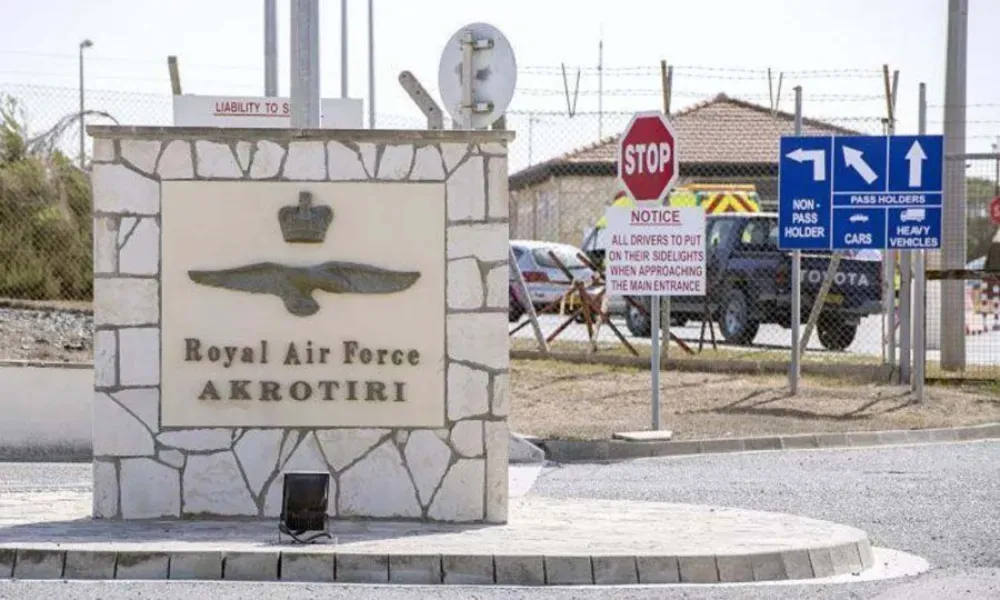

The Municipality of Kourion has voiced strong concern over plans by the British Bases at Akrotiri to install new antennas in the area, following a public meeting held on Wednesday to discuss the project.
Speaking on Politis Radio's Proini Epitheorisi programme, Kourion mayor Pantelis Georgiou said local authorities now have “the final picture” of what the British are planning and claimed that the information initially provided did not reflect the true scale of the project.
According to Georgiou, local authorities were initially told that 20 antennas would be installed and 18 existing antennas removed. However, around two weeks ago, they learned that a first phase of the project would involve the construction of 68 additional antennas.
The mayor said a second phase would include the construction of two new buildings within the radar area, together with an expansion of an existing station building. A third phase, expected between 2031 and 2034, would involve further expansion of related infrastructure.
“This significantly militarises the wider Akrotiri area,” Georgiou said, adding that the plans raise two major concerns: public health and public safety.
‘We discovered they were lying to us’
Asked why the plans differed from the original information provided, Georgiou said the British authorities had not offered a satisfactory explanation.
“At first, representatives of the Bases conveyed the information they said they had available,” he said. “But along the way we discovered they were lying to us.”
According to the mayor, once local authorities insisted on receiving specific documents, it emerged that the project had been planned since the previous year.
“Everyone within the British Bases knew about it at least since last year. They simply did not inform us because they did not want us reacting to these plans,” he said.
Municipality seeks radiation data
Addressing health concerns, Georgiou said the municipality wants to fully understand the technology that will be used by the new antennas.
He said officials have requested data on radiation emissions so it can be examined by specialists conducting studies on potential health impacts.
At present, a monitoring device is installed at the former community council building, with readings transmitted to the Republic of Cyprus through the Electromechanical Services Department.
The municipality has requested additional monitoring equipment closer to residential areas situated nearest to the existing and proposed antennas.
According to Georgiou, British authorities have indicated that two additional monitoring stations will be installed at locations to be agreed.
As for existing antennas, he said the only data currently available comes from the Electromechanical Services Department, which has indicated that radiation levels remain within limits established by national legislation.
However, he noted that participants at Wednesday's public meeting, attended by around 200 people, argued that the legal limits remain too high compared with levels that could potentially create health concerns.
For that reason, calls were made for new national legislation to reduce exposure limits, similar to measures adopted in other countries.
Cancer study findings
The mayor also addressed concerns about cancer cases in the wider area.
He said that when opposition to the antenna plans first emerged, the municipality requested an epidemiological study from the Health Ministry focused on Akrotiri.
According to Georgiou, the study found that the average incidence of cancer in Akrotiri is lower than the national average for Cyprus.
He argued, however, that this does not necessarily settle the issue because any potential effects may extend beyond Akrotiri itself.
As a result, the municipality has requested that additional monitoring devices be installed in neighbouring communities, including Asomatos, which lies in the direction towards which the antennas are oriented.
Land acquisition concerns
In addition to health and safety issues, Georgiou raised concerns over land rights.
He claimed that British authorities are seeking to requisition and expropriate community-owned land in the Akrotiri area.
The land in question covers around 360 donums and, according to the municipality, would effectively cut off access to the sea between the existing antenna site and the coastline.
Legal action and ECHR appeals planned
Georgiou said Wednesday's public meeting agreed to seek legal opinions from the municipality's advisers in order to determine whether there are grounds for administrative and court challenges once relevant decisions are formally issued.
The municipality is also launching an information campaign both locally and internationally.
In addition, Georgiou said efforts will be made to pressure the government and other stakeholders to pursue what he described as greater independence from British authorities in the administration of the area.
Among the measures under consideration are individual appeals to the European Court of Human Rights (ECHR) and public mobilisations.
The mayor said legal assessments are expected to take another two to three weeks, after which the municipality will announce further action “at all levels.”