
The Tax Department is expected to seek legal guidance on whether compensation payments awarded to Greek Cypriot owners of property in the north should be subject to taxation.
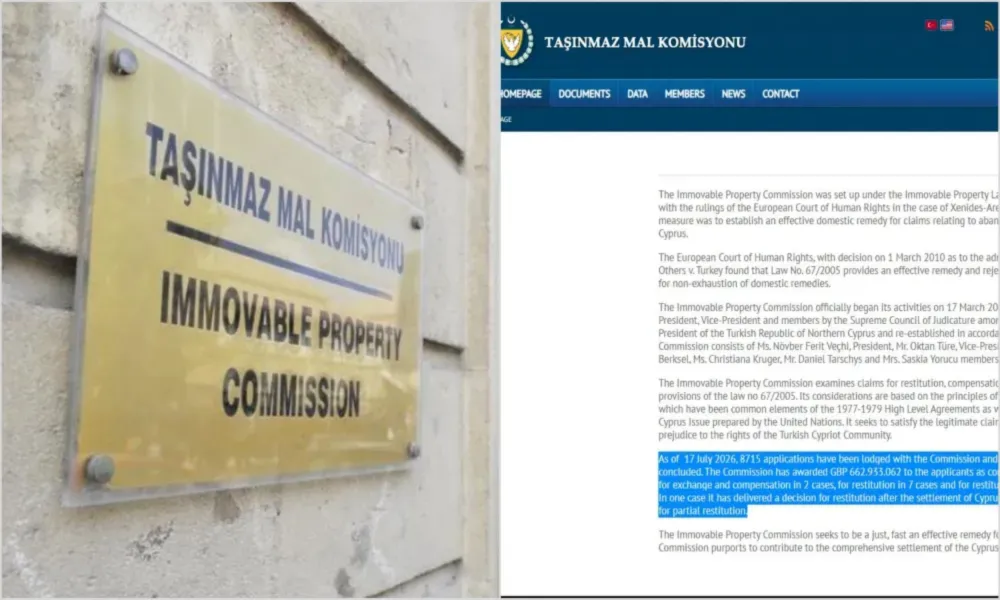
According to figures published by the so-called Immovable Property Commission in the occupied north, compensation awards had reached €776 million by 17 July 2026.
Compensation awarded to date by the commission amounts to £662,933,062 sterling, equivalent to approximately €775.9 million at current exchange rates.
The commission's website states that a total of 8,715 applications had been submitted by that date, of which 3,288 had been examined.
In addition, the commission has issued decisions involving:
- Exchange and compensation in two cases.
- Return of property in seven cases.
- Return of property and compensation in eight cases.
- Restoration following a Cyprus settlement in one case.
- Partial restoration in one case.
The commission was established in 2005 in the north following a ruling by the European Court of Human Rights, which recognised it as an "effective domestic remedy" for Greek Cypriot owners of property in the occupied territories.
The most recent publicly known case concerned the payment of €9 million to the heirs of refugee Christos Saveriades for the sale of property in Famagusta through a friendly settlement handled by lawyer Achilleas Demetriades.
Authorities know who applied
Competent authorities of the Republic of Cyprus are aware of which Greek Cypriot refugees have applied to the commission and sold their property in the occupied areas.
As Politis was informed, applicants can be identified because payments are made through bank accounts.
According to guidance published by a law firm operating in the north that assists with applications to the commission, compensation is paid into a bank account selected by the applicant.
As a result, the supervisory authority, namely the Central Bank of Cyprus, is also informed, unless the money is deposited into a bank account abroad.
The issue was also raised during a meeting of the House Refugees Committee last March.
The president of the Union of Displaced Communities of Famagusta, Michalis Tziortas, revealed that President Nikos Christodoulides had informed representatives of occupied communities that the authorities know who has applied to the commission.
To tax or not to tax?
Although there have been isolated cases of taxation in the past, the Tax Department has stopped taxing compensation payments received by refugees from the commission.
According to information obtained by Politis, guidance will be sought from the Legal Service, although the issue is viewed as primarily political rather than legal.
Under existing legislation, income arising from the sale of immovable property would normally be taxable.
On the other hand, the people concerned are refugees who have been deprived of their property for 52 years.
The question being raised is whether it is fair to tax individuals today for the disposal of property that remained inaccessible to them for decades.
Concerns over Equal Distribution of Burdens loans
Greek Cypriots who sell property through the commission do not notify the Republic's Department of Lands and Surveys.
As a result, official records continue to show them as the legal owners of the properties concerned.
This creates what is described as a serious loophole, as title deeds can still be used to secure low-interest loans from the Central Agency for Equal Distribution of Burdens, even though the properties may already have been sold.
The state subsidises the interest on such loans.
For refugee applicants, approved loans can reach up to 80% of the value of occupied or inaccessible property, or up to €130,000 for a first-home housing loan.
Owners of occupied property who are not refugees may also qualify.
Repayment of subsidies
Regulations governing the Equal Distribution of Burdens Agency stipulate that anyone who disposes of occupied property after benefiting from the interest subsidy scheme must repay the subsidies received.
The regulations state that a person who sells occupied or inaccessible immovable property used to secure an interest subsidy, either before or during the subsidy period, is obliged to immediately repay the agency the amount of subsidy received from the date on which the property was disposed of.
The obligation is included in the agreement signed between the beneficiary and the agency.
Such individuals may also face criminal consequences if it is established that they obtained the loan through false representations.
Properties under mortgage not compensated
It is also noteworthy that the commission does not award compensation for property in the occupied areas that is mortgaged to the Equal Distribution of Burdens Agency.
For that reason, the agency is currently considering requests from refugees seeking the release of specific plots of land so they may subsequently apply to the commission.
Collection from crossing points
A number of law firms operating in the north, in cooperation with firms in the government-controlled areas, assist applicants with submissions to the commission.
According to information published on their websites, Greek Cypriots who cannot travel to their offices, either because they have never crossed into the north or do not drive, can be collected from crossing points and transported to meetings.
Politis identified one law firm in the occupied areas whose website includes a Greek Cypriot mobile phone number for people seeking information about the application process before the so-called Immovable Property Commission.