
There are places in Cyprus I miss even though I have never lived there. I think people my age will understand what I mean. We grew up with villages that belonged to us grammatically before they ever belonged to us geographically: our village, our house, our land. The possessive came first. Understanding came later.
Some of us grew up knowing the layout of houses we had never entered, because they had been described to us so many times that we could almost walk through them. We knew where our grandparents slept and where the kitchen was, which tree stood outside and which neighbour lived next door. We knew which road led to the sea, where someone used to buy bread, which field belonged to whom. We knew these places through repetition, the way children know the settings of bedtime stories. Except these weren't stories. And nobody ever said "the end."
By the time we arrived, everyone else already seemed to know the plot. There had been a beginning, but we had missed it, and nobody was particularly interested in starting from page one. It was history to us before we understood that it had once been somebody's present.
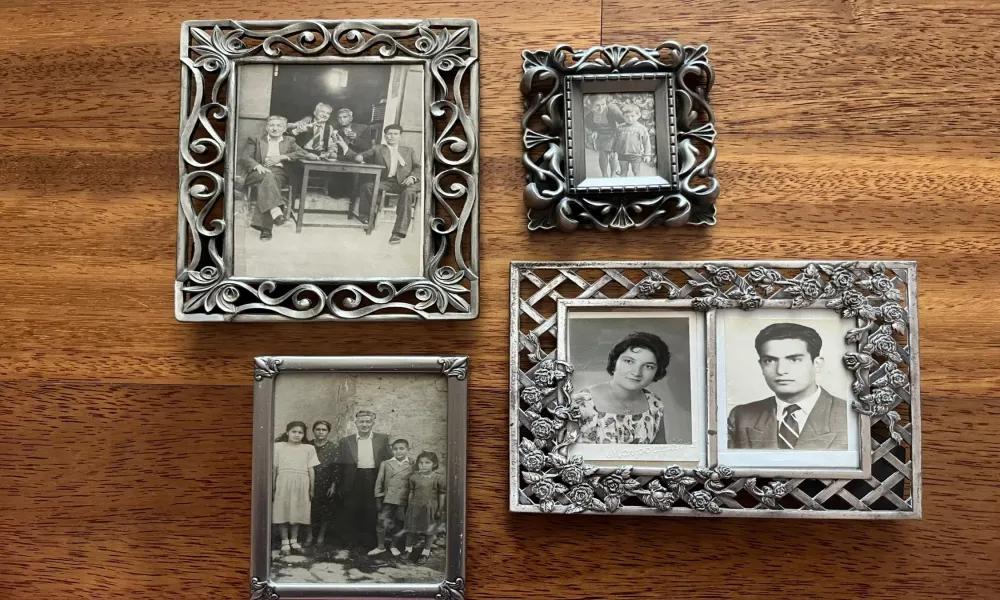
We learned dates and maps. We learned words like displacement, invasion and missing. But at home, history had other names: a grandmother's village, a grandfather's house, the photograph in the drawer, the key nobody quite knew what to do with but nobody was ever going to throw away.
Every generation inherits things. Property, jewellery, recipes, questionable genetics. Ours also inherited unfinished sentences. "When there is a solution..." "When we go back..." "You should have seen it before..."
In that way, we inherited memories we do not actually remember, which may be one of the strangest parts of being our age in Cyprus. You can hear a story so many times that eventually you stop remembering when you first heard it. It simply becomes something you know, lodged somewhere between family history and your own memory, even though you were never there to witness it.
And yet, many of us eventually did visit some of these places. When I did, I realised I was seeing two villages at once. There was the village standing in front of me, and there was the village my grandparents were describing. One existing in geography and the other in memory.
There are days when the Cyprus problem feels enormous, when history, family, politics, identity, injustice and memory seem compressed into one small island. Then there are days when we don't think about it at all because there is work to finish and rent to pay, relationships to maintain, children to raise, parents who are getting older, friends leaving Cyprus and friends coming back.
Life, with almost offensive reliability, gets on with itself. That can be uncomfortable to admit.
Because how do you tell someone who lost a home that you sometimes go weeks without thinking about the reason they lost it? How do you explain that distance without making it sound like indifference, particularly when you know that the story sitting quietly at the edges of your life shaped the entirety of theirs?
Maybe this is simply what time does. It does not necessarily make history matter less, but it changes the people who are asked to carry it.
Somewhere around 30, something else begins to happen, and I am not sure anyone prepares us for it. We start reaching the ages they were when it happened and the maths suddenly becomes uncomfortable.
The grandmother whose stories always seemed to belong to another historical era was once a girl. The grandfather who tells you about leaving was once young enough to believe he would be back soon. They were children and teenagers, newlyweds and new parents. They were 20, 25, 30. They were us. And suddenly history becomes the age you are now.
You look again at an old photograph and stop seeing the elderly person you know today. Instead, you notice how young they were. You notice their clothes, their hair, the way they are standing beside friends or family, and perhaps for the first time you understand that they were not walking around feeling like historical figures. They were ordinary people having an ordinary day. They had plans for the following week. They presumably worried about stupid things. They had errands to run, people to see, conversations they intended to continue. They did not know that the life they were living would eventually be divided into before and after, or that ordinary details they barely noticed would become the details they spent the rest of their lives remembering. They did not know they were standing in photographs their grandchildren would one day analyse for clues. They did not know that home was about to become a word that meant somewhere else.
History is easier to understand when the people inside it remain historical figures. It becomes much harder when you realise they could have been you.
At 20, history feels as though it must eventually move, because surely that is what history does. At 30, you begin to appreciate that history is perfectly capable of sitting on the sofa for another decade. So perhaps our hope has become quieter. More cautious. Less easily impressed by adjectives. That does not necessarily mean it is gone.
There is another realisation that arrives with getting older, and unlike the political stalemate, this one cannot be postponed indefinitely.
The people who remember are getting older too. For now, there is still a living bridge between the Cyprus we inherited through stories and the Cyprus that existed in somebody's actual memory. There are still people who can correct us when we get the details wrong, who can identify the person standing at the edge of the photograph, who remember what was opposite the house even though the photograph doesn't show it. For now, if we forget something, we can still ask what colour the front door was or where exactly the house stood. We can ask who lived next door, what they could see from the window, where they played, what they took with them and what they left behind. And we can still say, “tell me again," and they can.
Perhaps sometimes we have rolled our eyes because we have heard the story before. Perhaps we know how it ends before they begin, or can predict the sentence that is coming next. Familiarity has a way of making us believe there will always be another opportunity to listen. But growing older changes that assumption too.
One of the cruellest things about time, may be realising that there can come a day when you would give anything to hear a story you once thought you had heard enough times.
The Cyprus problem sounds different from the way it did when we were children, not because we have finally understood it, but because we are beginning to understand how much of it we never can.
It still sounds like “the other side,” although now we occasionally stop to wonder why we call it that. It sounds like another announcement about talks, another cautious flicker of hope, another reminder that we know exactly what confidence-building measures are while occasionally lacking confidence that they will build anything.
But increasingly, it sounds like other things too. It sounds like caring and exhaustion existing at the same time, and then feeling guilty about the exhaustion. It sounds like hearing a grandmother say “our village” and finally being old enough to understand everything she has placed inside the word "our." It sounds like someone beginning a story you have heard a hundred times and, instead of saying "I know," allowing them to tell it for the hundred and first.
Because perhaps this is another thing about being 30 in Cyprus. We are old enough now to look at the people in those photographs and realise that they were once our age, but not old enough to know what it will feel like when they are no longer here to explain the things we still don't understand.
We know now that our village may be a village we never lived in and our house may be a house we know only through photographs and other people's memories. We are beginning to understand that it is possible to inherit somebody's longing without ever acquiring the memory that belongs to it.
For now, though, the people who remember are still here.
So ask.
Tell me where the house was.
Tell me about the neighbours.
Tell me what you could see from the window.
Tell me what you thought you would do the following week.
Tell me again.
Because one day, when we say "tell me again," there will be no one left to tell us.
And then the memories we inherited will be ours to remember.