
By T. A. Maniatea
In the first decade of the 20th century, a 20-year-old man makes his way up the Acropolis once again. Every day, for three weeks, he follows the same route, as if carrying out a ritual of unidentified devotion.
He reaches the summit of the rock, slowly circles the Parthenon, pauses, sketches details and records reflections in a small notebook.
“...I remain incapable of understanding the greatness of this thing... A wild and desperate struggle...”
He then lies face down on the ground and, from there, raises his eyes, gradually tracing the ancient columns with his gaze. In awe. As if afraid they might disappear before him.
Then he settles at the eastern entrance to the temple and observes it for hours.
Decades later, in an interview, he would explain:
“The ancient Greeks did something wonderfully paradoxical. They carved marble as if it were sugar, creating a fantastic construction whose triglyphs and all its details were executed with such mastery that the only thing you can do before it is take off your hat. Theoretically, the Parthenon is not functional, but its presence shows how restrictive the very concept of functionality can be. The temple is simple, pure architecture, and it is functional because it moves us. The Parthenon is certainly one of humanity's greatest achievements and if you ask me how one should ascend the Acropolis to see it, on foot or by car, I would answer: on one's knees!”
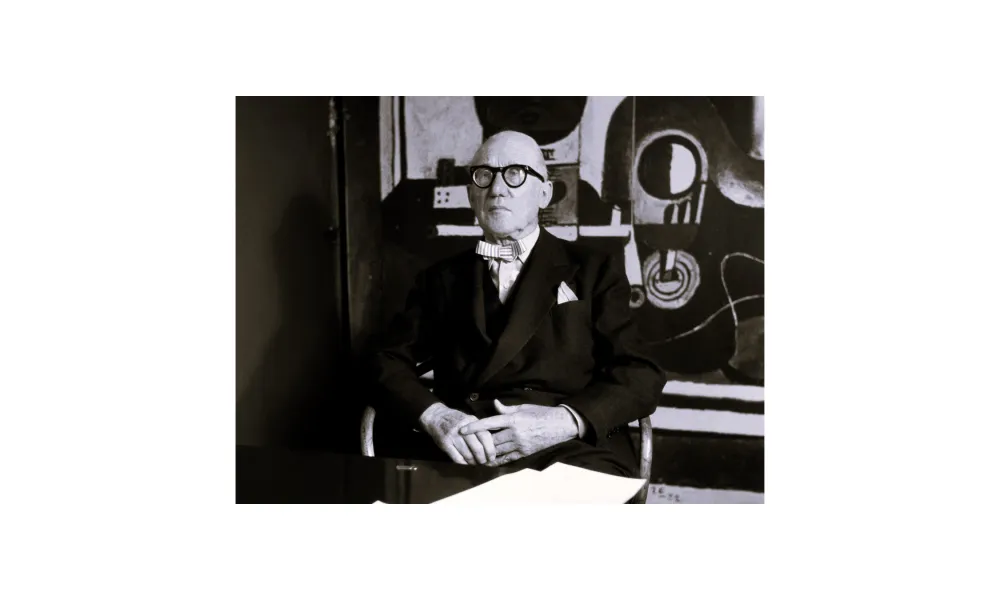
For the great lover of the Acropolis and its monuments, the founder of modern architecture, urban planner and theorist Charles-Édouard Jeanneret-Gris, better known as Le Corbusier, who was born 139 years ago today, the monuments on the sacred rock were not simply fragments of the past.
They were an open road to the future.
As for the Parthenon, he said he would sign in blood that it was the ultimate architectural model. He devoted page after page to it in his books, explaining how light and the natural landscape reveal the temple's sculptural quality through an unparalleled combination of timeless truth and inspiration.
“For 21 days I worked incessantly on the Acropolis, nourished by the marvellous spectacle. I wonder what I managed to do during those 21 days. What I know is that I gained an idea of indisputable truth. I left crushed by a truth that is not cheerful, not light, but solid, unique and relentless. I had not yet matured and, in the life that lay before me, I still had to become a person of character. I tried to act and create work that was harmonious and humane. Whatever I accomplished, I did with this Acropolis deep within me...”
He made those remarks in 1933 during a lecture at the National Technical University of Athens, by which time he was internationally recognised at the age of 46.
A compass for Greek architects
From the first half of the 20th century, Le Corbusier became a guiding force for Greek architects.
Throughout his writings and manifestos, he constantly referred to ideas, values and places connected to Greek civilisation.
He approached classical truth with respect, distilled it and reconstructed it using modern materials.
He did not reproduce tradition, nor did he copy it.
Instead, he extracted from its roots something fresh and modern.
“The Academy, meaning academicism and rigid devotion to tradition, flatters human laziness. Through my travels, through my Acropolis, I learned to think, to observe and to get to the heart of a problem.”
His influence proved decisive in shaping and defining Modernism in 20th-century Greece.
Even the pseudonym Le Corbusier signified a permanent break with traditional architecture and a symbolic rebirth.
He had become a champion of modernism, an enlightener of future generations.
He embodied the figure envisioned by Jean-Jacques Rousseau in the 18th century: an athlete who enjoys fighting bare-handed while defending the unity of word and deed, moral virtue and social engagement, structure and form, idea and matter.