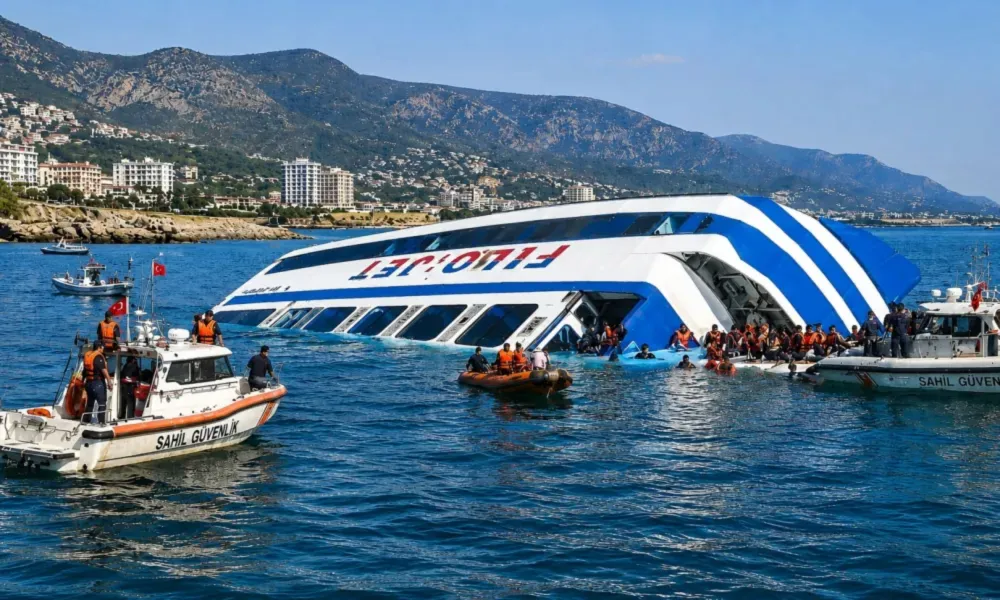

Seventeen days after the Filo Jet sank off Kyrenia, a specialist underwater vehicle has begun penetrating its partly collapsed wreck in the most difficult stage yet of the search for 14 missing passengers.
The privately operated Optimus Prime is using cutting equipment to clear sections of the ferry about 554 metres beneath the surface, after the Turkish naval rescue vessel TCG Alemdar transferred the mission and left the area. Officials said approximately half of the upper deck had collapsed, obstructing access to the lower deck and internal compartments.
The operation could help recover the remaining victims and secure evidence about why the 26-year-old passenger ferry capsized shortly after leaving Kyrenia for Taşucu in Turkiye on Aug. 30.
Fourteen bodies have been recovered and 239 of the 267 passengers and crew survived. No additional recovery had been announced by the morning of Sept. 16.
The ferry’s voyage data recorder, commonly called its black box, has not been recovered. Its absence has left investigators dependent on the wreck, radio communications, maintenance documents, crew statements and mobile-phone videos filmed by passengers.
The investigation is increasingly focused not only on what happened aboard the ferry but on the system that allowed it to sail.
Sucuoğlu pledges to recover missing
Turkish Cypriot ‘public works and transport minister’ Faiz Sucuoğlu, appointed after his predecessor was dismissed, said his first priority was to reach the 14 missing people believed to be inside the ferry and return them to their families.
Sucuoğlu said Optimus Prime had capabilities not available to the vessels previously involved in the operation. Its remotely operated vehicle can work at depths of up to 1,000 metres and carry hydraulic cutting equipment.
He described the sinking as one of the greatest tragedies experienced by the Turkish Cypriot community since 1974 and said he had maintained close contact with the families, visiting them and passing on information about the search.
The appointment places Sucuoğlu in a difficult position. He did not oversee the ‘ministry’ when the Filo Jet was cleared to sail, but he now controls the department whose documents and decisions form part of the investigation.
His ‘ministry’ will be expected to provide records concerning the ferry’s certification, inspections, maintenance and departure clearance. Sucuoğlu’s handling of those records may ultimately prove as important as his supervision of the recovery operation.
Questions over departure clearance
‘Prime minister’ Ünal Üstel said after the accident that the ports department had initially withheld permission for the ferry to leave because of the weather, but that it departed about one hour later.
Other information presented during court proceedings indicated that the vessel possessed the necessary clearance and that the meteorology department considered the conditions suitable for the voyage.
Investigators must reconcile those accounts by determining whether an initial restriction was imposed, who lifted it and what information changed during the delay. They are also examining whether Taşucu port was operating normally when the ferry departed from Kyrenia.
The crew members questioned by police have said waves damaged the vessel’s forward section and caused rapid flooding. Survivors described hearing loud noises, seeing water enter the ferry and struggling to reach life jackets and exits as it developed a severe list.
Some passengers said they were initially told the problem was not serious. Others alleged that doors were closed during the emergency and that people escaped only after breaking windows.
Those accounts have not yet been tested against a completed technical report. Investigators must determine whether the vessel suffered a sudden new failure or whether the conditions exposed a structural weakness that already existed.
Troubled technical history
The Filo Jet, formerly named Iris Jet, had a history of accidents and deficiencies. It reportedly struck a quay and suffered water ingress in 2003. Naval engineer Erdal Kılıç said he found serious structural damage to its forward section when he examined the vessel after another incident in 2016.
Kılıç said the ferry’s sandwich-construction design required specialised repair techniques and supervision by a classification society. He alleged that he declined to carry out the work after disagreeing with the owners and questioned the standard of the repairs subsequently performed.
Those claims have not been adopted as findings by investigators. They have, however, increased pressure for disclosure of the vessel’s complete repair history.
A 2024 ruling by an Istanbul commercial court referred to Türk Loydu survey material from 2018 that recorded 29 deficiencies and non-conformities. The reported findings included engine smoke, a coolant leak and machinery requiring extensive work. The vessel was considered unfit for international passenger service at that stage.
The 2018 findings do not prove that the ferry remained unsafe in 2026. Vessels can be repaired and recertified. Investigators must establish whether each recorded deficiency was corrected and independently verified.
Former ‘transport minister’ Erhan Arıklı said Türk Loydu inspected the ferry at the Akdeniz shipyard roughly two and a half months before it sank. Reports have referred to certificates dated May 27, 2025, and June 2, 2026.
The scope of the latest inspection has not been made public. It remains unclear whether it covered the vessel’s earlier structural repairs, watertight compartments and stability or involved a more limited classification or statutory survey.
Police have requested additional documentation and certificates from Turkiye through judicial-assistance channels.
Nearly 300 statements collected
Nine suspects, including the company director, captain, deputy captain, engineers and other crew members, are being investigated on suspicion of causing death through carelessness and negligence. Their detention was extended for seven days on Sept. 11, while police are seeking five other people.
Investigators told the court that nearly 300 statements had been collected. They have seized telephones, computers and company documents and are examining a video sent by a missing passenger to relatives during the emergency.
Police said the footage appeared to show a broken structural or mounting component aboard the ferry. Experts must determine what the images depict, when the damage occurred and whether it contributed to the sinking.
Questions have also been raised about the captain’s qualifications. Court proceedings heard an allegation that his Turkish licence had become invalid after a lengthy absence from the profession and that he later obtained a Honduran master’s licence for $3,500.
The ports department said the captain held a valid document. Investigators are examining whether the foreign licence was authentic, properly endorsed and recognised for the vessel and route.
No finding of criminal responsibility has been made, and the suspects retain the presumption of innocence. The inquiry will need to determine whether responsibility extends beyond those aboard the ferry to company managers, inspectors, port officials and political authorities.
Foreign families given residency relief
The ruling coalition has introduced a six-month residence-permit exemption for foreign survivors and the relatives of foreign passengers who died or remain missing.
The measure, made public on Sept. 14, is intended to allow them to remain in northern Cyprus while following the legal and administrative proceedings. No residence fee will be charged, and the exemption may be extended for another six months.
The decision provides limited relief to families facing a potentially lengthy recovery, identification and judicial process. It does not address questions of compensation, legal assistance or insurance coverage, which are likely to become more prominent as the investigation continues.
Disaster becomes an election issue
The sinking has already altered Turkish Cypriot politics. Üstel dismissed Arıklı on Sept. 2, saying the step was necessary to remove doubts about the independence of the investigation. Arıklı’s Rebirth Party then withdrew from the coalition.
Early ‘parliamentary’ and local elections will be held together on Dec. 6. The disaster did not create every division within the coalition, but it accelerated its collapse and placed administrative competence at the centre of the election campaign.
A ‘parliamentary’ committee chaired by National Unity Party’s Sunat Atun, with Republican Turkish Party’s Teberrüken Uluçay as vice-chair, has begun examining the ferry’s permissions, inspections and possible administrative failures.
Former ‘prime minister’ Ferdi Sabit Soyer warned that the investigation should not become an electoral weapon. He said the governing party should not use the former junior coalition partner to shield itself, while the opposition should avoid treating the inquiry solely as an opportunity to damage the ruling coalition.
Soyer said the causes should be established objectively and that the presumption of innocence must apply to suspects, civil servants and politicians. Political polemics, he argued, would distract attention from the regulatory and institutional failures that require examination.
He also called for Turkish Cypriot relations with Turkiye to be based more firmly on rules and institutions rather than the emotional language of “motherland and childland.” Isolation and transport difficulties, he said, should not be used to justify exemptions from international maritime standards.
His intervention broadened the debate beyond individual negligence. It raised the question of whether informal accommodations, political influence and regulatory weakness had become accepted substitutes for professional supervision.
Understaffing scrutinised
The ports department reportedly has 74 active employees against an authorised establishment of 219. That gap does not establish the cause of the disaster but raises questions about whether the department had enough qualified surveyors, harbour masters and inspectors to perform its duties.
Investigators and the ‘parliamentary’ committee will need to establish whether the department could independently assess a high-speed passenger catamaran or depended heavily on documents and inspections supplied by external organisations.
The ruling coalition now faces two immediate tasks: recovering the missing and establishing the physical cause of the sinking. Its longer-term challenge will be rebuilding a safety system whose weaknesses have been exposed by the disaster.
That will require the publication of inspection and operating records, independent verification of crew qualifications, extraordinary reviews of passenger vessels serving northern Cyprus and a clear record of who authorises each departure.
The wreck may eventually show where the Filo Jet failed. The more difficult investigation will determine why the wider system did not prevent it from sailing.