
For the first time, the European Commission has publicly addressed the possibility of reopening Makariou Avenue in Nicosia to general traffic, warning that any change to the way the project operates must be assessed against the conditions under which it was approved and funded.
The Commission did not say that reopening Makariou Avenue to general traffic is prohibited, nor that such a decision would automatically require Cyprus to return EU funding. It did, however, make clear that if a subsequent change is inconsistent with the conditions of support and the objectives for which the project was approved, it could potentially constitute an irregularity.
The issue comes a day before discussion resumes at the House Transport Committee, adding a significant financial dimension to a debate that has continued for years.
Nearly €21m in EU funding
The redevelopment of Nicosia’s commercial triangle, including Makariou Avenue and Stasikratous Street, was financed by European cohesion policy funds.
According to figures cited in the report, 85% of the project was financed through European resources, with the EU contribution amounting to €20.995 million out of a total cost of €24.7 million.
In its response, the Commission refers to an overall project cost of approximately €25 million, of which €21 million came from EU funding.
The key issue, therefore, is not simply whether more cars should be allowed to use Makariou Avenue, as some have requested. It is whether such a decision would remain compatible with the project for which almost €21 million in European funding was provided.
Funding was tied to sustainable mobility
The European funding was not provided simply to improve the appearance of central Nicosia.
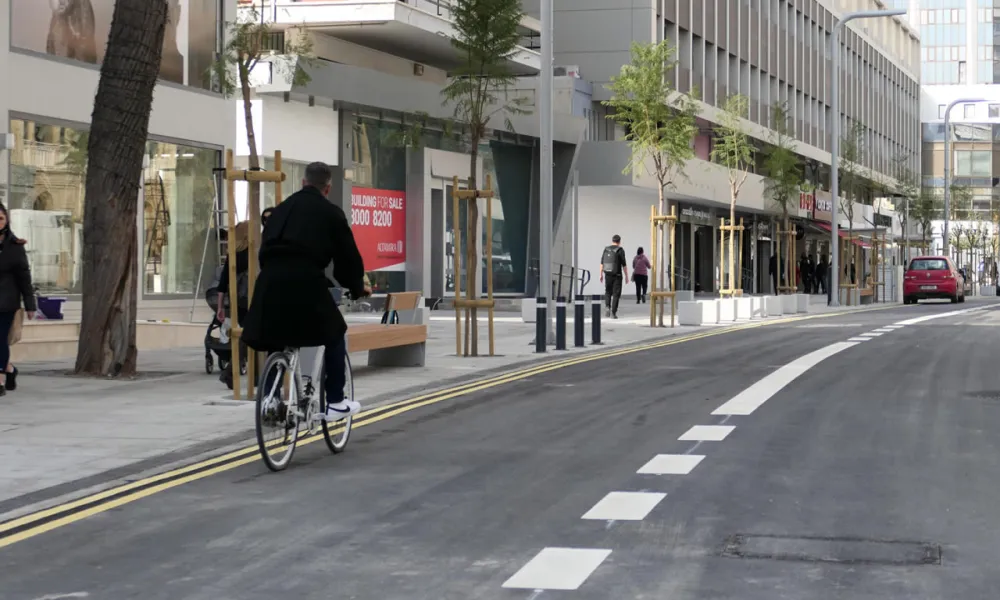
The project formed part of a broader strategy promoting sustainable mobility, reduced private-car use, stronger public transport and improved infrastructure for pedestrians and cyclists.
The redevelopment included changes to roads and pavements, the creation of bus lanes and infrastructure for cyclists and pedestrians, as well as measures intended to improve road safety and accessibility and reduce the dominance of cars in the area.
According to the project's description, the redevelopment reorganised roads and pavements, introduced traffic-calming measures and improved safety standards for all road users.
It also provided for bus lanes and infrastructure for future tram lines, continuous obstacle-free routes meeting accessibility standards for people with disabilities, improved cycling facilities, small squares and rest areas.
The area was redeveloped according to the “shared space” model and principles of sustainable mobility and bioclimatic design.
The intention was to create a friendly, pleasant, attractive, comfortable and shaded urban environment offering opportunities for outdoor social, recreational and commercial activity.
The wider objective was to upgrade the urban environment, give the area the identity of a European capital and create a high-quality commercial district capable of attracting people back to the city centre.
Reopening would require specific assessment
If Makariou Avenue is opened to general traffic, the authorities would therefore have to examine whether the new arrangement continues to serve those objectives or substantially changes the nature of the project.
The Commission said a general answer cannot be provided in advance.
Instead, any decision would require an assessment of the nature and extent of the proposed changes, as well as the specific conditions under which European funding was originally approved.
From an EU funding perspective, the Commission said that if an operation is subsequently modified in a way that is inconsistent with the conditions of support and the programme’s objectives, that could potentially constitute an irregularity.
The particular circumstances would therefore need to be assessed individually.
When could financial consequences arise?
The Commission also referred to EU rules governing the durability of co-financed projects.
Under Article 71(1) of Regulation (EU) No 1303/2013, an operation involving investment in infrastructure or productive investment may be required to repay European Structural and Investment Funds if, within five years of the final payment to the beneficiary, it undergoes a substantial change affecting its nature, objectives or implementation conditions in a way that could undermine its original objectives.
This does not mean the €20.995 million would automatically be lost if Makariou Avenue were reopened.
It does mean, however, that financial consequences are possible if the eventual change is considered substantial and incompatible with the original funding conditions.
Managing authority also has obligations
The Commission further pointed to Article 125(3)(c) of Regulation (EU) No 1303/2013, under which the managing authority must provide the beneficiary with a document setting out the conditions of support for each operation.
These conditions include specific requirements concerning the products or services to be delivered, the financing plan and the implementation deadline.
Under Article 125(4)(a), the managing authority must also verify that the co-financed products and services have been delivered and that the operation complies with applicable law, the operational programme and the conditions under which support was granted.
Commission refers to 2024 guidelines
The Commission also cited its 2024 guidelines on the closure of operational programmes, specifically the provisions dealing with non-functioning operations.
The guidelines state that when closure documents are submitted, member states must ensure that all operations are functional, meaning they have been physically completed or fully implemented and have contributed to achieving the objectives of the relevant priorities.
For the Nicosia project, the relevant priority is the promotion of sustainable transport and reduction of CO₂ emissions.
The guidelines further clarify that an operation which met the requirements of Article 71 but is no longer functional when the programme closes should not be considered a non-functioning operation.
Commission: EU contribution must be assessed against these conditions
The Commission's position is that any implications for the EU contribution must therefore be assessed against the project's specific circumstances.
That includes the conditions under which the project was approved, its contribution to the objectives of the relevant priority at programme closure and, where applicable, the durability requirements contained in Article 71.
In other words, reopening the road does not automatically trigger repayment, but neither can the financial implications be dismissed without an assessment.
Debate returns to Parliament
The debate over Makariou Avenue has intensified in recent months, amid concerns about commercial activity in central Nicosia and calls from some shopkeepers for general traffic to be restored as a way of improving access.
The Commission's position now adds another factor that must be considered before a final decision is taken.
The Republic of Cyprus and the competent authorities must consider not only whether opening the historic avenue to general traffic would be desirable or workable from a traffic-management and commercial perspective, but also whether it is compatible with the commitments made when European funding was secured.
Technical experts have also warned that reopening the avenue could have broader consequences and represent a step backwards from the sustainable mobility objectives underpinning the redevelopment.
The possibility of repaying EU funds is therefore not an automatic consequence, but it is now formally part of the discussion if a change to Makariou Avenue is ultimately judged to undermine the project's original objectives.