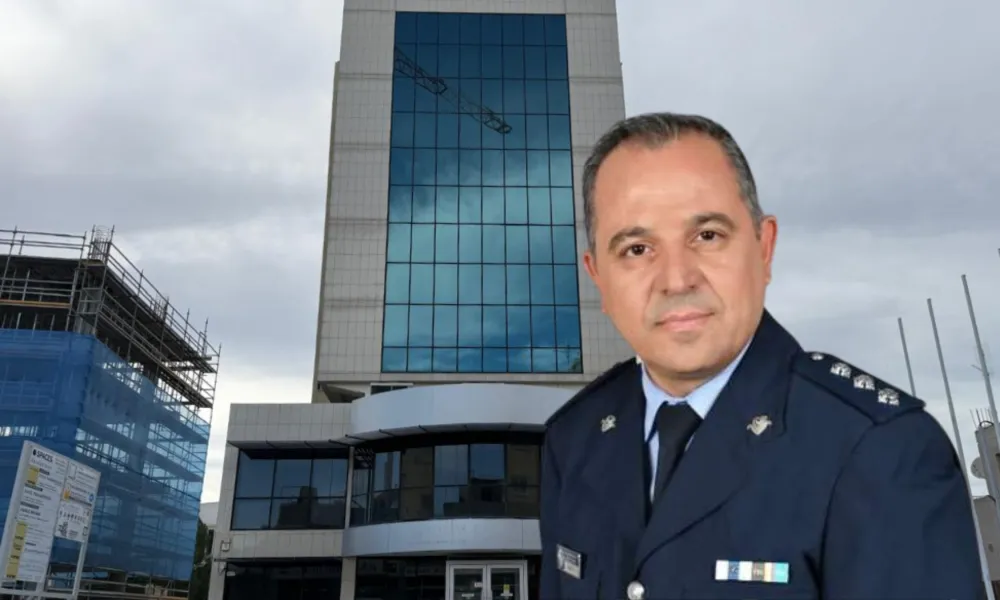

The structure and priorities of Cyprus’ new Directorate for Combating Organised Crime (DAOE) are taking shape, with Assistant Superintendent Christos Andreou saying it will comprise four subdivisions and bring existing services together under a unified structure.
Speaking on Politis radio’s Proini Epitheorisi programme with Katerina Eliadi, Andreou said the four subdivisions will cover Intelligence and Special Operations, Drug Law Enforcement, Organised Crime Investigations, and Strategic Analysis, International and European Relations.
The only entirely new service, he said, will be the team of investigators dedicated to organised crime cases.
Unified structure and financial investigations
Andreou explained that existing services will be reinforced and brought together under one structure, allowing them to operate horizontally across different areas.
The Intelligence and Special Operations division will collect, evaluate and analyse intelligence and map individuals, groups and networks involved in criminal activity.
Investigators, meanwhile, will handle serious organised crime cases across the Republic of Cyprus.
Andreou placed particular emphasis on financial investigations, arguing that the financial power accumulated by criminal networks allows them to fund new activities, establish infrastructure and reorganise after law enforcement operations.
Financial investigations can be launched when drugs are seized and there is evidence of financial benefit, or when a person’s assets cannot be justified by their declared income.
According to Andreou, the Drug Law Enforcement Unit (YKAN) has confiscated assets worth more than €1.5 million to €2 million over the past four to five years, with court freezing orders also being pursued.
The assets involved can include cash, bank deposits, property, vehicles and cryptocurrencies.
Cooperation in Cyprus and abroad
Andreou said the directorate works with the Tax Department, Customs and the Land Registry, requesting information from these authorities as part of financial investigations.
International cooperation also involves Europol, Interpol, other European countries and non-EU states.
As an example, he cited a recent murder conspiracy case in which Cyprus cooperated with police in Denmark, Sweden and Norway.
Drugs and criminal networks
Andreou described drugs as one of the biggest problems associated with organised criminal groups because of the substantial profits involved.
Some criminal organisations consist solely of Cypriots, he said, while others have associates overseas. Drugs entering Cyprus originate from abroad.
Referring to the major ketamine case, Andreou said investigators are examining whether the quantity involved was actually intended for the Cypriot market.
Based on wastewater data, he said, ketamine use does not appear to exist in Cyprus on a scale that would correspond with the quantity concerned.
Investigators are therefore examining indications that Cyprus may have been used as a transit point.
Four cases solved
Asked about the possible infiltration of criminal organisations into legitimate businesses or state institutions, Andreou said police have received information that will be investigated, but declined to provide further details.
Since DAOE began operating, four cases have already been solved, while others remain under investigation.
Asked about corruption within the police, Andreou said one of the four cases concerns a fellow police officer, adding that investigations are conducted on the basis of evidence and available information.
Directorate still being developed
Andreou said there is no final figure yet for the number of personnel who will staff DAOE because the directorate is still being established.
For the time being, its various services remain in their existing premises, while work is under way to create a single headquarters in Nicosia.
DAOE has already been operating on a pilot basis for several months, allowing its procedures and systems to be developed and refined.
Andreou also said there is close cooperation with the corresponding service in Greece.
Experience from the Greek model has, among other things, highlighted the importance of locating all parts of the Cypriot directorate under one roof, allowing it to operate autonomously while reducing the risk of information leaks.