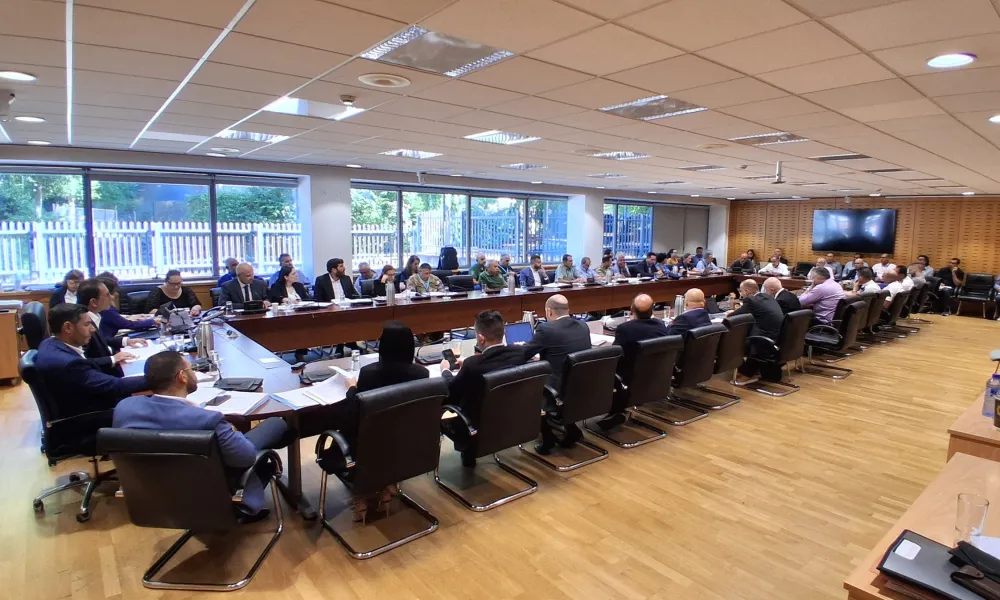
The road towards establishing a National Civil Protection Mechanism appears set to be difficult, after a series of objections and concerns emerged during the first discussion of the relevant bills before the House Interior Committee.
The proposed reform would create a new Directorate-General for Civil Protection within the Interior Ministry and formally establish a National Civil Protection Coordinator responsible for managing civil protection emergencies, including natural and man-made disasters.
A fundamental disagreement emerged, however, between the Defence Ministry and the philosophy underpinning the proposed system.
House Interior Committee chairman and AKEL MP Aristos Damianou called on the Interior Ministry to clarify from the outset how the disagreement will be resolved.
Broadly, the Defence Ministry is calling for one body to manage all types of crises, including both civil protection emergencies and wartime situations, which currently fall under the Defence Ministry and the National Guard General Staff. It wants that structure to operate under the Council of Ministers.
‘We have a different approach’
Brigadier Iakovos Mikellides, director of the Central Emergency Planning Service, set out the Defence Ministry's position during the committee meeting.
“As the Defence Ministry, we have a different approach,” he said.
“We are, of course, in favour of creating a central national civil protection mechanism, or more broadly a crisis management mechanism, but we believe it should come under the Council of Ministers, with the creation of a National Crisis Management Centre that would manage all crises, not only those referred to in the bill but also nuclear emergencies, cybersecurity incidents and situations of war.”
Mikellides said the Defence Ministry's position had become even clearer since it first raised its disagreement with the Interior Ministry in March.
Following encouragement from President Nikos Christodoulides, he said contacts had been held with other countries, including European states, Israel and the United States.
According to Mikellides, those contacts showed that Cyprus should move towards a unified crisis management system covering every type of emergency.
He described Cyprus' existing model as a “hybrid system” because the Republic has two or more separate systems or bodies responsible for crisis management.
Ministers to raise disagreement with President
Damianou pointed out that the issue amounted to a fundamental disagreement between the two ministries, rather than a dispute over an individual provision.
Interior Ministry Director-General Elikkos Elias referred to Article 4 of the proposed legislation, saying that, subject to Article 183 of the Constitution and the provisions of the Civil Emergency Planning Law, the Interior Ministry's intention is to establish a civil protection system without interfering in matters falling under the Central Emergency Planning Service.
“The two ministers will clarify this with the President of the Republic and we will return,” Elias said, adding that the aim was to achieve convergence before parliament begins examining the bill article by article.
Damianou described the disagreement as so fundamental that, under different circumstances, he would have suspended the committee meeting.
He said the Defence Ministry was proposing a holistic approach covering both the civil protection crises addressed in the bill and other emergencies falling under the Defence Ministry and National Guard, while the proposed legislation focuses on natural and man-made disasters.
Elias said the Interior Ministry had taken some of the Defence Ministry's requests into account during negotiations and had amended parts of the legislation as a result.
He argued that this had narrowed the differences between the two sides.
The ministries are expected to meet again before the article-by-article parliamentary discussion in an attempt to resolve any outstanding differences.
Forestry Department transfer not ruled out in future
A second point of contention concerns the possible transfer of the Forestry Department's forest firefighting responsibilities to the Interior Ministry.
The proposal triggered strong opposition from the Forestry Department and other organisations when it was first announced by the Presidential Palace around a year ago.
Elias said that, at this stage, the Interior Ministry does not intend to proceed with such a transfer.
He pointed to what he described as effective cooperation this year between the Forestry Department, Fire Service and National Fire Coordinator.
The initial proposal is therefore to transfer the Fire Service to the Interior Ministry, as firefighting lies at the core of its responsibilities.
According to Elias, this year's cooperation demonstrated that the Forestry Department could respond effectively to large-scale incidents through the proposed national mechanism and under the direction of the National Fire Coordinator.
As a result, neither the entire Forestry Department nor part of it will initially be placed under the new Directorate-General for Civil Protection.
Elias said the government had also taken into account the objections raised by the Forestry Department.
However, he did not rule out a future transfer.
The government will later reassess whether some responsibilities currently held by the Forestry Department, together with forest firefighting personnel, should be transferred to the Interior Ministry.
‘Others decided for us’
A representative of the Pancyprian Committee of Forest Firefighters responded by saying that “in a few words, others decided for us”, referring to the Interior Ministry's position on Forestry Department firefighting operations.
“We are waiting to see how things will proceed,” the representative added.
Despite those concerns, the committee said it supports the legislation because such a reform is necessary.
Opposition to any future transfer of part of the Forestry Department to the Interior Ministry was also expressed by farming organisations, specifically EKA.
Implementation expected in 2027
Turning to when the National Civil Protection Mechanism could begin operating, Elias referred to technical difficulties in incorporating certain prerequisites into the 2027 state budget.
If these cannot be included in time, he said funding for implementation of the mechanism would be incorporated into the supplementary budget in June 2027.
According to a statement by the Interior Minister read by Elias at the beginning of the committee meeting, the transition to the new system will not take place automatically once the legislation is approved.
Instead, the date on which the new framework takes effect will be determined by a decision of the Council of Ministers.
The government says this will provide the necessary time to prepare and staff the new structures and ensure an orderly transition to the new civil protection system.