
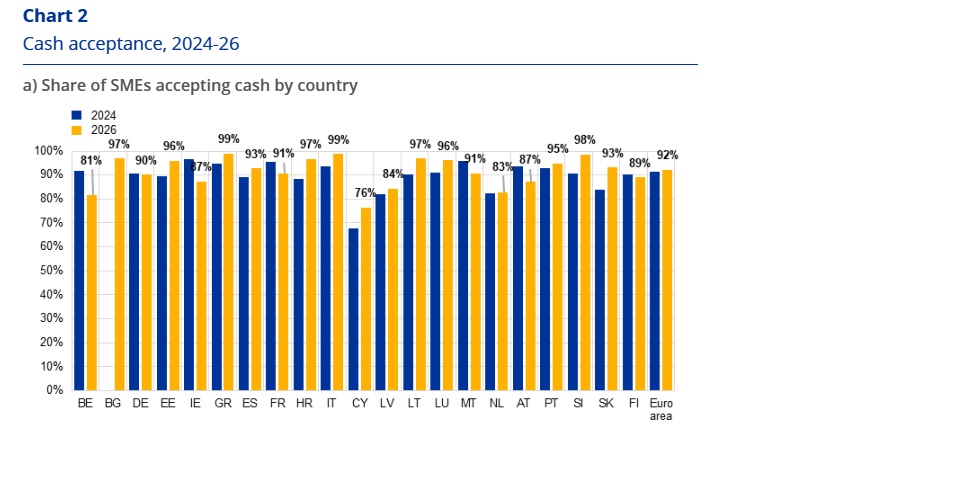
Cyprus has the lowest rate of cash acceptance among eurozone countries, according to a European Central Bank survey on cash usage by businesses across the single-currency area.
According to the survey results published on 13 August, cash continues to be widely accepted by companies throughout the eurozone.
In 2026, 92% of businesses selling goods and services at physical locations reported that they accept cash, compared with 90% in 2024.
"This suggests that the decline in cash acceptance observed during and after the COVID-19 pandemic has come to a halt," the survey notes.
Physical card payments are accepted by 88% of businesses, up from 87% in 2024.
In recent years, there has also been a significant increase in the number of businesses accepting mobile payments. The share rose from 36% in 2024 to 68% in 2026.
Cash is most commonly accepted in:
- Retail trade
- Restaurants
- Hotels
Acceptance in all three sectors stands at 93%.
Businesses in the arts, entertainment and recreation sector accept cash less frequently, though still at a relatively high rate of 84%.
Greece and Italy lead
Among eurozone countries, cash acceptance is highest in Greece and Italy, both at 99%, and lowest in Belgium (81%) and Cyprus (76%).
Although Cyprus records the lowest rate in the eurozone, this still represents an increase of nine percentage points compared with the previous equivalent survey conducted in 2021.
Of all companies that currently accept cash, 92% said they plan to continue doing so over the next five years.
Among businesses that do not accept cash, the most frequently cited reasons were:
- Customers do not use cash sufficiently (36%, compared with 39% in 2024).
- Depositing or withdrawing cash is inconvenient or difficult (35%, compared with 22% in 2024).
Among payment methods used by customers at physical points of sale:
- One-third of companies in the euro area have no preference.
- 24% prefer debit card payments.
- 21% prefer cash payments.
- 14% prefer credit card payments.
When comparing cash with digital payments, there is no category covered by the survey in which businesses regard digital payments as unequivocally superior to cash.
Companies view cash as significantly better than digital payments in terms of:
- Privacy
- Reliability
A large proportion of businesses also consider cash superior regarding:
- Overall cost
- Transaction speed
- Ease of handling
- Security
When deciding which payment methods to accept, the most important factors cited by businesses are:
- Consumer preference (26%)
- Security (22%)
- Ease of handling (15%)
The risk of errors when giving change (32%) and security concerns (29%) were the most commonly cited worries regarding cash payments.
Encouraging digital payments
Across the euro area, 25% of businesses report having introduced measures to encourage the use of digital payments, including:
- Installing cashless checkout systems.
- Reducing the number of cash-accepting tills.
- Promotional activities encouraging cashless transactions.
Some 13% of businesses in the eurozone have introduced self-service terminals.
Among those companies, 52% said at least some of those terminals still accept cash.
Across the euro area:
- 38% of companies use point-of-sale cash recycling machines.
- 37% have smart safes.
Bank counters remain the primary method used by businesses to withdraw cash.
They are used by 60% of companies that make cash withdrawals.
They have also become the main method for depositing cash, being used by 58% of businesses making deposits, overtaking ATM deposits (55%), which had been the most common method in both 2021 and 2024.
Future of cash acceptance
Businesses that currently accept cash at physical locations were asked:
"Do you believe you will continue to accept cash over the next five years?"
More than nine in ten (92%) businesses currently accepting cash said they expect to continue doing so.
Meanwhile:
- 6% said they do not expect to continue accepting cash.
- 2% were unsure.
In most countries, an overwhelming majority of SMEs say they will continue accepting cash in the future.
However, in Cyprus (51%), Greece (23%) and Bulgaria (18%), a significant share of SMEs said they may not accept cash in the future.