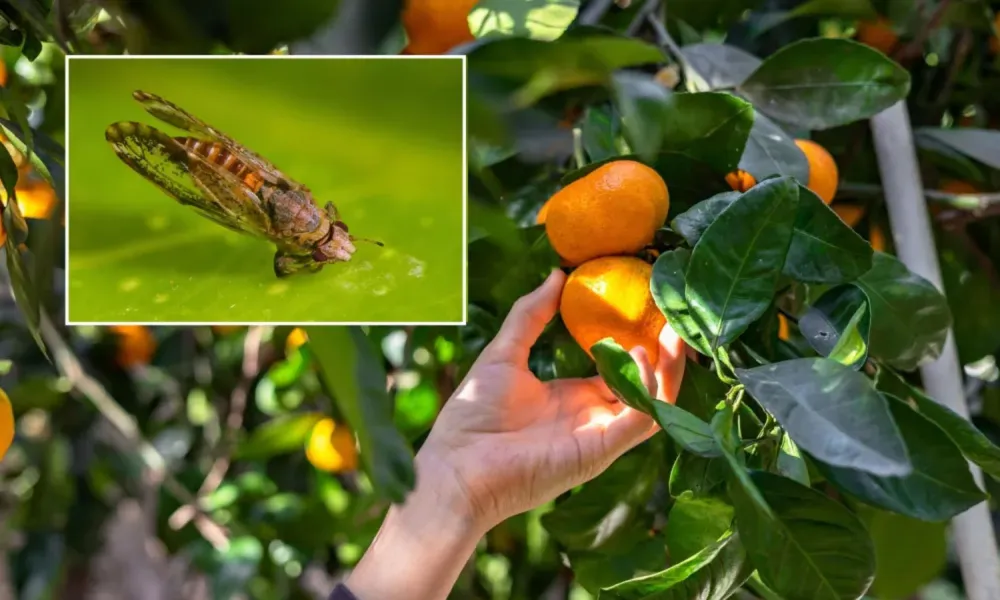

Joint efforts by Greek Cypriot and Turkish Cypriot scientists have significantly reduced populations of the Asian citrus psyllid (Diaphorina citri), the insect responsible for spreading huanglongbing (HLB), also known as citrus greening disease.
The breakthrough was welcomed by the Bicommunal Technical Committee on the Environment, which said coordinated action, scientific cooperation and information-sharing over the past year had delivered tangible results across the island.
The Asian citrus psyllid has spread throughout Cyprus since 2023 and is the primary carrier of the HLB bacterium, widely regarded as the most destructive citrus disease globally. The pest has not been detected in any other EU member state to date, making Cyprus a focal point of concern for European authorities.
HLB blocks the flow of nutrients within citrus trees, causing leaves to develop yellow mottling and fruit to become bitter and misshapen before the tree eventually dies. The disease has devastated citrus industries worldwide, including in Florida and Brazil.
Beneficial insects key to success
Following the detection of the pest in Cyprus in August 2023, the Department of Agriculture launched an eradication programme. However, the wide distribution of citrus trees in orchards, gardens and rural areas made complete eradication difficult.
In 2024, authorities introduced a biological control programme using Tamarixia radiata, a beneficial parasitic wasp imported from California that feeds on the Asian citrus psyllid.
Through the Bicommunal Technical Committee, scientists from both sides coordinated releases of the beneficial insect and shared monitoring data.
According to the Department of Agriculture, surveys conducted in October and November 2025 by specialists from the Department of Agriculture, the Agricultural Research Institute, Cyprus University of Technology and Spain's Valencian Institute for Agricultural Research found a significant decline in pest populations.
While the insect was detected in 100% of surveyed orchards in July 2024, adult psyllids were found in only 38.5% of monitored locations a year later, with population densities remaining very low in most areas.
Population now under control
Committee co-chair Michalis Loizides said the situation is now under control.
"We managed to suppress Diaphorina citri to levels that no longer cause the same degree of concern as before," he said, adding that any future appearance of the HLB bacterium would now be easier to contain.
Researchers also recorded a 96.2% parasitism rate among psyllid nymphs at the site with the highest pest density, evidence that Tamarixia radiata has become firmly established and is exerting strong biological pressure on the pest population.
A second beneficial parasitoid species, Tamarixia citricola, was also identified during the programme. The findings were recently published in the Journal of Applied Entomology.
Despite the positive results, officials cautioned that the threat has not disappeared and that surveillance efforts will continue, particularly in areas where the pest has previously been detected.