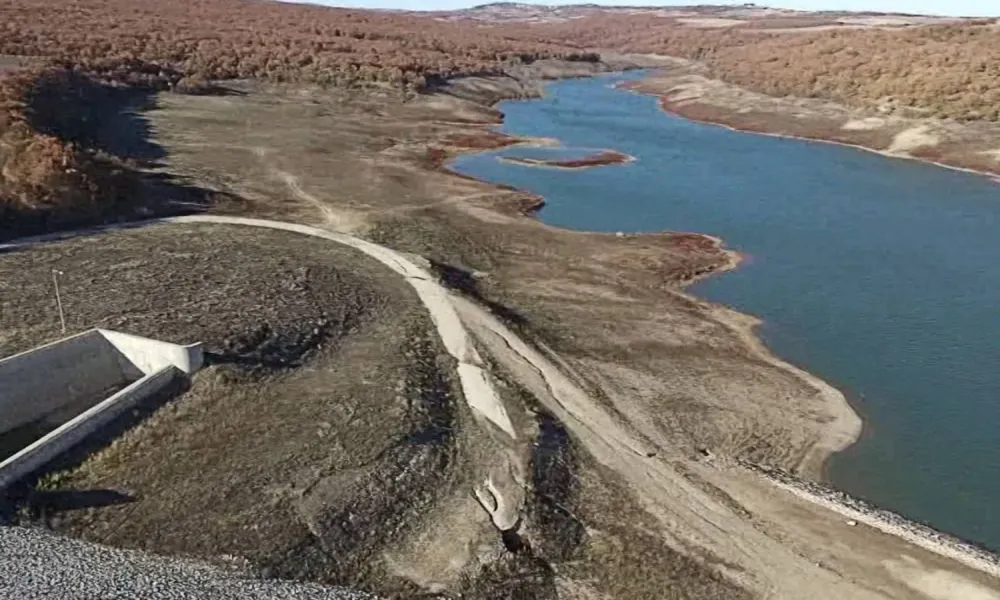

Every day, a wastewater treatment plant on the edge of Nicosia's buffer zone produces around 30,000 cubic metres of recycled water.
Located near the dividing line in the heart of the Mesaoria plain, Cyprus's largest agricultural region, the facility sits in an area where water scarcity is becoming increasingly severe. Decades of over-extraction have left many groundwater sources depleted, while farmers face growing pressure from drought and climate change.
Yet despite its value, most of this water has never reached the fields it was intended to serve.
For years, the overwhelming majority has flowed into the Pedieos River/Kanlıdere, replenishing some underground aquifers along the way before ultimately reaching the sea.
That is now changing.
A new infrastructure project, years in the making and largely unnoticed by the public, is set to transport part of that treated water across Cyprus's divide, from the north, where the plant is located, to the south. On an island increasingly defined by water scarcity, this modest pipeline may prove to be one of the most important pieces of infrastructure built in recent years.
A success story few talk about
Hidden behind one of Cyprus's most enduring political divisions is an unusual example of practical cooperation.
Often referred to informally as "sewage diplomacy", the Mia Milia/Haspolat Wastewater Treatment Plant, officially known as the Nicosia Wastewater Treatment Plant, has quietly connected the island's two communities for almost half a century.
Situated in an industrial area north of the Green Line, the facility is arguably the longest-running example of Greek Cypriot and Turkish Cypriot cooperation since 1974.
Its operation has survived changing political climates, failed reunification efforts and even periods when no crossing points existed between the two sides.
The reason was simple: neither side could easily do without it.
Wastewater follows gravity. Geography does not recognise political boundaries.
Redirecting the entire sewerage network to avoid crossing the divide would have required an enormous investment that neither side was willing to make. As a result, successive local administrations continued operating the system jointly, with wastewater from southern Nicosia flowing north for treatment.
Former Nicosia mayor and current President of the Nicosia District Local Government Organisation (EOA), Constantinos Yiorkadjis, says long-term cooperation creates opportunities that politics alone often cannot.
"When you have good cooperation you can sit down and exchange ideas and brainstorm and never lose hope."
For Mehmet Harmancı, mayor of the Nicosia Turkish Municipality for the past three terms, the explanation is more straightforward.
"Whether we like each other or not, it's a necessity."
Now, a new EU-funded pipeline built alongside a major repair project is about to take that cooperation a step further.
Before Cyprus was divided
The origins of the project stretch back to before the island's partition.
In March 1971, the World Bank approved financing for the Nicosia Sewerage Project. Engineers selected Mia Milia/Haspolat as the location for the city's treatment works, largely because the natural slope of the land directed wastewater towards that area.
At the time, Mia Milia was a Greek Cypriot village with a recorded population of 1,381 residents.
As Harmancı notes:
"The topography was taking all the dirty water to that area."
The original facility, tendered under the umbrella of the United Nations Development Programme (UNDP), consisted of a basic lagoon treatment system capable of processing 10,000 cubic metres a day.
Construction advanced rapidly.
By mid-1974, approximately 86 kilometres of sewerage pipes and 26 kilometres of house connections had already been laid.
Then came the events of July 1974.
The Greek-backed coup and subsequent Turkish military intervention halted the project and permanently altered its geography. The treatment plant ended up in the north, while much of the network and the Sewerage Board of Nicosia remained in the south.
The Demetriades-Akıncı understanding
The division created an unusual dependency.
The south had most of the sewerage network but no treatment plant.
The north controlled the treatment plant but lacked the rest of the system.
Constructing entirely separate facilities for each side was considered prohibitively expensive, particularly at a time when, as Harmancı recalls:
"The economy was suffering."
In September 1978, former mayors Lellos Demetriades and Mustafa Akıncı reached a practical agreement.
The treatment plant at Mia Milia/Haspolat would be completed, the sewerage infrastructure would be finalised and the city would continue operating a single integrated system.
Wastewater from both communities would flow to the same facility.
The plant entered operation in 1980.
What began as a technical arrangement soon became something much more important.
The trust built through cooperation on sewerage helped lay the groundwork for the Nicosia Master Plan, a bicommunal urban planning initiative launched in 1979.
The project would later earn international recognition through the:
- World Habitat Award (1989)
- Europa Nostra Medal of Honour (2003)
- Aga Khan Award for Architecture (2007)
Decades of operation
For more than twenty years, the plant quietly treated wastewater from both sides of the capital.
But Nicosia continued to grow.
By the early 2000s, population growth had pushed a facility designed in the 1970s beyond its intended limits. Environmental concerns, including odour problems, became increasingly difficult to ignore.
In 2003, the two communities agreed to modernise the plant.
The timing was significant.
That April, the first crossing point opened on the Green Line, allowing movement between the two sides for the first time in almost thirty years. Reunification negotiations were also advancing, and there was still hope Cyprus might enter the European Union as a reunited country.
The upgrade introduced treatment processes capable of producing water suitable for agricultural irrigation.
Since then, the facility has consistently produced approximately 30,000 cubic metres of treated water daily, meeting European standards for agricultural reuse.
Building a modern facility
Even after the failure of reunification negotiations in 2004, cooperation on the project continued.
A new agreement was concluded in 2006.
Acting as a neutral contracting authority, UNDP launched an international tender in 2009.
German company WTE Wassertechnik GmbH won the contract to build, operate and maintain the plant for ten years.
Construction began in March 2010.
Trial operations started in 2013 and full operation commenced in April 2014, followed by an official inauguration on 2 July 2014.
The United Nations described the project as:
"A perfect example of bicommunal cooperation."
Today, the facility serves central Nicosia on both sides of the divide.
Its recycled water output is informally shared, with:
- 70% allocated to the south
- 30% remaining in the north
The formula broadly reflects population distribution, funding contributions and wastewater volumes.
The missing link
Despite the plant's modernisation, one crucial element remained absent.
There was still no proper system for delivering the recycled water to agricultural users.
As a result, almost the entire annual output, around 11 million cubic metres, continued flowing into the river.
The main obstacle was not treatment capacity.
It was infrastructure.
A major sewer trunk known as Trunk-1, which passes through the buffer zone and into the south, was deteriorating badly. Ground collapses and repeated failures made replacement unavoidable.
That replacement created an opportunity.
Alongside the new sewer trunk, a second pipeline is now being installed to transport recycled water towards agricultural areas.
According to UNDP, EU funding has been secured for 2,713 metres of pipeline between the treatment plant and the edge of the buffer zone.
Of that:
- 2,003 metres have already been completed
- 710 metres are expected to be finished by the end of November
An additional 400-metre extension and a pumping station will push the water further south at an estimated EU-funded cost of €2.5 million.
The pumping station will also support irrigation on both sides of the divide.
UNDP describes this as only the first phase of a larger plan aimed at reusing most of the plant's treated water.
Future phases would include larger pipelines and additional storage facilities, with full completion potentially achievable by 2029, if financing is secured.
Back on the political agenda
The project returned to the political spotlight in December 2025, when President Nikos Christodoulides, Turkish Cypriot leader Tufan Erhürman and UN envoy María Ángela Holguín agreed to prioritise a range of confidence-building measures, including the water pipeline project.
While progress on many confidence-building initiatives has been slow, work on the recycled-water pipeline has continued.
Neither Yiorkadjis nor Harmancı portrays the project as a political statement.
"The whole purpose was not to send any message to anybody," Yiorkadjis says.
"It was just to get the city to work better."
Yet he also recognises the broader lesson.
"If you have trust which is built on a historical context of actual results, then you can proceed step by step and try to tackle more complicated projects."
A resource both sides need
The recycled water has become increasingly valuable as Cyprus grapples with severe drought.
Reservoir inflows in the south fell to their lowest levels since record-keeping began in 1901, while water reserves dropped to 13.7% of capacity in February 2026.
Rainfall has declined by an estimated 15% since 1901, while demand has risen by roughly 300%, driven by population growth and tourism.
Both sides have responded differently.
The Republic of Cyprus now obtains more than 70% of its drinking water through desalination, while recycling over 85% of its treated wastewater.
In the north, over-pumping has damaged aquifers, increasing salinity levels, while imported water from Turkey now provides a critical lifeline through an 80-kilometre undersea pipeline connected to the Panagra/Geçitköy reservoir.
Against that backdrop, the Mia Milia/Haspolat plant offers something neither desalination nor imported water can provide:
A locally produced, climate-resilient resource generated every day through cooperation.
Necessity, not diplomacy
The Mia Milia/Haspolat project was never conceived as a peace initiative.
It emerged because geography left little alternative.
Nature imposed a problem.
Cooperation became the practical solution.
Yet over time, necessity produced interdependence, and interdependence proved remarkably durable.
The project survived long after the politicians who created it left office.
Local government, rather than national leadership, kept the cooperation alive.
Today, the plant stands not simply as a wastewater facility but as a working example of how shared challenges can sometimes be addressed without waiting for a comprehensive political settlement.
What else could be built?
Cyprus faces common pressures that affect both communities:
- Water scarcity
- Climate change
- Energy dependence
- Limited resources
None of these challenges stop at political boundaries.
The Mia Milia/Haspolat project demonstrates that practical cooperation is possible even in the absence of a political solution.
The larger question may not be whether such cooperation can work.
It may be how many other problems on the island are waiting for someone to decide they cannot afford not to cooperate.
Source: Ciren