
The interim government of Venezuela on Wednesday signed a series of agreements with energy giants Chevron and ENI aimed at expanding oil production, alongside a separate deal with GE Vernova to help rebuild the country's electricity sector.
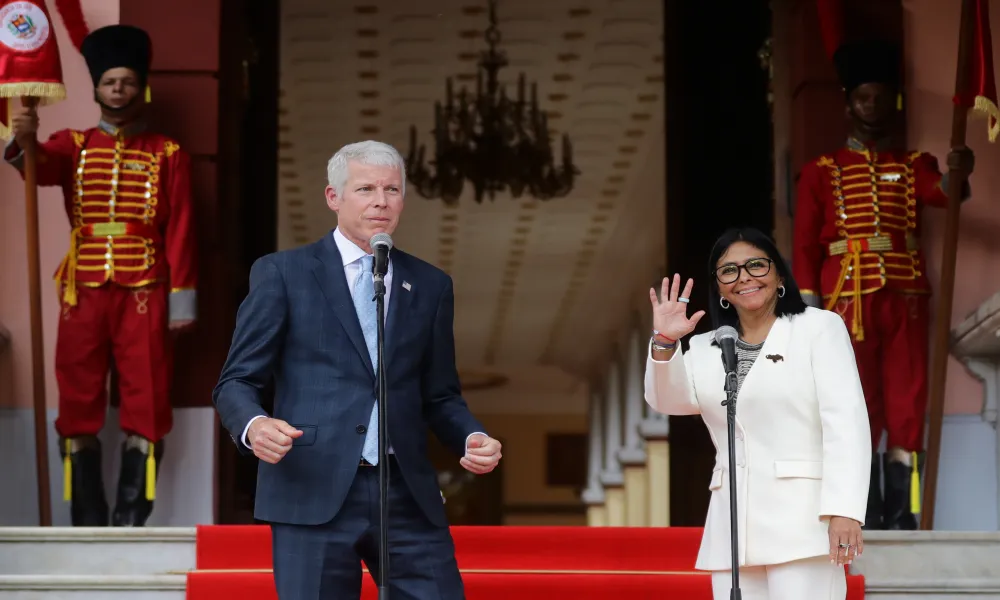
The agreements were signed under the supervision of US Energy Secretary Chris Wright, as Washington seeks to accelerate development of Venezuela's vast oil and gas reserves following the capture of former president Nicolás Maduro during a military operation in Caracas nine months ago.
Chevron and ENI secure major concessions
Chevron, a long-standing partner in Venezuela's energy sector, obtained licences for new oil fields and expects to double production from its three joint ventures to around 600,000 barrels per day within five years.
Italian energy group ENI secured exclusive rights to develop the giant Junín 5 field in the Orinoco Belt, one of the world's largest hydrocarbon regions.
Meanwhile, GE Vernova, which inherited General Electric's energy business, signed an agreement aimed at repairing large parts of Venezuela's power generation and distribution network.
Washington targets long-term oil expansion
The agreements follow Donald Trump's announcement of a broader bilateral framework under which the United States would gain majority control over more than 65 billion barrels of Venezuelan crude reserves, equivalent to roughly one-fifth of the country's total reserves.
Interim President Delcy Rodríguez, who took office following Maduro's capture, said the agreement was signed last Friday.
Chris Wright said the new contracts could help bring:
"Peace" and "prosperity"
to the country with the world's largest proven oil reserves.
Rejecting criticism that Washington was attempting to seize Venezuelan resources, Wright said:
"Private companies provide the capital needed to produce oil, but the profits, licence fees and taxes go entirely to the government and people of Venezuela."
Production expected to rise sharply
At its peak, Venezuela's oil industry produced more than three million barrels per day.
According to Wright, production could exceed two million barrels per day by the end of the decade.
Output stood below one million barrels daily at the start of this year but has since increased by almost 30%.
The agreement also provides for a 35% stake for the US government in North American Blue Energy Partners (NABEP), Venezuela's second-largest private oil company.
In return, the company will provide Washington with access to 20% of its production at discounted prices, with supplies destined for specialised US refineries capable of processing Venezuela's heavy crude.
Trump hails "historic" agreement
Trump described the arrangements as:
"The biggest oil deal in world history"
as he seeks to keep fuel prices low ahead of the midterm elections during his second term.
Energy analysts caution, however, that the agreement's full economic impact is unlikely to be felt for several years.
NABEP was founded by businessman Alejandro Betancourt, who amassed wealth through state-linked contracts during the administrations of Hugo Chávez and Nicolás Maduro.
Betancourt has faced investigations in Spain and Switzerland related to alleged money-laundering activities.
Sovereignty and elections
The agreement has already received approval from Venezuela's parliament and armed forces.
Rodríguez stressed that Venezuela retains sovereignty and ownership of all oil reserves developed by foreign companies.
At the same time, she remains under pressure from Washington over the country's political future.
Trump said Venezuela is not yet:
"Ready" to organise elections.
Rodríguez responded:
"There will be an electoral process, but only when Venezuela is ready."
The Venezuelan government and opposition held a round of talks last month, encouraged by Washington as part of preparations for a political transition.
US Secretary of State Marco Rubio told Fox News that another round of negotiations is expected within approximately ten days.