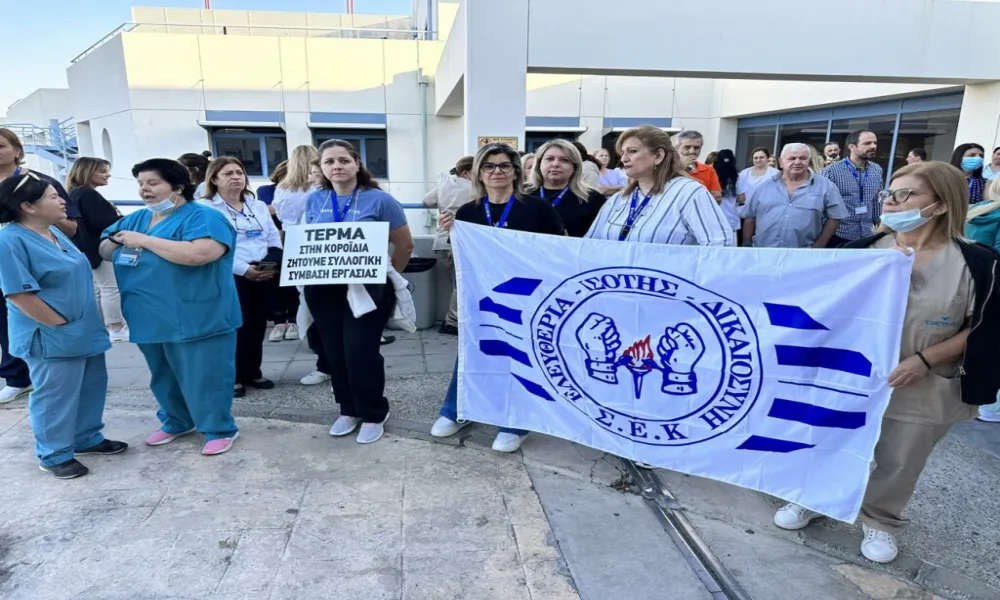

The State Health Services Organisation (OKYPY) and trade unions appear close to averting the planned 48-hour strike scheduled for 10 and 11 November, following movement by the organisation on issues that had been major sticking points in negotiations over a new collective agreement.
While no final agreement emerged from Wednesday's meeting, discussions produced new momentum, with both sides reportedly reaching a verbal convergence on wage increases and, crucially, on how those increases would be granted.
According to Politis information, OKYPY showed greater willingness to accept proposals put forward by the unions in an effort to break the deadlock. The developments have generated cautious optimism, although the strike has not yet been called off.
Evaluation-linked pay no longer central issue
The main development is a verbal convergence on salary increases of 2.75% for 2026 and 2.75% for 2027.
The unions had initially sought increases of 3% per year, while OKYPY proposed 2.75% for 2026 and 2.5% for 2027.
However, the percentages were not the main obstacle.
The key point of contention was OKYPY's proposal that 25% of salary increases be linked to employee performance evaluations.
OKYPY argued that the measure would reward performance, while unions opposed committing to such an arrangement as a condition of the new agreement.
According to information obtained by Politis, that approach has now changed and the link between evaluations and pay increases is no longer included in the framework of the verbal convergence.
The shift is regarded as significant, provided it is reflected in the organisation's formal proposal.
Friday expected to be decisive
The final outcome remains uncertain.
A revised working document is expected to be presented to the OKYPY board today and, if approved, forwarded to the unions on Friday.
That will determine whether the verbal understandings can be translated into a formal agreement and whether there is sufficient ground to suspend industrial action.
Outstanding issues remain
Two commitments from the previous collective agreement also remain unresolved.
The first concerns the conversion of salary increments from a three-year to an annual basis. Although agreed in 2024, the change was never implemented because legislative amendments are required.
According to reports, the relevant bill has now been prepared and is expected to be submitted to the Council of Ministers before proceeding to the House of Representatives.
The second unresolved issue concerns staff structures and career advancement prospects for employees.
No final arrangement has yet been reached on that matter.
These pending issues remain important because the failure to implement provisions of the previous agreement, together with the deadlock over its renewal, were among the main reasons cited for the strike announcement.
As a result, while progress on pay increases may open the door to a settlement, it does not mean all employee concerns have been resolved.
Until a written proposal is submitted and reviewed by the unions, the decision to proceed with the 48-hour strike remains in force.
Nevertheless, the atmosphere following Wednesday's talks was markedly different from previous days, making Friday a pivotal moment in determining whether public hospitals can avoid the planned industrial action.