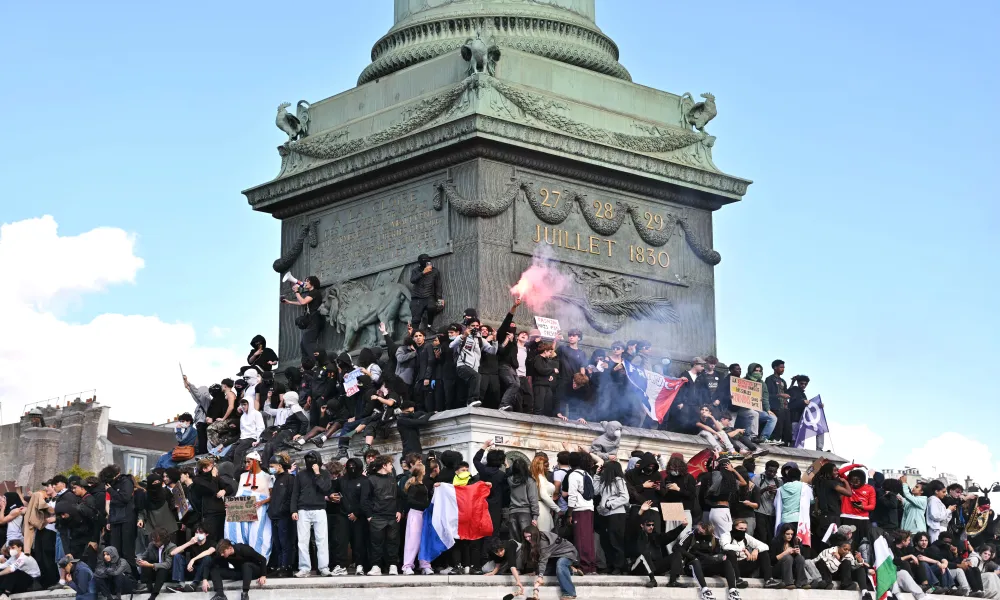

Trade unions across France are holding a nationwide strike today, 5 November, joined by student and pupil organisations protesting over the rising cost of living, wage demands and cuts contained in the government's proposed 2027 budget.
Union leaders describe the social climate as particularly tense, warning that public frustration is growing and that conditions remain fragile.
The organisations say they were dissatisfied with the outcome of a meeting held with government officials on 21 October, during which economic and labour issues affecting workers were discussed.
"We want two things: wage increases everywhere and a revision of the government's budget plan, which in its current form is disastrous for the country," Sophie Binet, secretary-general of the CGT, told France 2 on Monday.
She added that the mobilisation would bring together private-sector workers, public-sector employees, pensioners and young people.
Unions demand wage increases across all sectors
In a joint statement published on 5 October, the unions accused the government of targeting the most vulnerable through its 2027 budget proposals.
According to the statement, the budget "mainly targets the most vulnerable and the sick by freezing social benefits and reducing the protective role of the social security system".
The unions also criticised reductions in funding for public services and the freezing of the salary index used for public-sector workers, measures included in the budget proposal currently before Parliament.
The inter-union alliance has put forward seven core demands.
Among them is an increase in all social benefits.
On wages, the unions are calling for immediate negotiations across all businesses and sectors with the aim of raising salaries and ensuring equal pay between women and men.
Other demands include:
- Higher pensions.
- An increase in the public-sector salary index and measures to improve career progression for public employees.
- An increase in the national minimum wage (SMIC).
The minimum wage issue was also discussed during the 21 October meeting with unions.
At the time, the government appeared open to discussing the issue, according to Cyril Chabanier, president of the CFTC.
Labour and Solidarity Minister Jean-Pierre Farandou later told France Inter that an exceptional increase for the nearly two million workers earning the minimum wage was "not taboo", although no decision has yet been taken.
As a result, unions are expected to use the 5 November demonstrations to renew pressure for an increase in the minimum wage.
Calls for tax justice and climate action
Climate issues also feature prominently in the unions' demands.
The joint statement calls for increased resources to address global warming and adapt society to its effects, as well as a strategy to return industrial production to France while supporting decarbonisation.
The unions are also seeking increased funding for public services so they can "prepare the future, educate young people, care for and support the elderly, and respond to climate disruption".
They are also demanding what they describe as "tax justice", including changes to the taxation of wealth, inheritances and dividends.
In addition, the unions want the evaluation, conditional allocation and redistribution of €211 billion in state aid granted to businesses in 2023, based on calculations by a special inquiry committee of the Senate.
Sector-specific demands
Alongside the broader platform, individual sectors are advancing their own demands.
In education, the Snes-FSU is calling for additional resources for the national education system and the abolition of secondary-school reforms introduced in 2018 by former education minister Jean-Michel Blanquer.
In transport, major unions at the state railway operator SNCF have joined the mobilisation, denouncing what they describe as "social regression and wage stagnation".
Students and pupils join demonstrations
Workers are not the only participants in Thursday's mobilisation.
"This is also a day connected to youth mobilisation," Caroline Chevé, secretary-general of the FSU, told AFP.
Speaking on 31 October, Sabrina Karbach of the USL Student Union said students would organise blockades before joining demonstrations called by workers.
The Yellow Vests movement is also expected to participate, promoting the slogan: "5 November belongs to the people."