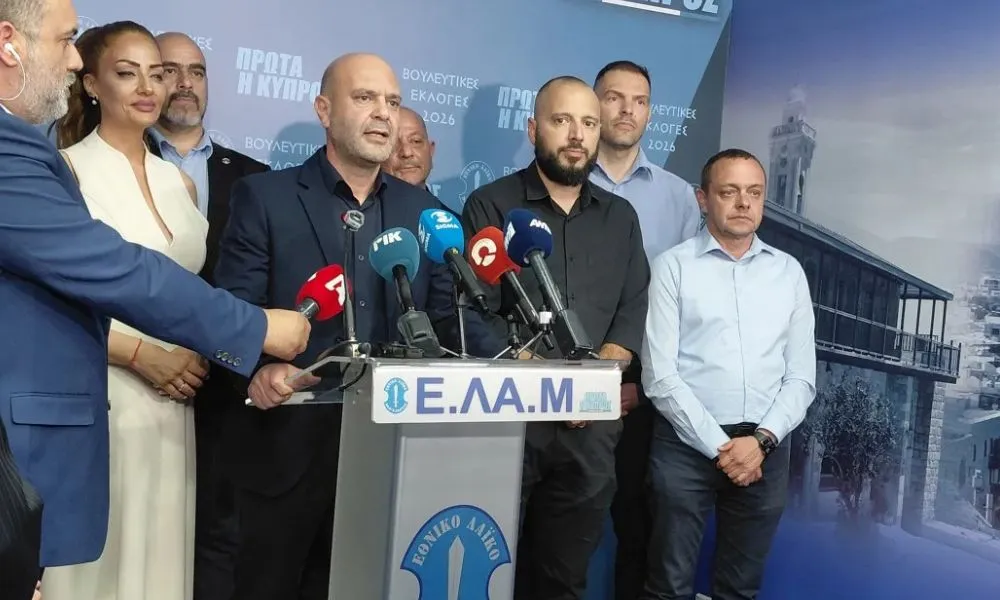

The National Popular Front (ELAM) recorded double the number of seats and a vote share close to 11% (10.9%) in Sunday’s parliamentary elections, confirming the institutional rise of the far right in Cyprus. The party secured 40,572 votes, emerged as the third-largest force and increased its parliamentary presence from four to eight seats. It elected three MPs in Nicosia, two in Famagusta, two in Limassol and one in Larnaca.
The result confirms a trajectory of gradual growth from a much smaller base. In 2011, during its first meaningful participation in parliamentary elections, ELAM secured around 4,000 votes and failed to enter parliament. In 2016, it achieved representation for the first time with two seats, rising to four in 2021. Fifteen years after its first electoral appearance, it has now surpassed 40,000 votes, suggesting its support base is no longer simply a protest vote but has taken on more stable characteristics.
Has it reached its peak?
In the 2021 parliamentary elections, ELAM won 24,255 votes, or 6.8%, while in the 2024 European elections it secured 41,215 votes and 11.2%, gaining its first seat in the European Parliament. Against that backdrop, its 2026 parliamentary result carries a dual reading. On the one hand, the party increased its share by around four percentage points compared to the previous parliamentary election and doubled its seats. On the other, in absolute numbers it did not surpass its 2024 European result, which may indicate it is approaching the limits of its current electoral base.
At the same time, the final result fell short of expectations formed during parts of the pre-election period, with some polls placing ELAM as high as 15%. Moreover, although it secured third place, its margin over fourth-placed DIKO was narrow at just 0.9 percentage points. This tempers the narrative of unrestricted electoral momentum and reinforces the interpretation that, while significant, the party’s rise has limits.
This does not diminish the political weight of the outcome. Around 40,000 votes cannot be ignored, nor can the fact that a party with far-right origins and a hardline agenda on migration, the Cyprus issue, LGBTQ+ rights and identity has now consolidated itself as the third parliamentary force. Its historical and ideological links to Greece’s Golden Dawn have long shaped interpretations of its identity. However, the current question extends beyond its past to how it is positioning itself for a more normalised role within parliamentary politics.
Expansion into the right
A key feature of the period leading up to the election was ELAM’s attempt to broaden its appeal within the wider right, including the recruitment of former DISY figures. This strategy does not appear to have delivered a significant influx of new voters when compared with the 2024 European election result. Instead, it may have altered the party’s image, which had long been presented as purely anti-system. ELAM now appears more as a hybrid formation, maintaining a hard ideological core while also seeking to incorporate elements of the traditional right.
The migration factor
At the same time, migration appears to have influenced the party’s trajectory. ELAM consistently frames the issue as an existential challenge for the Republic of Cyprus, linking it to crime and demographic change. However, part of the electorate seems to believe the issue has been managed more effectively by the current government, while other concerns such as the economy, cost of living and the housing market have taken precedence in daily political debate.
In any case, ELAM’s result represents more than numerical growth. It signals the entrenchment of a far-right force within the parliamentary system, with an increased capacity to influence the balance of power in the new House.