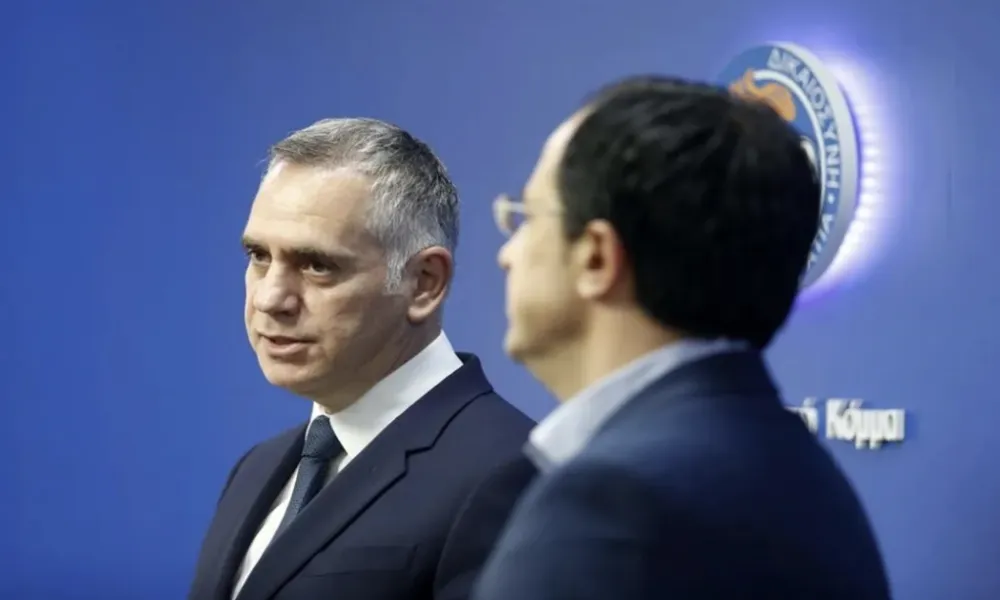



The initial assessment of this newspaper, published in the days following last Sunday's parliamentary elections, is that among the clear losers of the vote sits, unambiguously, Nikos Christodoulidis. That conclusion is openly and emphatically rejected by the presidency. Yet the president himself offered an early signal on election night, when he expressed regret that "by a few votes, it is a shame that parties like EDEK and DIPA were left out," referring to two of the three parties that participate in his governing arrangement. The remark was not made out of democratic sensitivity. Had it been, he would have also lamented the failure of Volt and the Hunters, which received roughly the same vote share as his allied parties. He spoke only to get ahead of a damaging impression: that two of his three coalition partners had been shut out of parliament. In the days that followed, presidential associates insisted on "discretion" in assessing the results. But both the posture of the executive and the statements that have filtered out make the Palace's deep anxiety about what comes next unmistakable.
Early days, but the ground has shifted
The outcome of a parliamentary election does not predetermine the course of any rivalry, let alone a presidential race in 2028. What it does do is shape the political terrain on which Nikos Christodoulidis will have to operate for the next two years, and it directly affects his prospects for re-election. The parliamentary elections did not simply record the balance of party forces in the new legislature. They functioned as a political barometer, measuring the stability of the current government, the equilibrium of the party system, and the durability of the alliance that brought Christodoulidis to power in 2023.
Christodoulidis was elected three years ago not as the candidate of a large, unified party machine but through his own independent candidacy, backed by DIKO and a coalition of smaller centrist forces, what is commonly called the "intermediate space," combined with significant defections from DISY. He also enjoyed direct support from ELAM, the far-right party, in the second round.
Today, the picture has changed substantially. The parties that backed him appear weakened and face serious questions of political survival. The combined electoral weight of the centrist coalition has contracted sharply compared with 2021 and 2023, both in parliamentary seats and in broader public support. This is not merely an arithmetical loss; it reflects the political erosion of the president's allies. Of the original coalition, only DIKO managed to survive, albeit diminished. In short, the political base on which Christodoulidis was elected to power in 2023 has been undermined and, crucially, short-circuited.
The balance of power has changed
At the same time, DISY emerges from the elections with markedly renewed confidence. Despite the internal turbulence that followed its 2023 defeat and loss of power, DISY not only maintained strong vote shares but confirmed its position as the most powerful party machine on the island. Its first-place finish is not just an electoral success; it is a political rehabilitation after a period of introversion that had followed its presidential defeat.
This development fundamentally alters the landscape ahead of 2028. The presidential palace had calculated that a significant DISY collapse, as the polls had suggested was possible, would create conditions for a leadership challenge within the party and perhaps open the door to a future political rapprochement with Christodoulidis. That rapprochement was envisioned not as a repeat of the rebellious defections that had pushed DISY members toward Christodoulidis in 2023, but as an institutional consequence of a possible DISY defeat.
The presidential strategy of persistent penetration into DISY's ranks, whether through individuals or through political positioning, has not produced the expected results. On the contrary, it appears to have deepened suspicion of Christodoulidis within the traditional right and contributed to the consolidation of the party's ranks. A DISY that emerges strong will find it very difficult to yield to any internal pressure to drift toward the patterns that had encouraged its recent introversion.
The elephant returns
The psychology of the party is shifting perceptibly. From a defensive posture after 2023, DISY is moving toward one of active competition for power. Under current conditions, any prospect of political coexistence between DISY and the sitting president looks near impossible.
And yet the elephant in the room, former president Nikos Anastasiades, has reappeared, suddenly advocating that Nikos Christodoulidis be regarded as someone who emerged from the heart of DISY. "Nikos Christodoulidis comes from the bowels of the movement," Anastasiades said. "His philosophy, therefore, does not differ from that of DISY. At some point, bitterness must be overcome, emotions transcended, and with prudence we must conduct ourselves politically in a way that, if and when the collective bodies continue to see constructive opposition as the right path, it is pursued in a manner that is beneficial."
Anastasiades continues to position himself as the informal leader of the right-wing camp, attempting to pre-empt discussions that would inevitably lead to a party candidacy for the presidency. In a television interview on ANT1 just 24 hours after the elections, he said: "What takes precedence is... not ambitions, but a measured and very prudent management of the result and of the prospect. That is, not to be led, for the sake of personal ambitions, into adventures. And of course one has the right to compete, and of course one has the right to deliberate..."
Party circles consider this intervention characteristic of the former president's approach, and suggest the statement alone could trigger a new cycle of internal division within DISY. For now, it has been met by the party leadership with near-complete silence, and silence, in this context, speaks clearly enough.