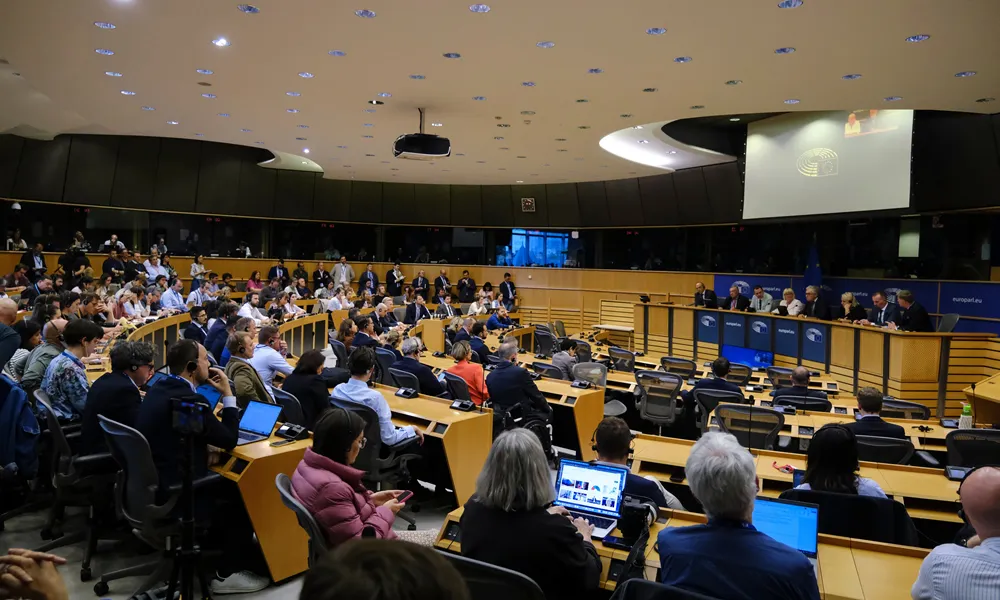



When ELAM candidate Geadis Geadi was elected to the European Parliament in June 2024, Cyprus joined a list that would have been unthinkable a decade ago. For the first time in the party's history, a formation with neo-fascist roots and a pedigree traced directly to Golden Dawn in Greece had secured a seat in the legislature of the European Union. Migration had become the single biggest concern for Cypriot voters, arrivals from the Middle East and Africa surged in early 2024, and ELAM's anti-immigration platform filled the space that establishment parties had left open. However, there is also one data point in a movement that spans continents and has moved from the political margins to the edge of power across much of the democratic world.
In the June 2024 European Parliament elections, far-right parliamentary groups expanded their share of seats from 135 in 2019, representing 18% of the chamber, to 187 seats, or 26% of the total. Radical-right parties have gained significant ground in various national elections across Europe, with their vote shares often exceeding 20%. The 2024 cycle was particularly striking: seven EU member states, including Croatia, the Czech Republic, Finland, Hungary, Italy, the Netherlands and Slovakia, now have far-right parties within government. In France, Marine Le Pen's National Rally took 31.4% of the European vote, enough to prompt President Emmanuel Macron to dissolve parliament and call a snap election. In Germany, the Alternative for Germany finished second in the 2025 federal elections, its best result ever, after winning a state election in Thuringia for the first time since the Second World War.
The scale of the shift has drawn comparisons to the interwar period, though scholars are careful to note the differences. The global rise of radical-right leaders, parties, and movements and events such as the US Capitol riots and Russia's invasion of Ukraine have triggered debates about the reincarnation of fascism. Whether or not the "f" word applies in each national context is contested; what is not contested is the direction of travel. Pascal Delwit, a professor of political science at the Université libre de Bruxelles, argues this is not a short-term trend but rather a political movement that has been building for nearly two decades, with a steady upward trajectory.
What is driving the surge
Economic insecurity since the 2008 financial crisis, resentment of liberal elites, rapid demographic change, and the perception that mainstream parties can no longer govern effectively have created a political environment in which authoritarian, nativist parties can appeal to voters who once belonged firmly to the centre. Many voters feel neglected and believe they have been left to fend for themselves, expressing concerns about immigration and the sense that migratory flows are keeping wages too low.
One of the most significant implications of the far-right surge in Europe has been its normalisation in contemporary politics. Many European centrist mainstream parties have begun adopting hardline policies, especially on migration, pushed by parties such as the AfD and FPÖ because they see those messages resonating with large sections of the public. The EU itself has followed with a 2024 overhaul of migration policy moved toward tougher border measures and expedited deportations. In Britain, Prime Minister Keir Starmer's Labour government has taken an increasingly stern line on migration, while the populist Reform UK party, led by Brexit campaigner Nigel Farage, siphoned eight authorities from Conservative strongholds in local elections and now holds roughly 42% of seats in those councils.
Beyond economic anxiety, digital platforms have accelerated the spread of far-right ideas across borders in ways that have no historical precedent. Research describes what some scholars call a "networked movement" that encourages decentralised, plausibly deniable activism, arising from cultural immersion rather than direct command, with platforms such as Telegram and short-form video used to reach and radicalise disaffected youth. The speed of that process has itself changed with a radicalisation process that once unfolded over months or years and now it typically takes days or even hours, largely due to the prevalence of extremist short-form online propaganda.
The American accelerant
Donald Trump's return to the White House in January 2025 has emboldened the European far right in concrete, not merely symbolic, ways. Right-wing populists in Europe felt empowered by Trump's re-election, and high-profile interventions, including Elon Musk's public endorsement of the AfD and US Vice President JD Vance's speech at the Munich Security Conference criticising the political exclusion of far-right parties, provided American backing to movements that had previously been treated as untouchable. The practical effects of the Trump administration's anti-EU posture, including tariffs and rhetorical hostility toward NATO, have complicated the picture for some European far-right parties that had tied themselves to Washington while also claiming to defend national sovereignty against Brussels. After all, the Trump administration's outright anti-EU policies affect radical-right electorates too.
In Cyprus, ELAM's trajectory reflects broader patterns while carrying local specificities. The party, founded in 2008, secured its first seat in the European Parliament in 2024, where it subsequently became the third-largest political force, displacing the centre-right Democratic Party. Its ideological roots are not ambiguous. ELAM is described in its Wikipedia entry as a far-right, ultranationalist, neo-fascist and neo-Nazi party. Before its formal founding, the organisation existed under the name "Golden Dawn: Cypriot Kernel," and the party's current leader, Christos Christou, was an active Golden Dawn member. The party officially cut ties with Golden Dawn in 2020.
Despite its radical positions, ELAM has managed to integrate into the political mainstream to some extent, collaborating with other parties on specific issues while maintaining its distinct far-right identity. Its MEP has since joined the European Conservatives and Reformists group, the same parliamentary family as Italy's Brothers of Italy and Spain's Vox. That mainstreaming was confirmed most dramatically in the May 2026 parliamentary elections, when ELAM secured eight seats and became the joint third-largest party in the House of Representatives, winning 10.9% of the vote in a result described by observers as a historic breakthrough.
Geadis Geadi himself pushes back on the labels. In a conversation with Politis to the Point, back in September, he rejected the characterisation of ELAM as a far-right or extremist party, distancing himself from the ideological baggage the terms carry. At the same time, he calls for a strict, unified European approach to asylum seekers, including preventing those who enter member states irregularly from moving freely across the EU. Whether that rebranding holds up against the party's documented history is another matter, but it reflects a broader pattern across Europe's radical right. A deliberate effort to present as a serious governing force rather than a fringe movement.
The picture is not uniformly dark
Despite their electoral successes, radical-right parties are making only modest progress in gaining executive power at the national level. European radical-right parties since 2020 have received 24% of the vote in legislative elections and won 23% of parliamentary seats, but executive influence has been harder to translate. In Romania, a far-right candidate who placed first in the first round of the presidential election saw the result annulled by the Constitutional Court over Russian interference. In France, the RN's parliamentary advance proved more limited than polls had suggested. In Germany, the AfD has been kept out of coalition government through a sustained cordon sanitaire, even as individual politicians have begun breaching it at the local level.
Rather than conquering Europe, the radical right seems set on preventing the EU from becoming what it needs to become, blocking and delaying reforms necessary to confront the EU's current and future challenges. That is, in many ways, the more durable danger, a slow erosion of the institutional consensus that has underpinned European democracy since 1945.
A party that once celebrated Golden Dawn's entry into the Greek parliament now sits as the third political force in the House of Representatives, with eight MPs and a seat in the European Parliament. The island's chronic vulnerabilities, high migration pressure, a frozen conflict, economic inequality and declining trust in institutions, are precisely the conditions in which far-right parties have historically grown.