
By Kritonas Kapsalis
Disy's clear first place in the May 2026 parliamentary elections, with 27.1% and 17 seats, restored a sense of political confidence at Pindarou. The party showed that, despite the trauma of the 2023 presidential election, it remains the strongest organised pole of the centre right. That does not mean, however, that the road to the presidency in 2028 lies open. On the contrary, the biggest obstacle facing Disy may not be in front of it but inside it.
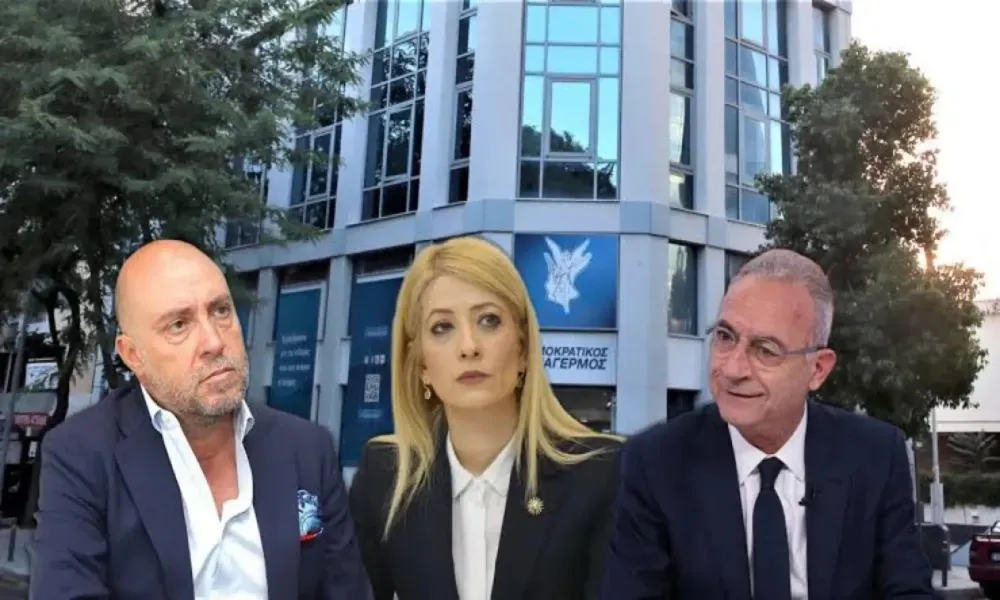
The critical question is not only who the candidate will be. It is above all how that candidate will be chosen and, more importantly still, what state the party will be in the day after the choice is made. Three names are currently in the frame. Disy president Annita Demetriou, former president Averof Neophytou and Nicosia MP George Pamborides. Selecting the candidate through a pancyprian electoral convention, open to tens of thousands of members, gives the eventual winner strong democratic legitimacy. In theory, then, everything is settled. In practice, that is exactly where the risks begin.
Disy knows firsthand what it means to enter a presidential election without the whole party standing behind its official candidate. In 2023, Neophytou finished third with 26.11%, behind Nikos Christodoulides and Andreas Mavroyiannis. That defeat was not simply an electoral loss. It exposed a deep rift within Disy's ranks, much of which shifted toward Christodoulides. If 2028 repeats the same pattern, even with different faces, Disy risks finding itself once again a spectator in the second round.
Necessary conditions
The first condition for victory is time. The internal process cannot drag on for months and turn 2027 into an endless clash of personal camps. The longer a contest between Demetriou, Neophytou and Pamborides is prolonged, the more it will generate public disagreements, personal attacks, backroom manoeuvring, leaks and suspicion. And the greater the opening will be for the Presidential Palace and other candidates to exploit Pindarou's divisions.
The logical choice, on this reasoning, is to settle the matter before 2026 ends. Not because the presidential campaign itself needs to start a year and a half early, but for the opposite reason, to bring the internal pre-election period to a swift close. That would leave the whole of 2027 available for healing wounds, producing policy, presenting a programme and, above all, building the image of a party that has left its internal contest behind.
At the same time, the rules need to be entirely clear before the ballot boxes are set up. Who gets to vote, when the membership roll closes, who is eligible to take part and what framework will govern the internal campaign cannot become points of dispute the day after the result. The winner must emerge from a process that the losing candidates can accept without reservation. Otherwise, a democratic process designed to unite the party could become the trigger for its next split.
The second, and perhaps most important, condition is how the losing candidates behave. It is not enough for the winner of the internal vote to secure the nomination. They need to bring the other two with them. Particularly in the case of Demetriou and Neophytou, their joint presence at the same post after the candidate is chosen would send the strongest possible signal that the 2023 crisis is finally closed. Cold distance, half measures or parallel personal strategies, by contrast, would give the impression of a party that has simply postponed its own confrontation.
The third condition is electability. Current polling suggests that the party nomination alone will not be enough. In a recent Pulse survey commissioned by Disy, Demetriou appeared in one first round scenario on 26%, ahead of Christodoulides on 24%, with Mavroyiannis on 30%. Dozens more polls are certain to appear before the end of the year, and they will inform Disy's own members which of its figures, and it has no shortage of them, actually have the capacity to win. Disy should not simply be choosing who can win the internal race at Pindarou, but who can win Cyprus.
The fourth condition is a clear political identity. Demetriou has repeatedly made clear that Disy remains in opposition, yet during the parliamentary campaign period that line softened. That matters ahead of 2028. A party seeking to return to power cannot present itself simultaneously as an opposition force and an informal government partner. It can support government policies it agrees with, but it needs to build a clear alternative governing proposal of its own. Otherwise, Christodoulides will be able to argue that he himself represents the broader centre right and that his differences with Disy are more personal than political. That is precisely what Pindarou needs to prevent, turning 2028 from a contest between two distinct governing proposals into a family dispute within the centre right, which would also work in favour of a centre left candidate.
The fifth condition is expansion. Disy's 27.1% in the parliamentary election is an excellent starting point, but it is not a presidential majority. Disy's candidate will need to reach beyond the party's own base, toward centrist voters, toward disaffected Disy supporters who backed Christodoulides in 2023, and toward citizens who no longer identify consistently with any party. The battle for the second round will not be won through party discipline alone, but through political alliances and personal acceptance.
This is perhaps where the biggest paradox lies. Christodoulides remains a serious contender precisely for as long as Disy stays vulnerable to internal division. His political rise in 2023 was built on his ability to draw votes from the centre right space without controlling Pindarou. If the party enters 2028 with a single candidate, a single line and no internal wars, the pool the sitting president can draw from shrinks considerably. But if the internal process leaves behind embittered, excluded or politically homeless Disy supporters, the Presidential Palace will try once again to work its way into the cracks.
The conditions
The answer to the question of under what conditions Disy's candidate wins in 2028 is, in this light, relatively simple. It wins if the selection happens in time, with clear rules and no disputes. It wins if the losing candidates genuinely stand beside the winner. It wins if the party chooses not simply the most popular figure internally, but the one who can widen its reach, drawing votes from Diko, Elam and Direct Democracy, as well as from the roughly 17% of voters who backed parties that failed to enter parliament. It wins if Disy maintains a clear political distance from the government and puts forward a convincing alternative. Above all, it wins if 2028 does not turn into a rematch of 2023 between personalities and party machines.
The biggest threat facing Pindarou is not, at least for now, a shortage of strong candidates. The danger is having a strong candidate but only half a party behind them, as was the case in 2023. If Disy avoids that mistake, its first place finish in 2026 could yet prove to be the first step back to the Presidential Palace.