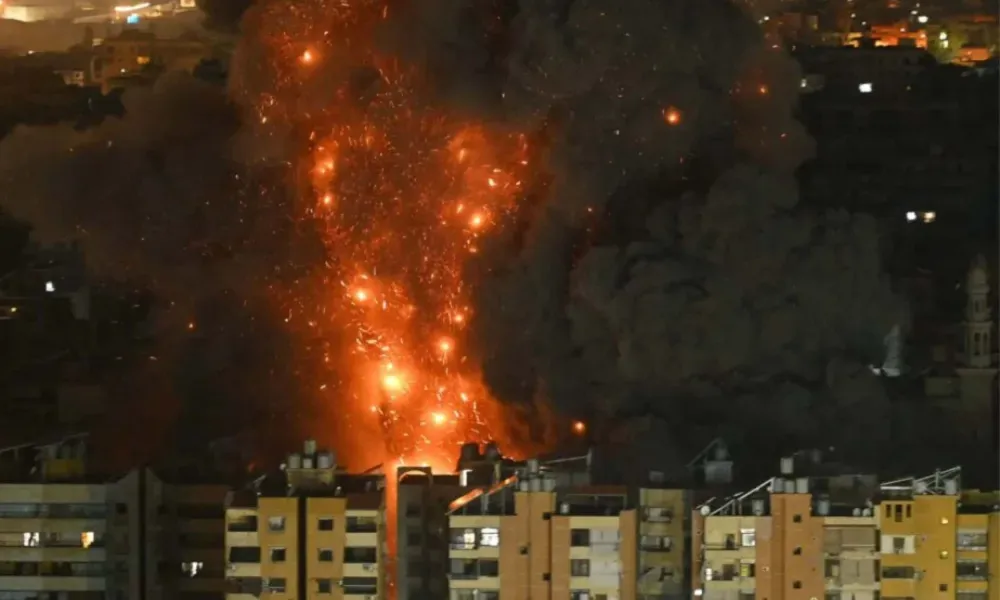

A major escalation unfolded overnight in the Middle East after the United States launched a new wave of airstrikes against Iran, prompting Tehran to warn of a "decisive" response.
Tensions also spread across the Gulf, with air raid sirens activated in Bahrain during the early hours of Tuesday and Kuwaiti forces reporting efforts to repel hostile missile and drone attacks.
US launches new operation against Iran
The latest military operation began shortly after midnight when the US Central Command (CENTCOM) announced what it described as "robust strikes" against targets in southern Iran.
Washington said the operation was a response to attacks on three commercial vessels in the Strait of Hormuz, which it attributed to Tehran. US officials argued the incidents constituted a breach of the de-escalation memorandum agreed by both sides in mid-June.
The United States also announced the reimposition of sanctions on Iranian oil, banning new transactions involving Iranian hydrocarbons.
The renewed tensions immediately affected energy markets, with US crude oil prices rising after Asian markets opened.
Tehran accuses Washington of violating de-escalation agreement
Shortly after the strikes were announced, Iran's Foreign Ministry accused the United States of violating the de-escalation agreement and warned that the Islamic Republic would take "decisive measures" to protect its national security.
Meanwhile, Iranian state media reported a series of explosions on Qeshm Island, in Sirik and in the port city of Bandar Abbas, home to one of Iran's most important maritime facilities near the Strait of Hormuz.
More than 80 targets hit
Hours later, CENTCOM released further details, saying more than 80 targets had been struck.
According to the US military, the targets included air defence systems, command-and-control networks, coastal radar installations, anti-ship missile launch facilities and more than 60 fast attack boats belonging to Iran's Revolutionary Guards operating near the Strait of Hormuz.
US media, citing sources within the Trump administration, reported that the latest operation was significantly broader than strikes conducted roughly a week and a half earlier and could continue for some time.
Iranian media reported several injuries, particularly in the Sirik area.
Strait of Hormuz at the centre of the crisis
The latest confrontation is closely linked to growing tensions surrounding the Strait of Hormuz, one of the world's most important oil shipping routes.
Several attacks on tankers have been reported in recent days, with Saudi Arabia and Qatar blaming Iran for two of the incidents.
Doha summoned Iran's chargé d'affaires and delivered an official protest, demanding explanations and calling for an end to actions threatening maritime security and global energy supplies.
Tehran rejected the accusations as baseless and reiterated that it would not return to the pre-war status quo in the Strait of Hormuz.
Bahrain and Kuwait on alert
The crisis has also spread across the Gulf.
At around 6 a.m., air raid sirens sounded across Bahrain. The Interior Ministry urged residents to remain calm and proceed to the nearest safe locations but did not provide further details about the reason for the alert.
Bahrain hosts the headquarters of the US Fifth Fleet and has repeatedly been identified as a potential target since the outbreak of the regional conflict.
Shortly afterwards, Kuwait's armed forces announced that they were responding to what they described as hostile missile and drone attacks.
"Kuwaiti air defenses are currently confronting hostile missile and drone attacks," the military said in a post on X, without identifying the source of the attacks.
تتصدى حالياً الدفاعات الجوية الكويتية لهجمات صاروخية وطائرات مسيرة معادية.
— KUWAIT ARMY - الجيش الكويتي (@KuwaitArmyGHQ) July 8, 2026
تنوه رئاسة الأركان العامة للجيش أن أصوات الانفجارات إن سمعت فهي نتيجة اعتراض منظومات الدفاع الجوي للهجمات المعادية.
يرجى من الجميع التقيد بتعليمات الأمن والسلامة الصادرة عن الجهات المختصة.… pic.twitter.com/nhXrpThL4T
Kuwait, which hosts significant US military facilities, has faced repeated threats since the conflict intensified following the US-Israeli attack on Iran on February 28.