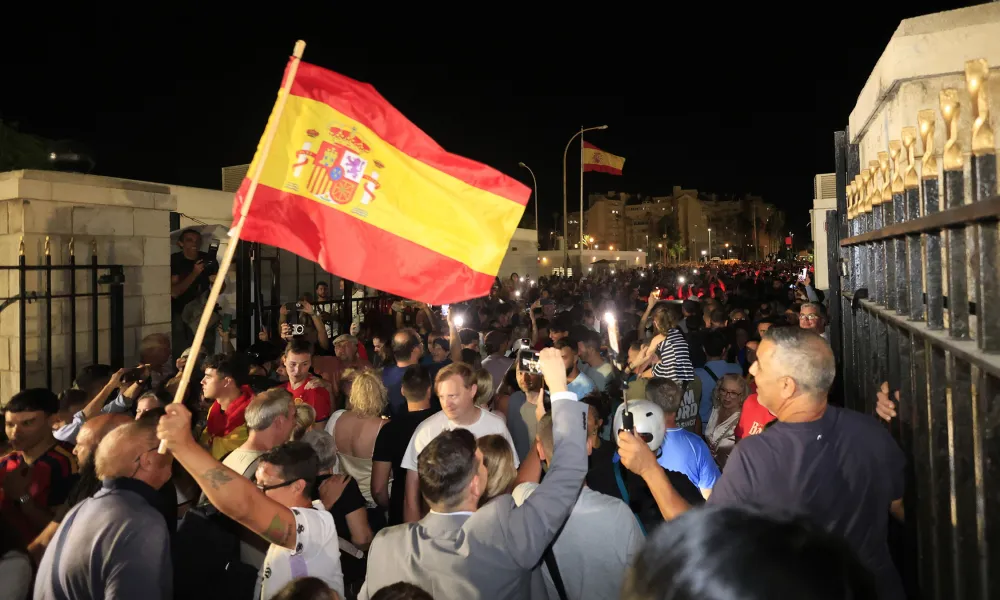

The border fence between Spain and Gibraltar came down at midnight on Wednesday, ending decades of checks and queues for residents, tourists and the thousands of Spanish workers who cross into the territory each day. The treaty behind the change was signed in Brussels on Tuesday by the United Kingdom, Spain, Gibraltar and the European Union, closing out more than four years of negotiations that began after Britain left the bloc.
Under the deal, border and customs checks on the land frontier are eliminated, and Spain takes over responsibility for Schengen checks at Gibraltar's airport and port. Travellers arriving from outside the Schengen area, including from Britain, will instead go through passport checks handled jointly by Gibraltarian and Spanish officials at those two points of entry. The fence itself, which had physically divided the two territories since 1908, has now been fully dismantled in the border town of La Línea de la Concepción.
Gibraltar, ceded to Britain under the 1713 Treaty of Utrecht, is home to around 38,000 people and depends heavily on cross-border labour, with close to 15,000 Spanish workers, nearly half the territory's workforce, making the crossing each day. The surrounding Campo de Gibraltar region of Andalusia, one of the poorer parts of Spain, relies just as heavily on that daily traffic in the other direction.
A long and difficult history
The border has not always functioned this freely. Spain's dictator, Francisco Franco, sealed it entirely in 1969 after Gibraltarians voted overwhelmingly to remain British, a closure that lasted 13 years and separated families and workers alike. More recently, the years of uncertainty following the Brexit referendum, in which 96% of Gibraltarians voted to remain in the EU, left cross-border commuters unsure how long a hard border might eventually take to cross.
Spanish prime minister Pedro Sánchez travelled to La Línea de la Concepción on Wednesday to watch the final section of fence come down, describing it as the last wall in continental Europe. Gibraltar's chief minister, Fabian Picardo, said the frontier would now become a place of cooperation and shared opportunity, while stressing the deal does not touch the territory's British sovereignty. The EU's trade representative, Maroš Šefčovič, called it a very special feeling to see a fence come down, after what he described as four years of patient, complex negotiation.
The change also brings new rules for business. Goods sold in Gibraltar will now need to meet EU regulations, and the territory's long-standing VAT-free status will end, replaced by a new transaction tax starting at 15% this year and rising to 17% later on, alongside higher excise rates on some goods. Despite the fence coming down, Gibraltar has stepped up other security measures, including live facial recognition cameras at entry points and an expanded police and customs presence.
Sources: BBC, The Guardian UK, Euronews