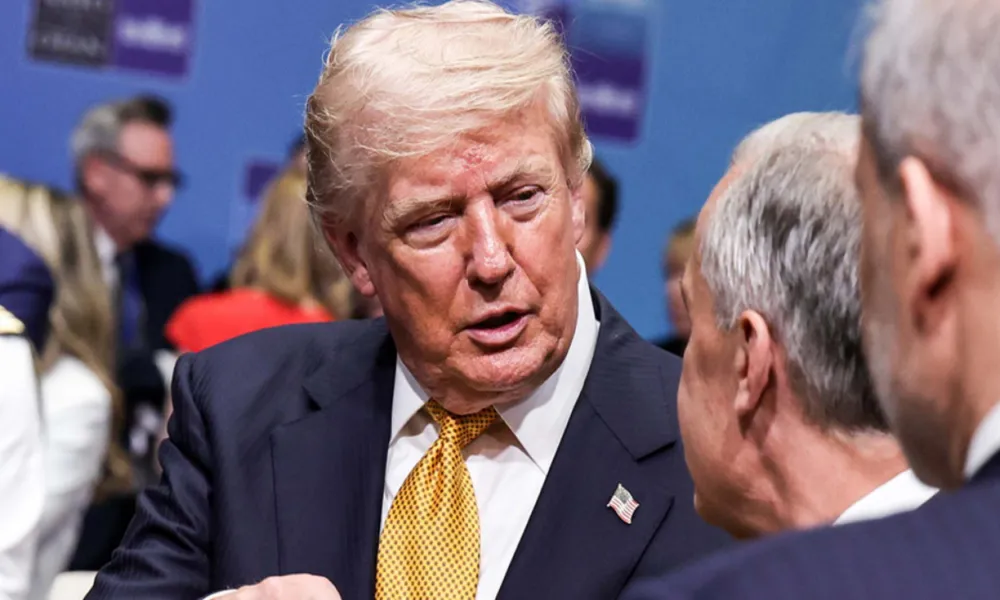

US President Donald Trump announced on Sunday that new negotiations with Iran are set to begin on Monday, a day after revealing that he had postponed a planned joint US-Israeli military strike against the Islamic Republic on condition that a deal is reached quickly.
Speaking to reporters aboard Air Force One as he travelled from New Jersey to Washington, Mr Trump said Tehran was aware of the scale of the planned attack and wanted to avoid it.
"Of course they don't want to be attacked. They knew the extent of it because they saw it taking shape," he said. "What we're going to do now is talk to them in the form of a negotiation. That will begin tomorrow afternoon."
Mr Trump did not specify where the talks would take place, how long they would last or who would participate.
Neither Iran nor the countries reportedly involved in mediation efforts confirmed that negotiations were due to begin.
Trump points to Hormuz and Iran's nuclear programme
The US president insisted there is already an agreement concerning the Strait of Hormuz and expressed confidence that a deal could also be reached on what he described as the "denuclearisation" of Iran.
Western countries have long accused Tehran of seeking to develop nuclear weapons, an allegation Iran has consistently denied.
Mr Trump also stressed that US forces remain ready to act if ordered.
The previous day, he announced that he had decided to cancel what he described as a new round of US-Israeli strikes that would have demonstrated a level of military power "not seen since World War II", provided a rapid agreement could be reached, particularly regarding the full reopening of the Strait of Hormuz.
According to Mr Trump, he decided to postpone the attack following requests from Saudi Arabia, the United Arab Emirates, Qatar and Iran itself.
Hormuz remains a flashpoint
The Strait of Hormuz, one of the world's most important routes for global oil trade, has effectively remained closed since Tehran imposed restrictions following the resumption of hostilities with the United States in early July.
The closure has triggered fresh concerns for the global economy.
A preliminary agreement signed in mid-June between Washington and Tehran, known as the Islamabad Memorandum of Understanding, had raised hopes of a diplomatic solution within a renewable 60-day timeframe. However, the agreement failed to produce lasting progress and extensive military exchanges resumed at the beginning of July.
Since the outbreak of the conflict on 28 February, when the US and Israel launched attacks against Iran, Mr Trump has repeatedly threatened large-scale military action before subsequently stepping back.
He again cited the outline of a possible agreement as the reason for delaying planned strikes.
Tehran signals progress with Oman
Although the negotiations announced by Mr Trump have not been confirmed by Iran, Tehran indicated on Sunday that it was close to reaching an agreement with Oman regarding navigation through the Strait of Hormuz.
Iran currently requires vessels transiting the strait to follow a route along its coastline and has made clear that it intends to retain control over the strategic waterway.
According to Iranian Foreign Ministry spokesman Esmaeil Baghaei, discussions are advancing towards a mutually acceptable navigation route.
"We are close to reaching an agreement on a route acceptable to both sides, neither the northern nor the southern one, while respecting each country's sovereign rights and safeguarding our national interests and security," he told Iranian state television.
Oman has neither confirmed nor denied the claim.
Oil prices fall
Mr Trump's announcement was followed by a decline in oil prices during early trading.
The price of Brent crude, the international benchmark, fell by almost 5% to $84 per barrel, after having risen above $100 per barrel in late July.
Despite the prospect of negotiations, tensions in the Strait of Hormuz remain high.
Late on Sunday, an explosion was reported near an oil tanker in the area, although no casualties were recorded, according to the UK Maritime Trade Operations (UKMTO) organisation, which operates under the British Ministry of Defence.
Conflict spreads beyond the Gulf
According to US media reports, the Trump administration had been considering a new wave of strikes against Iranian energy infrastructure, including refineries and power stations, over the weekend. CBS News reported that Israel was expected to participate.
Saudi state news agency SPA reported that Crown Prince Mohammed bin Salman urged Mr Trump during a phone conversation to prioritise dialogue in order to reduce tensions.
The conflict has also expanded into the Red Sea, where the Iran-aligned Houthi movement announced a blockade of Saudi ports and later claimed attacks against oil tankers and port facilities in the kingdom.
The developments have raised concerns for commercial shipping through the Bab el-Mandeb Strait, a vital maritime route that has become even more important following disruptions in the Strait of Hormuz.