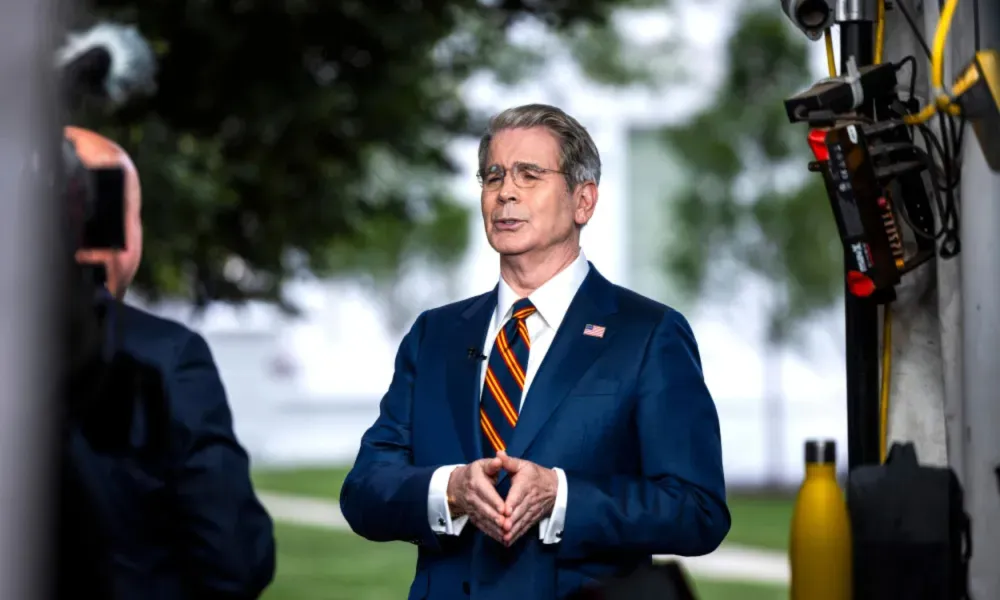

US Treasury Secretary Scott Bessent warned on Thursday that Iran could face a level of economic isolation "the world has never seen before", while indicating that additional measures are due to be announced next week.
Speaking to the conservative television network Newsmax, Bessent said the planned measures would go beyond restrictions already imposed on Iranian Gulf ports in response to Tehran's closure of the Strait of Hormuz, a strategically important route for global oil and gas shipments.
"It will be a combination of economic isolation that the world has never seen before and the continuation of the blockade in the Strait of Hormuz, preventing anything from entering or leaving Iranian ports," Bessent said.
He added:
"Stay tuned. More announcements are coming next week."
The Treasury secretary did not provide details about the nature of the additional measures.
Economic pressure and physical restrictions
Bessent described the US strategy as relying on two forms of pressure: economic squeeze measures and physical restrictions.
Drawing comparisons with Cuba and Venezuela, he argued that economic isolation can have a rapid impact.
"Venezuela collapsed immediately when we imposed a blockade," he claimed.
US priorities
Earlier, US Vice President JD Vance told Fox News that Washington's top objective in the confrontation with Iran is to keep energy prices low for American consumers.
"Our number one goal is to ensure that oil and gasoline remain cheap for Americans," Vance said.
He added that the administration's second priority is ensuring that Iran never acquires a nuclear weapon.
Diplomacy remains stalled
On 4 August, Bessent told CNBC that a deal between Washington and Tehran to reopen the Strait of Hormuz could be reached "today or tomorrow," comments that helped boost Wall Street and push oil prices lower at the time.
However, with negotiations appearing deadlocked, Washington is increasingly focusing on economic pressure rather than diplomacy.
Both sides continue to insist on their respective conditions for reopening the Strait of Hormuz, leaving little sign of an immediate breakthrough.