
Reform UK leader Nigel Farage regained his parliamentary seat today after winning the by-election he triggered in an effort to strengthen his position against allegations that he failed to declare certain financial gifts.
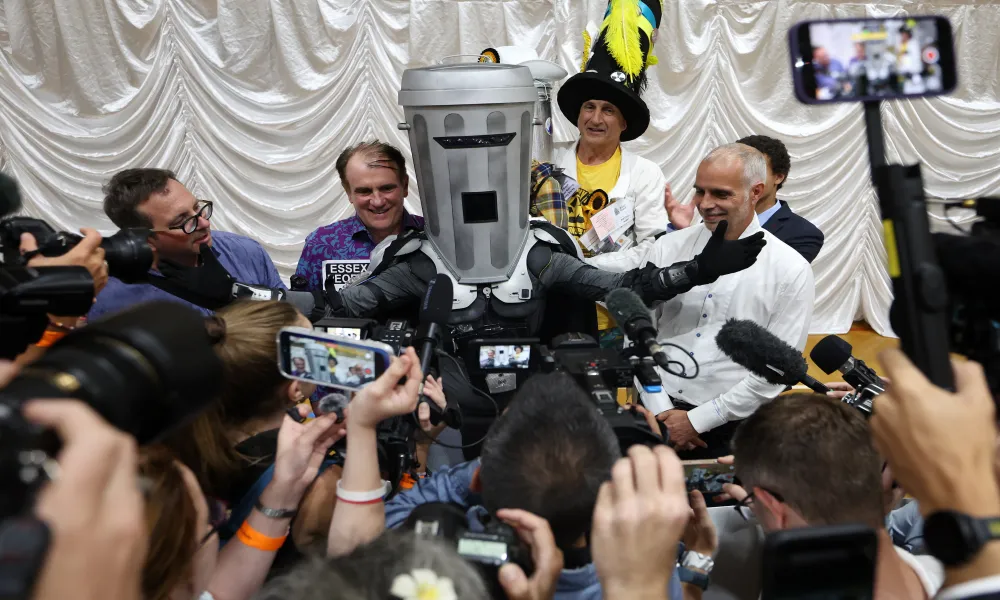
However, the move was somewhat overshadowed by the performance of his main opponent, a comedian dressed as a rubbish bin, who secured more than a quarter of the vote.
In an unusual move, Farage, one of the leading figures behind Brexit, did not attend the vote count in the southern English seaside town of Clacton, saying police had warned him of a planned disruption during the announcement of the result.
“I’ll be damned if I’m going to stand on a stage, having won a resounding victory, and be subjected to abuse and humiliation from nobodies,” Farage told supporters at a gathering before the result was declared.
The by-election was called after Farage resigned his seat last month in order to seek a fresh mandate from voters. He claimed he was fighting against an establishment determined to discredit him over undeclared gifts from donors.
Britain’s main political parties boycotted the contest, describing it as a self-serving publicity stunt.
As a result, Farage’s principal challenger became Count Binface, a satirical character created by comedian Jonathan Harvey, who has become a regular feature of British election campaigns.
Farage won 62.8% of the vote.
Count Binface, whose policies include imposing a cap on the price of ice cream cones, “nationalising” singer Adele and introducing compulsory military service for people who talk loudly on mobile phones on public transport, secured 26.7%.
Although Reform UK had previously led opinion polls, the party's popularity has declined in part because of questions surrounding Farage's finances.
Parliament is investigating whether Farage should have declared a £5 million gift from a billionaire cryptocurrency investor.
Opponents argued that the Clacton by-election was little more than an attempt to divert attention from those allegations.
The absence of candidates from major political parties even led some of Farage’s supporters to question whether the veteran politician had made the right decision.
Laura Richards-Grey, a political science lecturer at Birkbeck, University of London, said the absence of major-party rivals undermined Farage’s attempt to frame the campaign as a battle between “the people” and “the establishment”.
She added that some voters viewed the election as “a waste of time and money”.
Despite his victory, parliament’s standards committee is expected to resume its investigation into Farage’s financial declarations once he returns to Westminster.
At the centre of the inquiry is whether he should have declared the gift from a Thailand-based billionaire before the 2024 general election.
Under parliamentary rules, MPs must declare donations received during the year before an election within one month of taking office.
Farage has acknowledged receiving the money without declaring it, arguing that he did nothing wrong because it was a personal gift.
According to The Times, he is also alleged to have received another undeclared donation from George Cottrell, a cryptocurrency businessman who was convicted of fraud in the United States in 2017.
If parliamentary authorities conclude that Farage breached the rules, he could face suspension from Parliament. That could trigger another contest for his seat, one in which the major parties would be expected to field candidates.