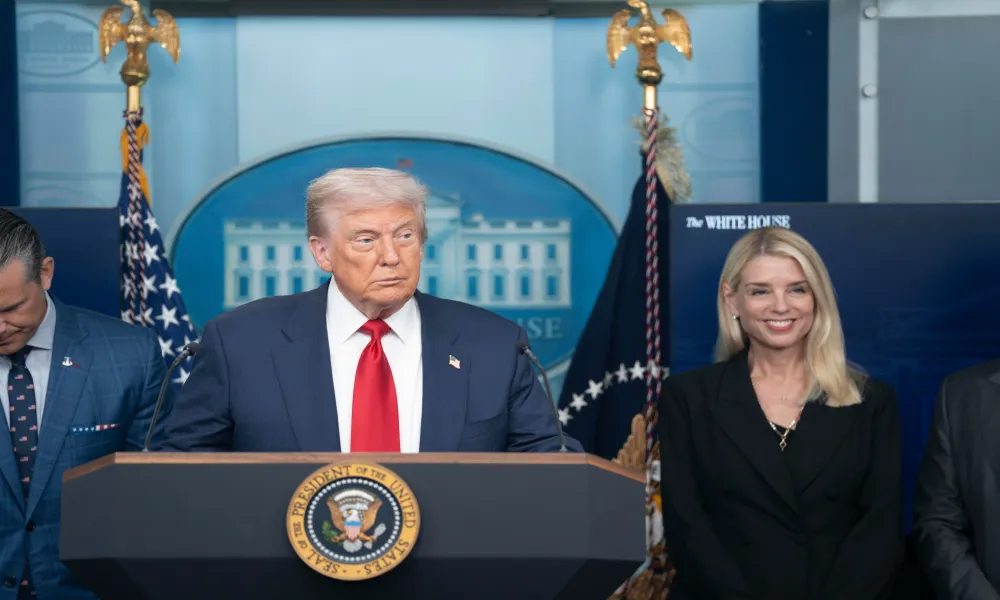

As millions of Americans grapple with rising fuel prices linked to the war with Iran, the value of President Donald Trump's investments in oil and gas companies has increased significantly, according to a report by Democrats in the US Congress obtained by CBS News.
The report estimates that the value of Trump's energy portfolio may have increased by as much as $35.8 million since the beginning of 2026.
According to the findings, the current value of those investments is estimated at between $22.5 million and $81.6 million, compared with between $12.6 million and $46 million at the end of 2025. The increase is attributed both to rising energy stock prices and to additional share purchases made through the president's investment accounts.
The revelations have gained political significance following recent comments by Trump highlighting the financial benefits US energy companies have enjoyed from turmoil in the Middle East.
Speaking at a rally in Georgia on 24 October, Trump said American oil and natural gas companies were making hundreds of billions of dollars.
"I don't care. I'll say it. We're making a fortune," he reportedly told supporters, while acknowledging that advisers had suggested he avoid drawing attention to the industry's windfall gains as consumers struggle with higher petrol prices.
Stock purchases continued after war began
According to data cited by CBS News, energy stocks held by Trump at the end of 2025 have risen by an average of 43%.
Particular attention has focused on transactions carried out after 28 February, when US-Israeli military operations against Iran began.
Between March and the end of August, investment accounts linked to the president reportedly purchased energy shares worth between $4.7 million and $17.5 million, while selling shares worth between $2 million and $5.4 million.
The report states that more than 94% of all energy-stock purchases recorded during 2026 took place after the start of the conflict.
Among the largest holdings are investments in Chevron, valued at up to $23.1 million, and ExxonMobil, valued at up to $18.4 million.
Since 20 February, Chevron shares have gained nearly 25%, while ExxonMobil shares have risen by around 22%.
The estimates are based on official financial disclosures and market data compiled by LSEG. Exact amounts remain unknown because US disclosure rules report investments within value ranges rather than specific figures.
Energy companies benefit while consumers pay more
The energy shock associated with the conflict has had a significant impact on US consumers.
Before military operations began, the average price of regular petrol in the United States stood at $2.87 per gallon. By late October it had reached $4.29 per gallon.
Diesel prices rose from $3.68 to $6.28 per gallon over the same period.
Meanwhile, Brent crude climbed above $115 per barrel, compared with levels below $75 per barrel before the conflict.
Democrats on the Joint Economic Committee estimate that Americans have paid an additional $101 billion for petrol as a result of higher prices, equivalent to roughly $856 per household.
Democratic Senator Maggie Hassan argues that the investments raise potential conflict-of-interest concerns because presidential decisions can directly affect the profitability of companies in which Trump has financial interests.
White House rejects conflict-of-interest allegations
The White House has rejected the accusations, insisting that Trump does not personally manage or direct investment activity conducted in his name.
White House spokesman Davis Ingle told CBS News that the investments are managed by independent financial institutions using automated investment strategies that track market indexes.
According to the administration, neither the president nor members of his family can influence the timing or content of transactions.
One transaction highlighted by CBS News has nevertheless drawn particular attention.
On 7 April, investment accounts linked to Trump reportedly sold between $500,000 and $1 million worth of ExxonMobil shares.
A few hours later, after US markets had closed, Trump announced a temporary ceasefire with Iran. The following day, ExxonMobil shares opened more than 6% lower.
While the timing has raised questions among critics, there is currently no evidence that the transaction involved insider information or direct intervention by the president.
With the war continuing and the 3 November midterm elections approaching, the debate over oil-industry profits has become another front in Washington's political battle.
Democrats argue the key question is whether the president is benefiting financially from a crisis that is increasing costs for ordinary Americans. The White House maintains that the investments are managed independently and remain outside Trump's control.
Source: CBS News