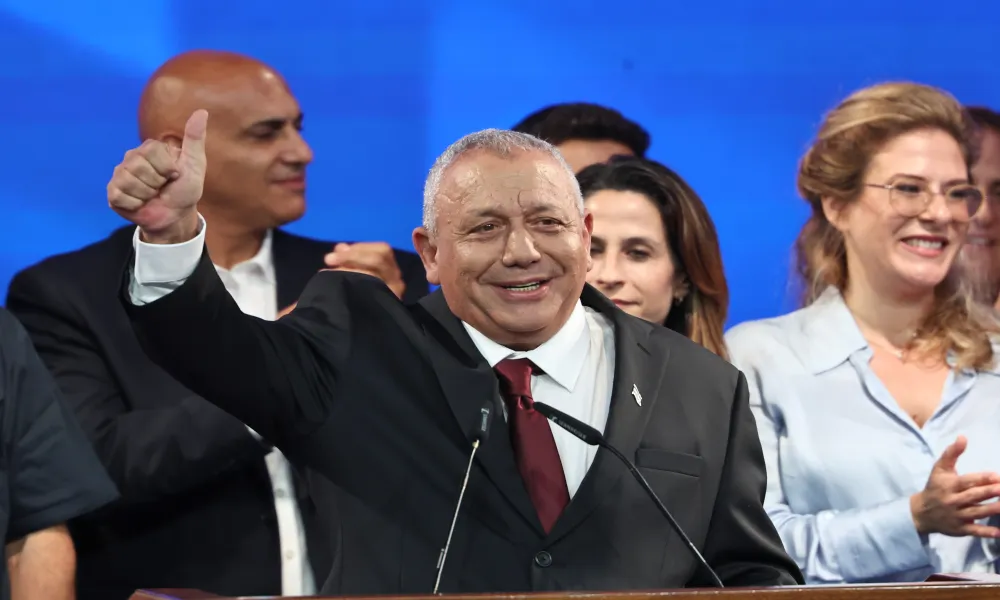

Israeli opposition leader Gadi Eisenkot, who formally received the mandate today to form Israel's next government, has said he is open to a coalition that could include the party of Benjamin Netanyahu, whom he has accused of plunging the country into a historic crisis.
Twelve days after the parliamentary elections, the 66-year-old former military chief secured the support of 67 members of parliament, compared with 46 for the outgoing prime minister.
During a ceremony at the presidential residence in Jerusalem, President Isaac Herzog called on him to build a government capable of uniting citizens across political divides.
“The State of Israel needs a stable government. Eisenkot, I expect you to do everything in your power to form a government that serves both those who voted for you and those who did not,” Herzog said.
In response, Eisenkot said he was prepared to welcome members of Netanyahu's Likud party into his coalition, despite having centred his election campaign on removing Netanyahu from power. He also said he would be open to members of Religious Zionism, the far-right party of outgoing Finance Minister Bezalel Smotrich.
“If members of these two parties genuinely believe the time has come for unity, I see no reason why they should not support a government led by me and based on the principles I have presented,” he said.
Eisenkot warned that Israel is passing through “one of the most critical periods the Israeli democracy has ever experienced” and is approaching “a point of no return”, calling for “creative and unconventional” political action.
He now has 28 days to form a coalition, with the possibility of a 14-day extension.
Minority government?
Coalition talks are expected to be difficult.
While parties backing Eisenkot are united in their desire to end Netanyahu's two decades of political dominance, they represent a broad ideological spectrum and remain divided over the shape of a future coalition.
The main point of contention concerns the role of the two principal Arab parties, which won 19 of the Knesset's 120 seats.
Their support could prove decisive, but some of Eisenkot's allies oppose relying on Arab party votes.
In a society deeply affected by the 7 October 2023 Hamas attack, cooperation with parties representing Palestinian citizens of Israel, who make up around 20 per cent of the population, could alienate part of the Jewish electorate.
Given these disagreements, Eisenkot may attempt to form a minority government despite lacking the 61 seats required for a parliamentary majority.
He hinted at that possibility by calling for the creation of a “national emergency government”.
Under such a scenario, only the 48 members of his own bloc would vote in favour of his government, compared with 46 aligned with Netanyahu. Some lawmakers from Arab and ultra-Orthodox parties could choose to abstain.
However, a government supported by only 48 lawmakers would be highly fragile, according to Asaf Shapira of the Israel Democracy Institute.
“To pass legislation, significant support from other parties is required,” Shapira told AFP, noting that every bill would require negotiations with other parliamentary groups.
At the same time, he said such arrangements could give Arab and ultra-Orthodox parties greater influence and strengthen parliamentary oversight of the executive.
Diplomatic challenges ahead
As efforts to form a government continue, President Herzog highlighted the diplomatic challenges facing Israel, particularly following the defeat of Donald Trump's political camp in the US midterm elections.
“We must move forward with diplomatic processes in the region after the war, implement the US president's 20-point plan for Gaza and deal with a new political reality in the United States,” Herzog said.
The Democrats, who emerged as the major winners in the midterms, have called for limits on support for Israel in light of the war in Gaza and the unpopular conflict with Iran, which began in late February under Netanyahu and Trump.
For his part, Netanyahu is seeking to exploit divisions among his opponents and continues to criticise Arab parties.
On Sunday, he reiterated that their inclusion in a governing coalition would “destroy the State of Israel from within.”
Source: ANA-MPA