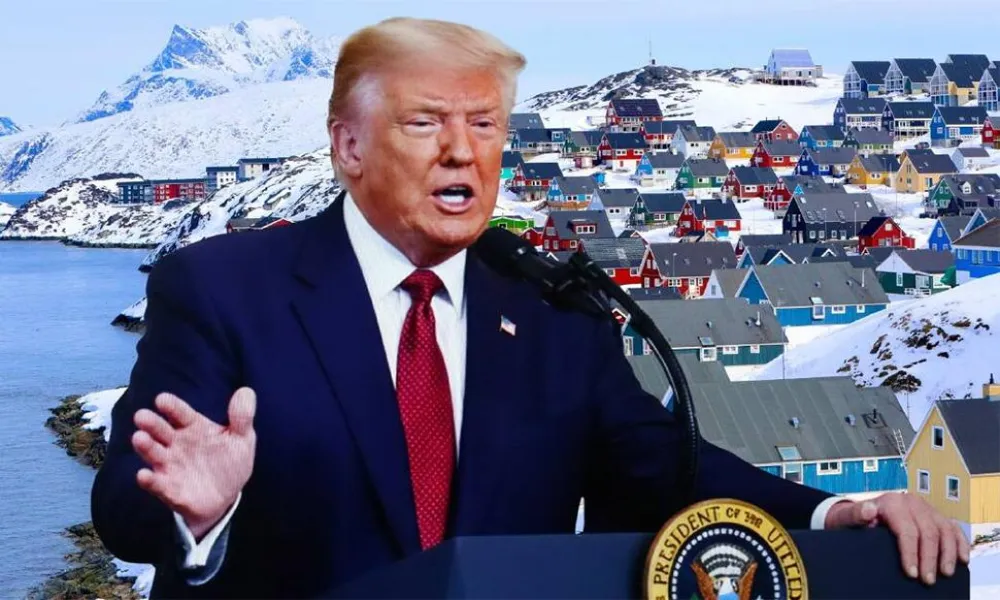

US President Donald Trump has said he may impose trade tariffs on countries that do not support the United States taking control of Greenland, escalating tensions with European allies as a bipartisan group of US lawmakers travelled to Denmark to calm the dispute.
Speaking on Friday at the White House during an event on rural health care, Trump said tariffs could be used as pressure over Greenland.
He said the United States “needs Greenland for national security” and added that he “may put a tariff on countries if they don’t go along with Greenland”.
This was the first time he publicly suggested using tariffs to force the issue.
Trump has for months argued that the US should control Greenland, a semi-autonomous territory that is part of the Kingdom of Denmark, a NATO ally.
Earlier this week, he said anything short of Greenland being in the US hands would be “unacceptable”. The White House has not ruled out the use of force.
The comments came as a group of US senators and members of the House of Representatives met Danish and Greenlandic leaders in Copenhagen. The delegation also held talks with Danish Prime Minister Mette Frederiksen. The visit aimed to reduce tensions and reaffirm long-standing ties.
Senator Chris Coons, a Democrat from Delaware who led the delegation, thanked Denmark for “225 years of being a good and trusted ally and partner”.
He said discussions focused on how to strengthen the relationship in the future. Republican Senator Lisa Murkowski of Alaska said the relationship was long-standing and “one that we need to nurture”.
Senator Murkowski said Greenland should be treated as an ally, not as a strategic asset. She also said most Americans oppose the idea of the United States acquiring Greenland. She cited polling showing around 75 per cent of Americans do not support such a move.
Earlier in the week, the foreign ministers of Denmark and Greenland met in Washington with US Vice President JD Vance and Secretary of State Marco Rubio.
The talks did not resolve the disagreement but led to plans for a joint working group. Denmark and the White House later gave sharply different accounts of the group’s purpose.
European leaders have said decisions about Greenland can only be made by Denmark and Greenland. Denmark has announced it will increase its military presence in Greenland in cooperation with allies, citing security concerns in the Arctic.
Trump has repeatedly said China and Russia are seeking influence in Greenland, which has large untapped reserves of critical minerals. He has used this claim to justify U.S. control of the territory.
Aaja Chemnitz, a Greenlandic politician and member of the Danish parliament who attended Friday’s meetings, rejected those claims. She said there had been “so many lies” and exaggerations about threats to Greenland. She said the main pressure currently faced by Greenland was coming from the United States.
In the US Congress, Senator Murkowski and Democratic Senator Jeanne Shaheen of New Hampshire have introduced bipartisan legislation.
The bill would block the use of US Defence or State Department funds to annex or take control of Greenland, or any NATO member’s territory, without that country’s consent or approval from NATO’s North Atlantic Council.
The issue is having a direct impact on Greenland’s political debate. Greenland’s Prime Minister, Jens-Frederik Nielsen, said on Tuesday that if forced to choose, Greenland would choose Denmark, NATO, the Kingdom of Denmark, and the European Union over the United States.
Indigenous leaders have also criticised statements from Washington. Sara Olsvig, chair of the Inuit Circumpolar Council based in Nuuk, said repeated claims that the US must own Greenland show how the administration views Greenlanders and Indigenous peoples.
The council represents around 180,000 Inuit across Greenland, Alaska, Canada and Russia’s Chukotka region.
Olsvig said the issue reflects how powerful states treat smaller and less powerful peoples. She said Indigenous Inuit in Greenland do not want to be colonised again.