
The Secretary-General of the United Nations, António Guterres, has recommended a 12-month extension of the mandate of the UN Peacekeeping Force in Cyprus (UNFICYP) until 31 January 2027, while raising serious concerns over violations linked to the construction of military installations in and around the buffer zone and the continued situation in Varosha.
In his observations accompanying the latest UNFICYP report, Guterres warns that such activities appear aimed at permanently altering the military status quo. At the same time, he notes the emergence of a cautious but tangible new dynamic in the Cyprus issue, following recent political developments and increased engagement between the two leaders.
The Secretary-General says he is encouraged by the absence of serious incidents within the buffer zone over the past year and by what he describes as restraint from major unilateral actions. However, he stresses that this has not translated into substantive progress towards de-escalation, particularly regarding the growing military build-up along the ceasefire lines.
Military concerns and surveillance systems
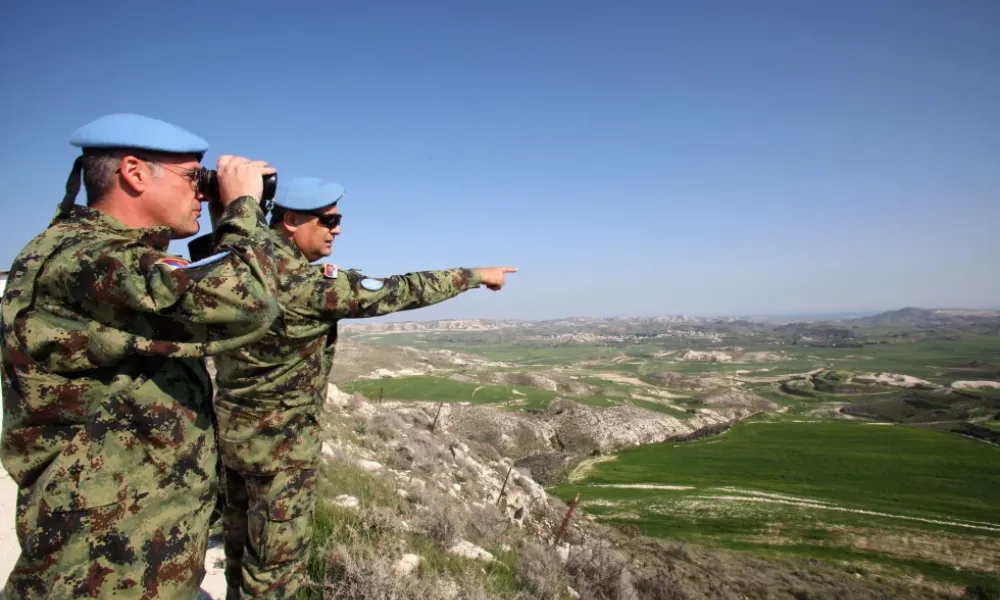
The report highlights ongoing concerns over military installations and surveillance systems deployed within and adjacent to the buffer zone. While the pace of installation slowed during the reporting period as projects near completion, UNFICYP continues to regard these systems as destabilising.
The National Guard slightly increased the number of surveillance devices, while Turkish forces proceeded with new towers and additional equipment. Other unauthorised constructions were also recorded. Of particular concern is the deliberate blurring of the distinction between civilian and military infrastructure, including the concealment of military positions within civilian structures, a practice the UN describes as deeply troubling.
UNFICYP’s role and limitations
Guterres underlines that UNFICYP remains central to maintaining stability, playing a key role in de-escalating low-level tensions and preserving the integrity of the buffer zone. He cautions, however, that the mission’s effectiveness depends on the full cooperation of both sides, reiterating that responsibility for respecting the buffer zone lies with the parties themselves.
He also issues a negative assessment of the continued stalemate over Pyla, noting that the prolonged suspension of the agreed arrangements does not contribute to stability and urging renewed cooperation with UNFICYP to identify a path forward.
Varosha and freedom of movement
The Secretary-General reiterates his concern over the fenced-off area of Varosha and the lack of response to Security Council calls to reverse actions taken since the partial opening of 2020. He recalls that the UN’s position, based on resolutions 550 and 789, remains unchanged and condemns ongoing restrictions on UNFICYP’s freedom of movement in Varosha, Strovilia and other locations.
Recommendation to renew the mandate
In light of UNFICYP’s continued contribution to peace and stability, Guterres formally recommends that the Security Council renew the mission’s mandate for a further year, until 31 January 2027. He also expresses appreciation to his newly appointed Special Representative and Head of UNFICYP, Khassim Diagne, for his dedicated leadership, and thanks the mission’s personnel for their sustained commitment.
Key findings from the UN Secretary-General’s report
Covering the period from 12 June to 15 December 2025, the report records increased political engagement alongside persistent and worrying trends of militarisation in and around the buffer zone.
Political developments
The UN notes intensified dialogue during the reporting period, including a July 2025 informal meeting convened by the Secretary-General in New York with the participation of both leaders and the guarantor powers Greece, Turkey and the United Kingdom. Progress was reviewed on six confidence-building initiatives agreed in March, ranging from youth engagement and environmental cooperation to new crossing points and solar energy use in the buffer zone. Four additional initiatives were agreed, including a civil society advisory body and air-quality monitoring.
A key development was the assumption of office by the new Turkish Cypriot leader, Tufan Erhürman, on 24 October 2025, followed by successive meetings with President Nikos Christodoulides under UN auspices in November and December. The report describes this as a sign of renewed leadership engagement.
Operational challenges and financial constraints
UNFICYP maintained an extensive presence in the buffer zone, conducting more than 15,000 military and police ground patrols and continuing to facilitate bicommunal contact. However, the mission operated under severe constraints due to the UN’s liquidity crisis.
Emergency measures led to a reduction of 60 military personnel, the freezing of five police posts and 13 vacant civilian positions. Only 20% of planned helicopter patrols were conducted between September and November, while bicommunal programmes were delayed or cancelled. October saw a 57% drop in bicommunal activities compared with 2024.
Security violations
By 30 November 2025, 146 violations had been recorded, with 112 attributed to Turkish forces and 34 to the National Guard. The report highlights long-term military investment along the buffer zone, including surveillance towers and sensors, which it warns could have destabilising effects.
Although installations slowed as projects neared completion, the UN continues to regard these systems as a major concern.
Varosha and responsibility
The report confirms that no steps have been taken to reverse actions in Varosha, despite Security Council resolutions. Renovation works, increased visitor numbers and ongoing military violations were recorded, while UNFICYP’s access remains severely restricted. The UN continues to hold Turkey responsible for the situation in the area.
Bicommual engagement and humanitarian issues
UNFICYP facilitated 163 activities during the reporting period, including 30 bicommunal events involving nearly 3,000 participants. Youth-focused initiatives, cultural cooperation and increased engagement in Pyla are described as encouraging signs.
The report also covers humanitarian issues, religious activities, education for enclaved persons and crossings, noting a decrease in asylum applications in 2025.
Significant reference is made to the Committee on Missing Persons, which has identified or exhumed the remains of 1,713 individuals since 2006. Leaders from both communities visited the CMP’s anthropological laboratory in December, reaffirming support for its strictly humanitarian mandate.
Finally, UNFICYP reports continued enforcement of the UN’s zero-tolerance policy on sexual exploitation and abuse. No such complaints were recorded during the period, though one allegation of sexual harassment and four cases of possible misconduct are under investigation.
Source: CNA