
The weaknesses of the existing legislation and the long-standing lack of decisiveness in taking measures against owners have intensified the problem, leaving public safety exposed. The new House of Representatives is now called upon to pass the new legislative framework for dangerous buildings as soon as possible.
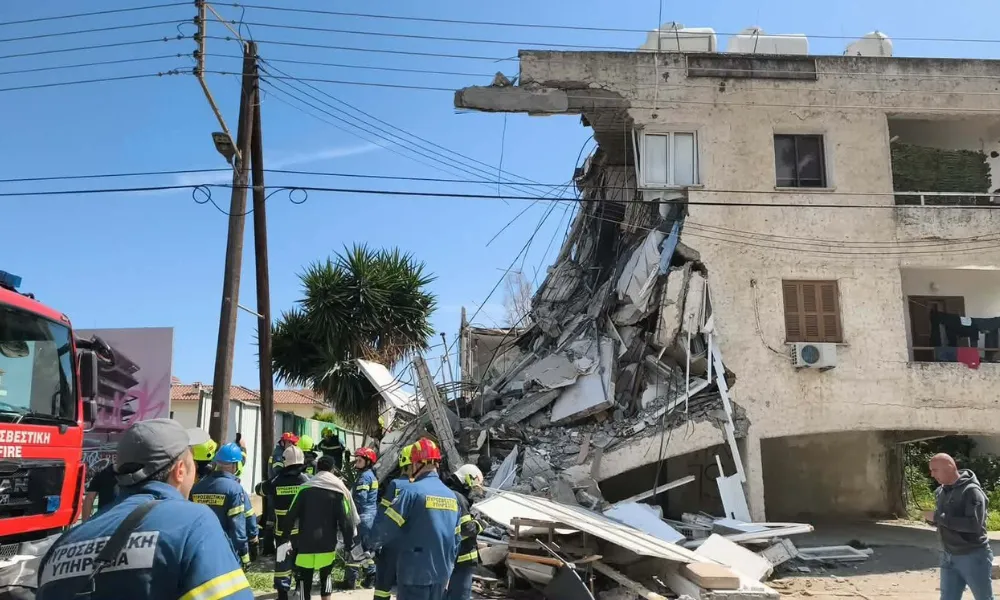
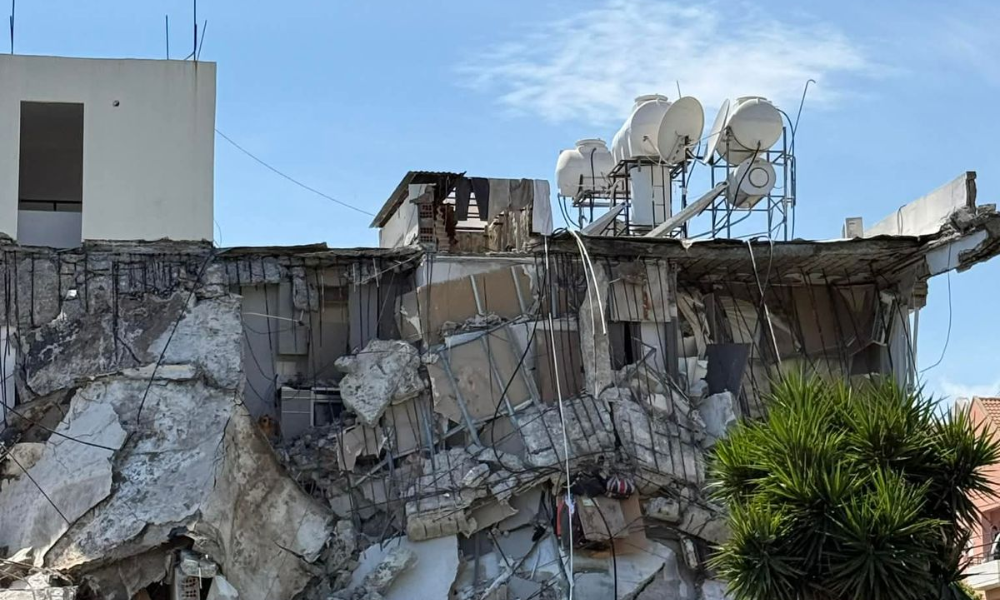
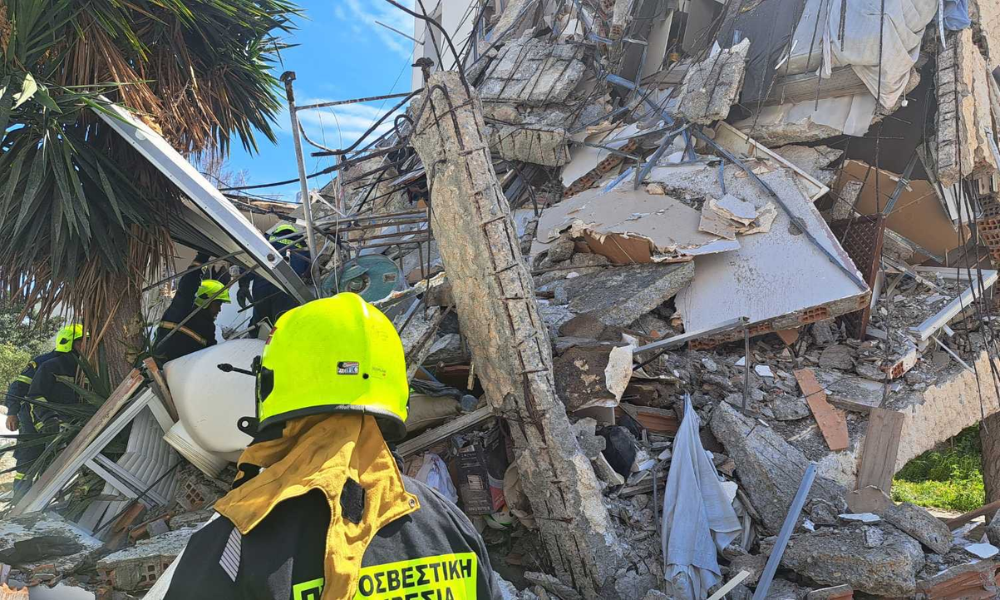
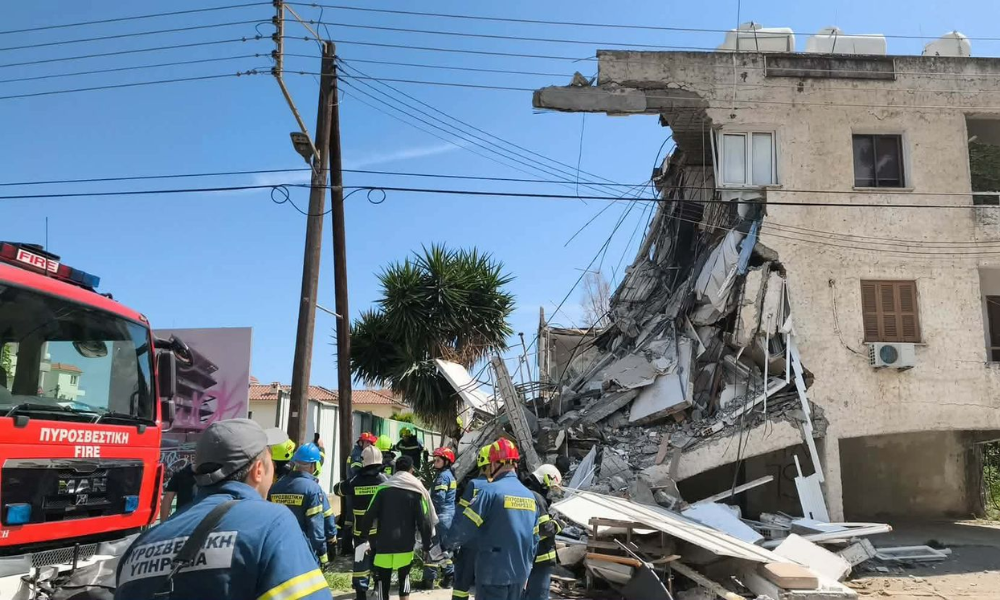
The dangerous condition of the building on Aeschylou Street in Germasogeia, which collapsed on Holy Saturday and claimed the lives of two young foreign nationals, had already been identified a decade ago by the then Municipality of Germasogeia, which sent a relevant letter to the apartment owners. What happened afterwards? Absolutely nothing. Today, victims are being mourned under the rubble of the building.
For the past year and a half, the competent authority for dangerous buildings has been the District Self-Government Organisations (EOAs), which inherited from municipalities and district administrations a list of 1,287 dangerous buildings across Cyprus. Most of these, including houses and apartment blocks, are located in Nicosia and Limassol. However, the real number is estimated to be much higher, which is why inspections by the EOAs have been decided.
The Minister of Interior, Konstantinos Ioannou, has requested the publication of the dangerous buildings so that both residents and the wider public are informed, in order to prevent further loss of life.
Two main reasons explain why the state has so far failed to address the issue of dangerous buildings, which was tragically brought back into public attention following the unjust deaths of the two young foreign nationals:
- Weaknesses in the current legislation, and
- Lack of decisiveness by the competent authorities in taking action.
Owners of dangerous properties often ignore recommendations for improvement works while renting out unsafe and unsuitable premises to migrants, who, lacking the financial means, are forced to seek the cheapest options available. These practices are the target of the “name and shame” approach proposed by Konstantinos Ioannou.
Members of the House Interior Committee, responding to criticism in recent days that they had not advanced amendments to the existing legislation to provide additional tools to the EOAs, stated that the issue could also be addressed within the current legal framework, provided that there is the will and determination to act. To some extent they are correct regarding the adequacy of the legislation, while they are absolutely correct about the lack of decisiveness.
What the current framework provides
The current regulatory framework governing the management of dangerous buildings is defined by the Streets and Buildings Regulation Law, particularly Articles 15A–15E, under which the competent authority may act as follows in cases involving dangerous structures:
- Article 15A, which concerns buildings showing deterioration but not posing an immediate danger (potentially dangerous buildings), allows the competent authority to issue a notice to the owner. Through this notice, the owner is required to appoint a consultant to prepare a report or repair study and submit it promptly to the authority. The owner may also be required to repair, remove, protect or fence the building and take any other measures specified in the notice within a defined timeframe.
- Article 15B, which concerns dangerous buildings, grants the competent authority the power to enter a dangerous building on its own initiative and take all necessary measures to eliminate the immediate risk. Additionally, through written notice served on the owner or occupants, the authority may request that the building be vacated within a specified period. If this request is refused, the authority may apply for a court order for the removal of persons and the evacuation of the building.
Furthermore, the competent authority may request the owner to appoint a consultant within a specified timeframe to prepare a report or study on eliminating the danger and repairing the building, and to submit it promptly to the authority. The owner may also be required to repair, remove, protect or fence the building and implement all necessary measures outlined in the notice within the prescribed timeframe.
If the owner is unable to carry out the required actions, they may inform the authority in writing within three days of receiving the notice, explaining the reasons for non-compliance. If the owner fails to comply within the deadline, the competent authority may undertake the necessary works itself, with the costs to be borne by the owner and recoverable as a civil debt.
Any person who receives a notice under Article 15B but fails to carry out the required works within the specified timeframe commits an offence under Articles 15D and 15E and is subject to criminal and/or administrative sanctions.
- Article 15D provides criminal penalties for non-compliance with such notices. Upon conviction, penalties may include imprisonment of up to one year and/or a fine of up to €10,000. In the event of a second or subsequent conviction, imprisonment may reach up to two years and fines up to €20,000.
- Article 15E establishes administrative fines independently of any criminal liability. In cases of non-compliance with notices concerning dangerous buildings, the competent authority may impose a fine of up to €20,000, with an additional daily fine of up to €200 if the violation continues. If the fine is not paid, the authority may take legal action to recover the amount as a civil debt.
Dangerous buildings in numbers
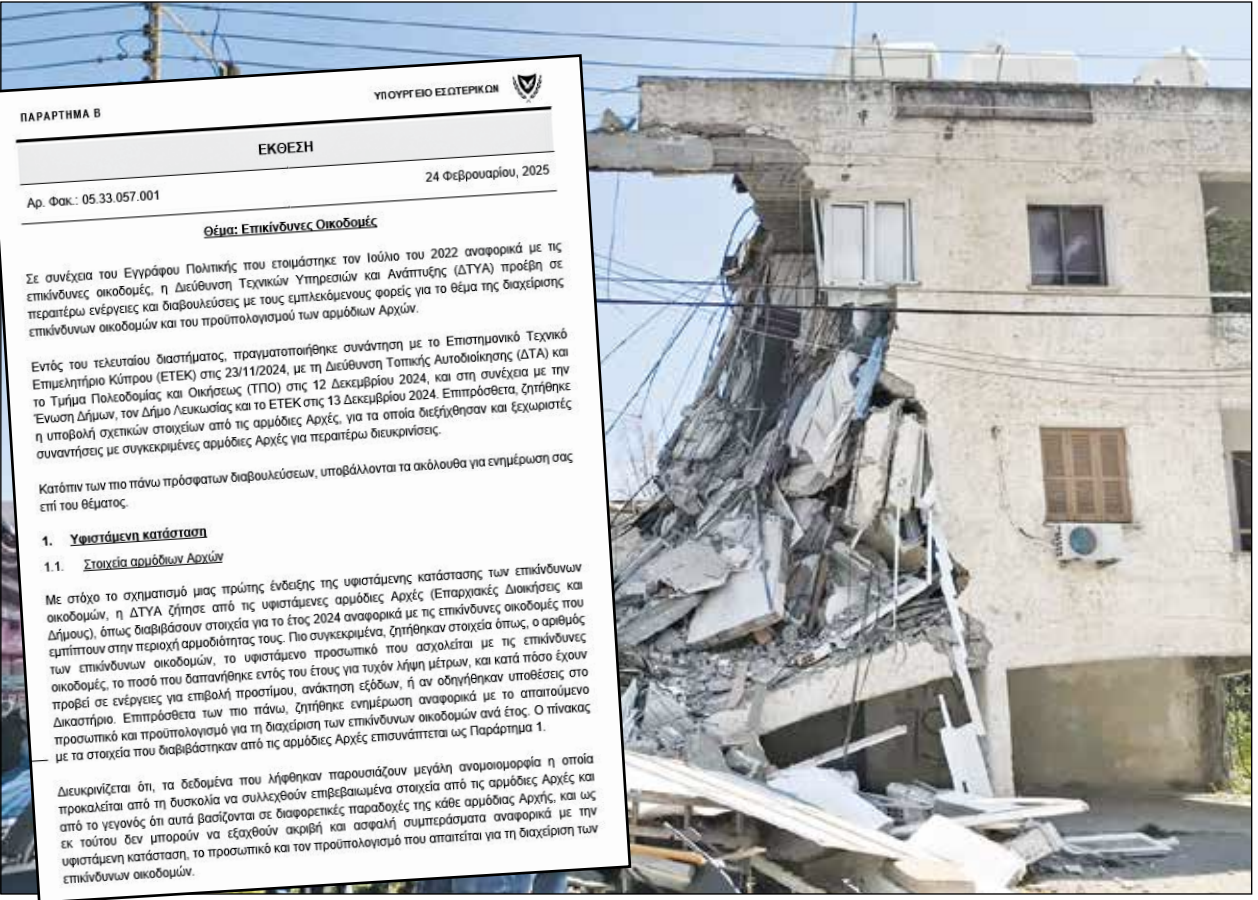
In 2024, in order to obtain an initial picture of the situation, the Technical Services and Development Directorate of the Ministry of Interior requested data from the then competent authorities, namely district administrations and municipalities.
The submitted data revealed the following:
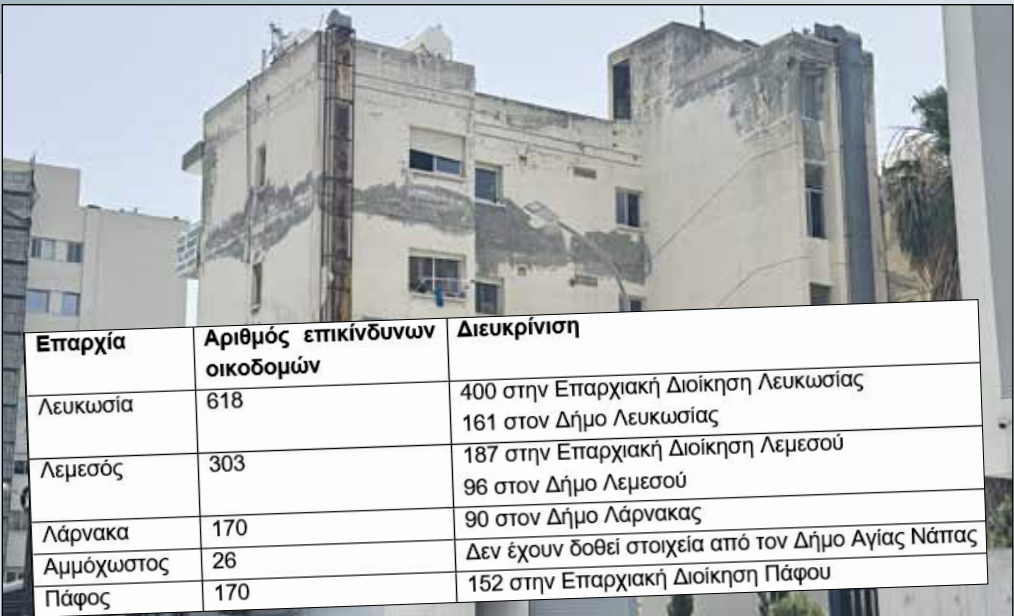
- The total number of dangerous buildings in 2024 reached 1,287 across Cyprus, excluding Turkish Cypriot properties.
- The highest number of dangerous buildings was recorded in Nicosia district (581) and Limassol district (303). Among the 25 competent authorities, the largest numbers were managed by the Nicosia District Administration (400), the Limassol District Administration (187), the Municipality of Nicosia (161), the Paphos District Administration (152), the Municipality of Limassol (96) and the Municipality of Larnaca (90). In the remaining authorities, the number did not exceed 35.
- The largest budgets for addressing dangerous buildings were recorded by the Municipality of Nicosia (€160,000)and the Municipality of Limassol (€100,000). Overall, the total amount spent in 2024 by seven competent authorities did not exceed €13,000, while the remaining fifteen authorities made no expenditure at all.
- The cost of removing risks in apartment buildings is extremely high. According to estimates by the Municipality of Limassol, measures for a detached house cost around €10,000, while for an apartment building the cost can reach €250,000. In one example, Limassol Municipality considered risk-removal works for a nine-storey building with an estimated contract value of about €570,000, which was ultimately not awarded due to the high cost.
- There is no uniform approach among authorities in managing dangerous buildings. For example, the Nicosia District Administration reported 400 dangerous buildings with an estimated annual cost of €50,000, while the Municipality of Strovolos reported about 35 buildings requiring €350,000 annually. Meanwhile, the Municipality of Paphos reported about nine buildings with an estimated annual cost of €2.5 million.
Weaknesses of the law
Despite the legal tools available, problems persist in implementing the legislation.
A study conducted last year by the Technical Services and Development Directorate of the Ministry of Interior highlighted significant weaknesses in the current legal framework, including difficulties in serving notices to property owners and particularly lengthy court procedures.
Under current legislation, notices must be served via registered double-post letters, which in many cases remain uncollected because recipients assume they relate to traffic camera fines. Additional difficulties arise in locating owners or their heirs, who may live abroad or may have died.
Even when measures to remove danger are implemented by either the authority or the owner, the duration of restoration cannot always be determined. In several cases, interventions are temporary, with buildings quickly returning to a dangerous condition.
The way dangerous buildings have been handled to date raises concerns about the effective management of both public safety and state resources. In many cases, instead of limiting their actions to emergency risk removal, authorities effectively become contractors repairing privately owned buildings whose owners neglect their maintenance, particularly in the case of apartment buildings where costs are much higher.
Lack of decisiveness
The research by the Technical Services and Development Directorate also explains how the EOAs inherited the 1,287 dangerous buildings from municipalities and district administrations.
Beyond legislative weaknesses, responsibility is also attributed to the lack of decisiveness by municipalities and district administrations in activating the legal tools available and taking measures against owners.
For example, according to oral information provided by the Municipality of Limassol, previous municipal councils had decided not to impose administrative fines. Similarly, the Municipality of Nicosia reportedly followed a practice of not initiating criminal proceedings, mainly because of the time required for court cases.
Such practices reinforce a sense of impunity and weaken efforts to prevent and address dangerous buildings.
Data collected for 2024 show that out of 25 municipalities, only two imposed administrative fines, three initiated cost recovery procedures, and three pursued court action against owners. According to both the Nicosia and Limassol municipalities, a significant level of owner compliance is achieved simply by notifying them of the authority’s intention to take such measures.
Significant legislative changes under preparation
In March 2025, the Ministry of Interior submitted proposals to the House of Representatives to amend the current legislation in order to provide additional tools to the EOAs. Instead of submitting a separate government bill, the ministry incorporated its proposals into existing legislative proposals already under discussion by the House Interior Committee, originally submitted by former DIPA MP and current Minister of Labour Marinos Mousiouttas.
These proposals remain pending before the House.
Among the proposed amendments are:
- Simplifying the process of serving notices by removing the requirement to send double registered letters and introducing alternative notification methods such as publication on the EOA website and notification of the local authority.
- Allowing demolition of dangerous buildings as a risk removal measure.
- Introducing ex parte court orders to enable rapid measures and evacuation of dangerous properties.
- Prohibiting the use or rental of buildings declared dangerous.
- Allowing water and electricity disconnections to pressure occupants to vacate dangerous buildings.
- Allowing authorities to seal dangerous buildings to prevent entry.
- Registering charges on the property to cover expenses incurred by the EOA for risk removal, with repayment arrangements for owners.
- Increasing the administrative fine from €20,000 to €40,000, with daily fines of up to €200 for continued violations.
- Increasing court-imposed fines to €20,000 for a first conviction and €40,000 for subsequent convictions.
Periodic inspection under discussion
Another proposal under discussion is the introduction of periodic building inspections, which would transfer responsibility for identifying dangerous buildings from the EOAs to property owners, with the involvement of members of the Cyprus Scientific and Technical Chamber (ETEK).
However, the Ministry of Interior has decided not to proceed with this measure at this stage due to unresolved issues, including the pending legislation on management committees for apartment buildings and housing complexes and the absence of a comprehensive national building registry.
“Name and shame”
According to the Minister of Interior, Konstantinos Ioannou, the aim of publishing lists of dangerous buildings is to ensure public safety and protect human life by fully informing those affected.
Public disclosure could have positive results. It would exert real pressure on owners to fulfil their obligations while also helping to prevent new tragic incidents.