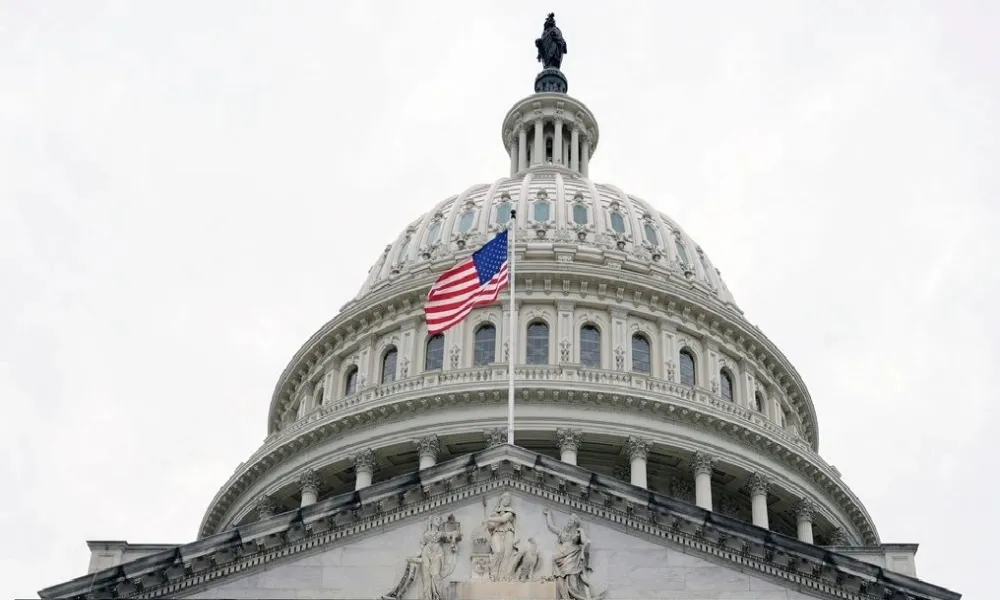


The US House of Representatives has passed a resolution directing President Trump to withdraw American forces from the conflict with Iran, the clearest congressional rebuke yet of a war now in its fourth month, as Trump himself appears stuck between an elusive diplomatic deal and a ceasefire that is fraying at the edges.
The House voted 215 to 208 on Wednesday to adopt the war powers resolution, with four Republicans crossing party lines to support it: Tom Barrett of Michigan, Brian Fitzpatrick of Pennsylvania, Warren Davidson of Ohio and Thomas Massie of Kentucky. It was the fourth time the House had attempted such a measure, and the first time it passed. Republican leaders had postponed the vote two weeks earlier when it became clear they lacked the numbers to defeat it, but the delay bought them nothing. Dissatisfaction with the war has only deepened.
The resolution now heads to the Senate, which under the War Powers Resolution of 1973 must take it up within roughly two and a half weeks. Its practical force, however, remains uncertain. Even if both chambers were to pass the measure, it would almost certainly require Trump's signature to be legally binding, or a two-thirds majority in both houses to override a veto. The Senate advanced its own parallel resolution last month on a procedural vote, but a final vote has not yet been scheduled.
Speaker Mike Johnson warned before the vote that passing the resolution would be a "dangerous prospect" that would weaken the president's authority to pursue a peaceful end to the conflict. The Trump administration has consistently argued that congressional efforts to limit the president's war powers are unconstitutional. Those arguments have done little to quiet the growing unease within the Republican Party, where the political arithmetic of the midterm elections is sharpening minds.
The vote in Congress came against a backdrop of mounting diplomatic uncertainty. Nearly a week has passed since American and Iranian negotiators reached a tentative agreement to extend the ceasefire by 60 days and open a new round of nuclear talks, but Trump has called for unspecified changes to the deal and Iranian officials show no sign of yielding to new demands. A series of exchanges of strikes this week, including Iranian drone attacks on Kuwait's airport and on targets in Bahrain, has raised fresh concern that the fragile truce could collapse altogether. Trump told reporters on Wednesday that the ceasefire was still holding and that negotiations had gone "very well," suggesting a potential breakthrough could come "over the weekend." Iranian officials have been more cautious, with Tehran insisting there is no formal negotiation process under way.
Secretary of State Marco Rubio, appearing before the House Foreign Affairs Committee on Wednesday, said that any nuclear agreement with Iran would be put before Congress. The hearing was a fractious affair, with Democratic members pressing Rubio not only on the war but on the president's fitness for office. The session deteriorated into open confrontation, with Rubio at one point asking: "Is this the Foreign Affairs Committee? Or is this a circus?"
The conflict began on 28 February 2026, when the United States and Israel launched large-scale strikes on Iran, killing Supreme Leader Ali Khamenei and triggering a chain of Iranian retaliatory strikes across the region. The war has disrupted global energy supplies, pushed oil prices back toward $100 a barrel, closed the Strait of Hormuz to normal shipping and sent economic shockwaves well beyond the Middle East. Trump had campaigned on a promise to end foreign military entanglements, and the gap between that promise and the current reality is increasingly difficult for members of his party to ignore.
Sources: Associated Press, NPR, CNN, Washington Post, Reuters