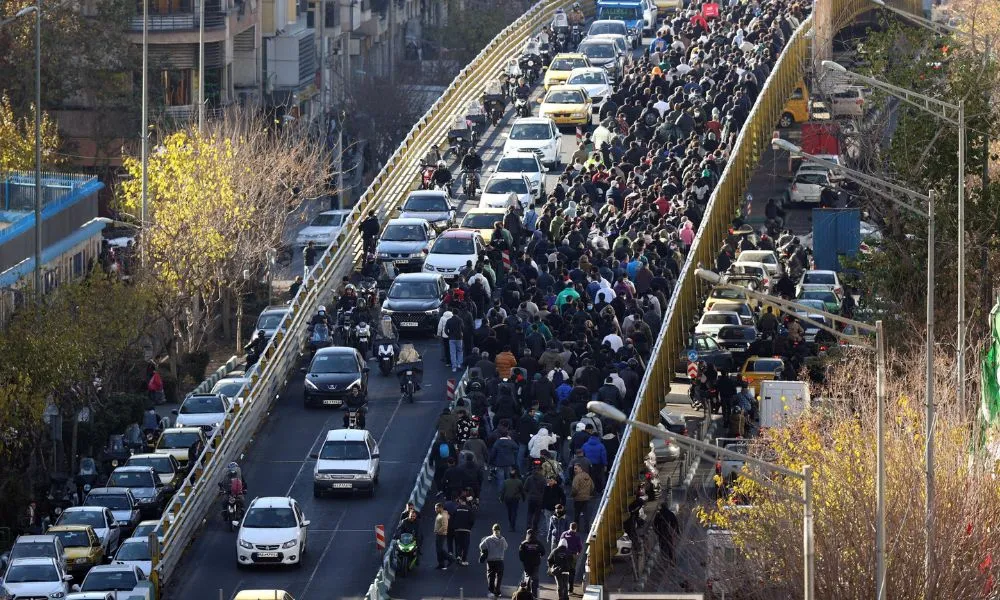
Iran is facing a renewed wave of unrest as protests driven by economic hardship expand across the country. With the national currency at historic lows and inflation eroding daily life, demonstrations that began in urban centres have now reached provincial towns, prompting a tougher response from the authorities and leaving at least three people dead.
Protests spread beyond Tehran
While demonstrations in Tehran have slowed in recent days, unrest has widened across the country. In the city of Lordegan, in the southwestern province of Chaharmahal and Bakhtiari, videos circulating online showed crowds gathered in the streets as gunfire was heard nearby. The footage was verified through identifiable landmarks in the area, around 470 kilometres south of the capital.
The semi-official Fars News Agency, citing an unnamed official, reported that two people were killed during clashes on Thursday. The US-based Abdorrahman Boroumand Center for Human Rights in Iran also confirmed two deaths, identifying those killed as demonstrators. Iranian state media did not immediately report the violence in Lordegan.
A pattern of unrest
Lordegan is no stranger to turmoil. In 2019, the area saw widespread protests after reports that residents had been infected with HIV through contaminated needles at a local clinic, with demonstrators at the time damaging government buildings.
Separately, a protest on Wednesday night reportedly resulted in the death of a 21-year-old volunteer member of the Islamic Revolutionary Guard Corps Basij force. The state-run IRNA confirmed the death but provided no further details. Another outlet, the Student News Network, which is considered close to the Basij, blamed demonstrators, citing comments by a deputy governor in Lorestan province.
All three fatalities were reported in cities predominantly inhabited by Iran’s Lur ethnic group.
Economic pressure at the core
Officials have acknowledged that the protests are rooted in economic distress. According to local authorities, inflation, rising living costs and the collapse of the national currency have pushed many Iranians to the streets.
Reformist President Masoud Pezeshkian has publicly conceded that his options are limited as the rial continues to slide. The currency has now fallen to around 1.4 million rials to the US dollar, a record low that has intensified public anger.
“The protests are an expression of livelihood concerns,” said a senior provincial official, pointing to inflation and currency instability as the main triggers.
The biggest protests since 2022
The current unrest is the most significant since 2022, when the death of Mahsa Amini in police custody sparked nationwide demonstrations. While the latest protests are largely economic in nature, some demonstrators have also been heard chanting slogans against Iran’s leadership.
In an apparent attempt to thin crowds in the capital, authorities declared Wednesday a public holiday across much of the country, officially citing cold weather. The move was widely interpreted as an effort to encourage residents to leave Tehran for a long weekend.
Arrests and security operations
State television reported the arrest of seven people, including five described as monarchists and two allegedly linked to Europe-based groups. In a separate operation, security forces were said to have seized 100 smuggled pistols, though no further details were provided.
As protests continue to ripple through Iran’s provinces, the combination of economic freefall and an increasingly forceful security response suggests the unrest may be far from over.