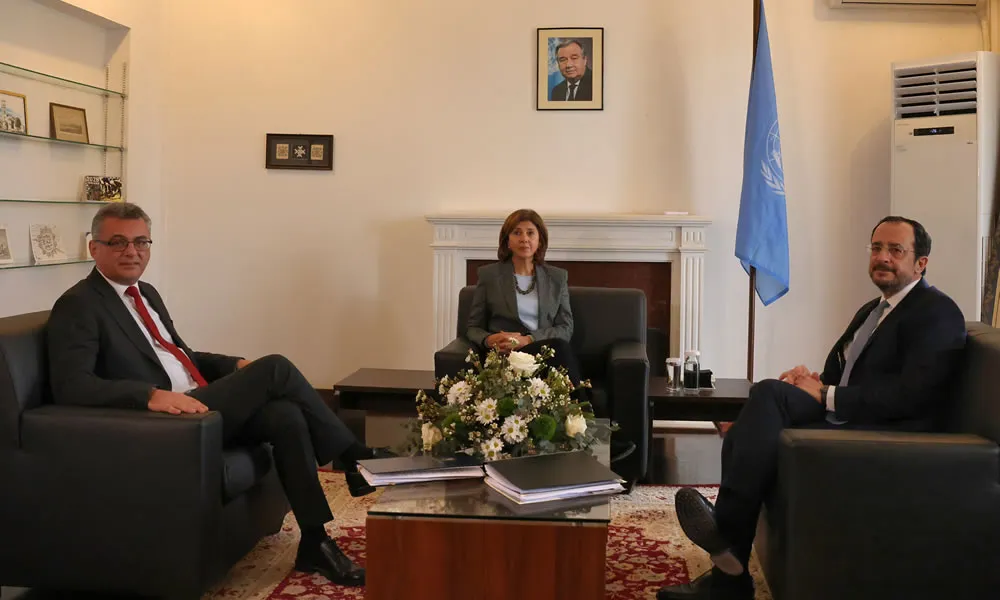
With the arrival of United Nations Secretary-General António Guterres’ Personal Envoy María Ángela Holguín in Cyprus on June 6, the Cyprus issue has once again moved to the forefront of diplomatic attention. As she prepares to meet the two leaders separately on Monday, June 8, expectations of renewed movement are growing, even as fundamental questions remain unanswered about the objectives, methodology and ultimate destination of any future process.
After months of relative quiet following the informal Geneva meeting in March, Holguín’s return is being interpreted by many observers as evidence that the United Nations has not abandoned efforts to inject new momentum into a process that has remained effectively frozen since the collapse of the Crans-Montana negotiations in 2017. Yet while expectations are rising, clarity remains remarkably scarce. The defining feature of the current moment is not momentum itself but ambiguity.
What exactly is Holguín coming to discuss? Is the objective an informal five-plus-one meeting later this summer? A joint declaration? A package of confidence-building measures? A roadmap toward renewed negotiations? Or merely an assessment of whether sufficient common ground exists to justify further diplomatic engagement?
The answer appears to depend largely on whom one asks.
Expectations are growing faster than substance
On the Greek Cypriot side, expectations have been steadily building over the past several weeks. President Nikos Christodoulides has repeatedly spoken about intensified diplomatic activity behind the scenes and has suggested that developments could eventually lead to a concrete settlement framework before the end of 2026.
While neither Turkish Cypriot leader Tufan Erhürman nor Ankara has publicly or discreetly suggested that a breakthrough in the more than six-decade-old Cyprus dispute is imminent, a noticeably different mood has emerged in sections of the Greek Cypriot political and media landscape. Much of the optimism appears to stem from expectations surrounding the renewed UN engagement and President Nikos Christodoulides’ references to behind-the-scenes diplomatic contacts following discussions last March 12 between UN Secretary-General António Guterres and Turkish President Recep Tayyip Erdoğan.
Greek Cypriot media reports have increasingly focused on scenarios that could potentially lead to a new phase in the process. Among the possibilities being discussed is an informal three-stage approach. Under this scenario, the first objective would be to secure agreement on a common political document defining the framework for future engagement. This could then be followed by efforts to formulate a broader strategic understanding between the parties, creating the political basis for a more substantive process. Only at a later stage would the parties move toward discussions on a comprehensive settlement.
Some commentators have gone a step further, speculating that if sufficient common ground can be identified during Holguín’s consultations, the United Nations may consider convening another informal expanded meeting later this summer involving the two Cypriot leaders, the three guarantor powers, and the United Nations. However, such discussions remain largely speculative at this stage, as no agreement has yet emerged on either the framework or the ultimate objective of any future process.
The problem is that none of these scenarios currently exists beyond the level of speculation.
Yet beneath the growing speculation, the hard facts remain remarkably unchanged. No agreed document has been announced. No mutually accepted negotiating framework has emerged. Nor has there been any indication that the Greek Cypriot side has moved closer to accepting the four-point methodology proposed by Turkish Cypriot leader Tufan Erhürman for what he has described as a “new exercise” on Cyprus, one designed to respond to UN Secretary-General António Guterres’ repeated insistence that any future process must be different from the many initiatives that have failed over the past six decades.
Equally, neither Ankara nor the Turkish Cypriot side has signaled any departure from their publicly stated positions regarding sovereign equality, equal international status, and the need for a fundamentally different negotiating architecture. As a result, the core disagreement that has frustrated successive UN efforts remains largely intact. The parties continue to differ not only on the substance of a possible settlement but also on the methodology, objectives and even the starting point of any future process. In that sense, despite renewed diplomatic activity and rising public expectations, the strategic gap separating the sides appears today much where it was before Holguín’s reappointment.
As a result, expectations continue to rise while the substance needed to sustain those expectations remains difficult to identify.
The same old question: What is the destination?
The central problem confronting Holguín may not be the lack of dialogue but the absence of agreement on where that dialogue should lead.
The Greek Cypriot leadership continues to insist that the only acceptable framework remains a bizonal, bicommunal federation with political equality as defined by United Nations resolutions.
The Turkish Cypriot side, supported by Türkiye, continues to maintain that sovereign equality and equal international status must be acknowledged before any formal negotiation process can begin.
These are not merely different negotiating tactics. They represent fundamentally different conceptions of the problem itself. For the Greek Cypriot side, the challenge is how to restart a process aimed at reunification. For the Turkish Cypriot side, the challenge is how to establish a relationship between two equal entities before discussing future arrangements.
The gap between those positions remains substantial. Holguín’s mission therefore appears less focused on launching negotiations and more focused on determining whether any bridge can still be built between these competing visions.
Confidence-building measures have limits
To be sure, some progress has been achieved in recent months. The two leaders have agreed on a number of confidence-building measures and technical initiatives, including cooperation on civil society participation, economic affairs, public health concerns and certain religious issues.
These developments should not be dismissed. They help preserve communication channels and demonstrate that cooperation remains possible in specific areas. However, they do not address the core political dispute.
Even the frequently discussed issue of opening new crossing points appears unlikely to produce an immediate breakthrough. Reports from both sides suggest that no major announcement should be expected during Holguín’s visit.
Consequently, the United Nations envoy faces a familiar dilemma. Technical cooperation can improve the atmosphere, but it cannot by itself resolve disagreements over sovereignty, governance, political equality or international status.
The challenge is transforming confidence-building into confidence itself.
Ankara remains the decisive variable
One of the more noteworthy developments in recent months has been the increasingly explicit acknowledgment, particularly within sections of the Greek Cypriot political and media establishment, that the Cyprus issue cannot be viewed solely through the prism of intercommunal relations on the island. President Nikos Christodoulides himself has repeatedly stated that “the key lies in Ankara,” an observation that reflects a growing recognition that any meaningful progress will require not only accommodation between the two Cypriot sides but also a broader understanding of Türkiye’s strategic interests.
This recognition is important because it touches on a reality that has often been overlooked in public debate. Historically, the Cyprus issue has always rested on two interconnected pillars. The first is the internal balance between the island’s two politically equal founding communities, Greek Cypriots and Turkish Cypriots. The second is the external balance between Greece and Türkiye, established through the 1960 constitutional order and the Treaty system that accompanied it. Every major diplomatic initiative, from the establishment of the Republic in 1960 to the Annan Plan and the Crans-Montana process, has ultimately struggled whenever one of these two balances was neglected.
The emerging debate within Greek Cypriot circles suggests a growing awareness that a settlement cannot be achieved solely by appealing to the Turkish Cypriot community while disregarding Ankara’s calculations. If Türkiye remains committed to the sovereign equality approach and sees little strategic advantage in returning to a process based exclusively on previously failed parameters, then the obvious question becomes: what incentives exist for Ankara to engage differently?
Several Greek Cypriot commentators have begun addressing this question with unusual candor. They argue that if a solution remains the stated objective, then the Greek Cypriot administration and its European partners must demonstrate why a settlement would be more beneficial for Türkiye than the continuation of the current status quo. Such a discussion inevitably extends beyond the island itself and touches on broader issues including Türkiye-EU relations, Customs Union modernization, regional energy cooperation, Eastern Mediterranean stability, trade, connectivity, and Türkiye’s broader role within the evolving European security architecture.
In many respects, this may represent one of the few genuinely new elements in the current debate. Previous initiatives were often built on the assumption that resolving Cyprus would automatically improve relations between Türkiye and the European Union. A growing number of observers now appear to be considering the reverse possibility: that progress on Cyprus may require first addressing the wider strategic environment in which Ankara makes its calculations.
Whether this emerging recognition evolves into a coherent diplomatic strategy remains uncertain. So far, little evidence has emerged that a comprehensive package capable of influencing Turkish strategic calculations is being actively developed. Nevertheless, the acknowledgment that the Cyprus issue is larger than Cyprus itself, and that any durable settlement must accommodate both the internal balance between the two communities and the external balance between Greece and Türkiye, may ultimately prove to be one of the more significant developments surrounding Holguín’s latest mission.
Political tensions in the north
The political atmosphere in northern Cyprus adds another layer of complexity to Holguín’s mission. With an early election widely expected in the fall, the debate over the future direction of the Cyprus issue is becoming increasingly intertwined with domestic political competition. The recent public exchange between Tufan Erhürman and Tahsin Ertuğruloğlu reflects not simply a personal disagreement but a broader divide over how the Turkish Cypriot side should engage with the latest UN effort.
Ertuğruloğlu’s strongly worded intervention highlighted concerns among supporters of the sovereign equality and equal international status policy that renewed diplomatic activity could gradually draw the Turkish Cypriot side back into negotiating frameworks they consider to have been exhausted after decades of unsuccessful attempts. At the center of the debate lies a fundamental question: can the emerging process genuinely differ from previous initiatives, as repeatedly advocated by UN Secretary-General António Guterres, or is it ultimately another effort to revive approaches that many Turkish Cypriots believe have consistently failed to deliver political equality, mutual consent or a sustainable settlement?
The controversy has also acquired an additional political dimension. In some Turkish Cypriot political circles, Ertuğruloğlu’s intervention is viewed not merely as the position of a ruling coalition member but as reflecting the thinking of influential policy circles in Ankara that remain deeply skeptical of any process perceived as a return to pre-2020 negotiating paradigms. Whether accurate or not, this perception contributes to the belief among some observers that the debate extends beyond domestic politics and forms part of a wider discussion taking place between northern Cyprus and Türkiye over the future parameters of the Cyprus issue.
What makes the debate politically significant is not that new arguments are being introduced, but that longstanding questions are being asked with renewed urgency. What exactly is the objective of the current diplomatic effort? What methodology will be followed? And perhaps most importantly, who will determine the parameters of any future process? These questions reflect a growing demand within parts of the Turkish Cypriot political spectrum for greater clarity regarding both the substance and direction of the UN initiative.
As a result, the debate is no longer confined to competing visions of a future settlement. It increasingly concerns the process itself, its transparency, its starting assumptions and whether the parties are entering discussions with a common understanding of what constitutes success.
The burden of ambiguity
The Cyprus problem has experienced many diplomatic cycles over the decades. A familiar pattern often emerges. Diplomatic activity generates optimism. Optimism generates expectations. Expectations eventually encounter political realities.
The current moment risks following the same trajectory. Almost everyone appears to support dialogue. Almost everyone welcomes diplomatic engagement. Yet there is little agreement regarding the destination, the timetable, the methodology or even the definition of success.
That ambiguity creates opportunities but also risks. Optimists see flexibility. Skeptics see confusion. Supporters see momentum. Critics see another exercise in expectation management. Both interpretations contain elements of truth.
A test for Holguín and for the parties
Ultimately, the significance of Holguín’s visit will not be measured by the number of meetings she holds or the diplomatic statements that follow. It will be measured by whether she can identify even a minimal area of common understanding capable of sustaining further engagement.
Can the parties agree on a common starting point? Can confidence-building measures evolve into political dialogue? Can the United Nations identify language that both sides can accept without appearing to abandon their core positions?
Those are the questions that will determine whether the coming months produce genuine movement or simply another round of diplomatic choreography.
For now, one conclusion seems unavoidable. The return of Holguín has reopened the conversation about Cyprus. But it has also exposed how much uncertainty still surrounds the process. Expectations are rising. Frustrations are visible. Controversies are multiplying.
And beneath it all remains the same unresolved question that has haunted every Cyprus initiative for decades: movement toward what, exactly?