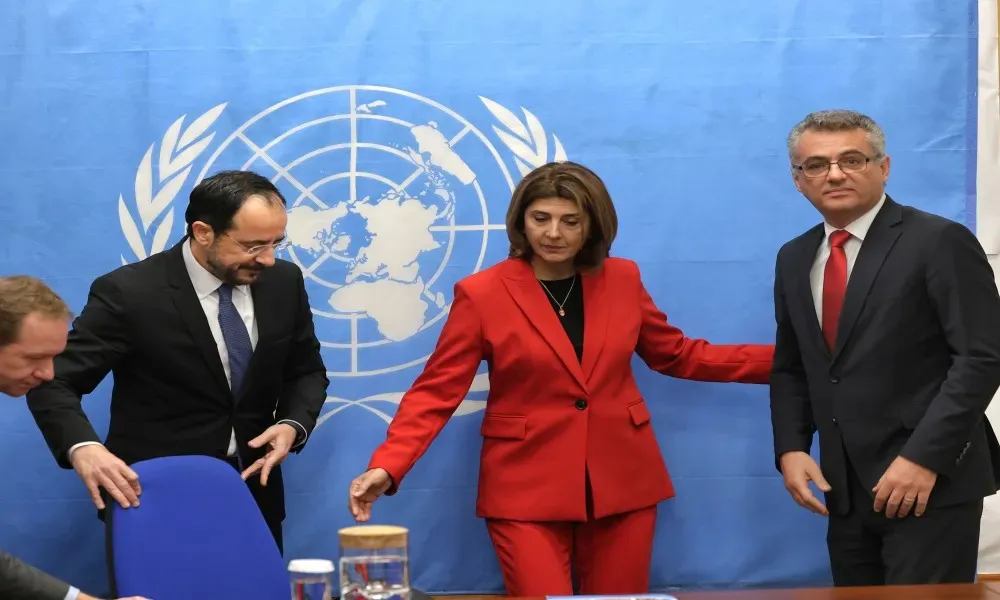
A calm political reading of Maria Angela Holguin’s statements and her meetings on Friday with the two leaders is that the United Nations now considers the convening of a new informal 5+1 expanded conference as almost certain, but not yet the start of substantive negotiations for a solution. Holguin consistently repeats that “we are working for the 5+1” and appears confident that it will take place, without however committing to a date or a specific political outcome. From the information available, four points stand out:
-
The current activity does not have formal characteristics but moves within the sphere of possible developments. The fact that Holguin will have contacts in Turkey today with Foreign Minister Hakan Fidan, will later travel to Athens, and after contacts in Brussels will return to Nicosia in two weeks demonstrates the extent of coordination among those involved before the conference is announced.
-
The UN’s objective appears to be the creation of political momentum, taking into account the broader circumstances. The language used is cautious. It refers to “next steps”, “preparation” and a “good meeting,” not to agreements or convergences. This usually means that the UN sees an opening for contacts but not yet common ground on substantive issues.
-
The reference to the “coming weeks” is perhaps the most significant element. Instead of speaking about months or an indefinite future, Holguin refers to a conference within a relatively short timeframe. All indications point to a five‑party meeting possibly taking place in July or early August.
-
There is still no indication of a shift in positions. So far, neither the Greek Cypriot nor the Turkish Cypriot side has shown publicly that it is moving away from its core positions. However, it is doubtful whether a five‑party meeting will take place solely to define preconditions if these are not agreed in advance through Holguin’s contacts.
Pragmatic approach
In essence, what emerges is a very pragmatic handling of developments in recent days, combined with a degree of cautious optimism about the next steps, as the UN envoy now openly refers to the 5+1 meeting while avoiding any reference to the substance of her contacts. It is also clear that she seeks to secure Ankara’s position and ensure that no party attempts at this stage to derail the process.
Preconditions and differences
Public statements do not suggest dramatic developments at this stage, but they do indicate that the UN believes sufficient conditions exist to test a new high-level diplomatic initiative in the coming months. This in itself represents a more advanced stage than in previous years or earlier unproductive five‑party meetings.
However, behind the visible activity, a substantial difference in approach remains between the parties. President Christodoulides appears to link a possible expanded conference with an announcement on the resumption of negotiations from the point they were interrupted at Crans‑Montana in 2017. Holguin, on the other hand, avoided adopting such an optimistic assessment. “We do not know yet, we will see what happens at the meeting,” she said, noting that such an outcome would be positive but premature to assume.
This position reflects the reality facing the UN. Despite improved climate and open channels of communication, the two sides continue to disagree even on the preconditions for launching a new process.
Erhürman’s “conditions”
Particular interest lies in the approach of Tufan Erhürman. The Turkish Cypriot leader does not reject the idea of a new 5+1 meeting, nor does he appear to face resistance from Ankara regarding its convening. On the contrary, he calls for clarification in advance of the content, objectives and operational rules of such a process. His approach is based on a “phased process” logic, where the rules are agreed first and substantive negotiations follow.
The conditions he sets are clear: political equality should not be subject to negotiation, timelines for the start and completion of talks should be defined, previous convergences should be confirmed, and a return to the current status quo in the event of a new deadlock should be excluded. These positions indicate that the Turkish Cypriot side is primarily interested in the framework and structure of the process rather than in creating impressions about its launch.
Substantive questions
At this point arises perhaps the most essential political question: can the parties discuss the major issues of a settlement when they have not managed to agree even on certain confidence-building measures or new crossing points?
At the same time, there are elements that allow for a more complex reflection. The issue of political equality, for example, is presented today as a key obstacle. However, in his report to the UN Security Council after Crans‑Montana, Antonio Guterres recorded that the two sides had essentially reached full agreement on the federal executive authority and effective participation. If that assessment remains valid, the question arises whether the problem lies in a lack of convergence or in the questioning of convergences already achieved.
This is precisely why the UN Secretary‑General retains a particular political advantage in the current context. In essence, he and his team are the only ones able to clarify what the real data of 2017 were and which elements can still form a common basis for the future.
Short-term objective
All this is linked to a broader planning. As many observers estimate, it would be overly optimistic to expect a comprehensive solution before the end of Antonio Guterres’s term. Instead, his apparent goal is to create a political framework that will allow the process to regain direction and continuity.
In other words, the success of the current initiative will not be judged by whether the Cyprus problem is resolved in the coming months, but by whether conditions are created for an organised return to negotiations, with a flexible handling of key elements of a future solution.
Under this perspective, the coming period may indeed prove significant. Not because a comprehensive agreement is imminent, but because this may represent the first serious attempt in recent years to redefine the framework within which a solution could eventually be achieved. The convening of a 5+1 meeting would in itself be an important development. The real question, however, is whether participants will arrive with a shared understanding of where they want the process to lead, or whether the conference will become yet another chapter in the long history of missed opportunities in the Cyprus issue.