The state will now target vulnerable population groups affected by energy poverty, through new financial incentives/schemes that are in preparation and aim at energy upgrading and energy saving in homes. Through these incentives, €100 million is expected to be secured and allocated from the EU through the Social Climate Fund. The amount will be utilised through the Renewable Energy and Energy Saving Fund and will concern investments by vulnerable households to be carried out during the period 2026–2032.
New schemes in preparation
Speaking to Politis, the Deputy Director of the Energy Service, Giorgos Tsiametis, explained that at the moment the previous subsidy schemes of the Fund have closed to new applications.
“The next schemes that will open,” he noted, “are oriented towards tackling energy poverty. Therefore, they will not be addressed to everyone. This is indeed the objective of the EU for the investments that will be made through the Social Climate Fund, from which the new schemes will be financed.”
The launch period has not yet been decided.
Energy efficiency first, then renewables
The new subsidy schemes, according to the thoughts being developed at the Ministry of Energy, will not only concern the installation of photovoltaic systems or roof insulation, as has been the case until today, a grant that for vulnerable units provided funding exceeding 80%.
As Mr Tsiametis clarifies, the idea now is for each beneficiary household to implement at least one individual energy-saving measure (EEXE) before applying for the installation of photovoltaic systems.
“This requirement ensures the achievement of a minimum level of energy performance and energy savings in the residential sector, while at the same time aligning with the European principle of ‘energy efficiency first,’ according to which reducing energy demand precedes investments in new energy infrastructure and energy generation technologies.”
The measures will not this time concern exclusively roof insulation, but more broadly improving the energy performance of the primary residence. This may include, in addition to roof insulation, wall insulation, replacement of air-conditioning units and installation of heat pumps.
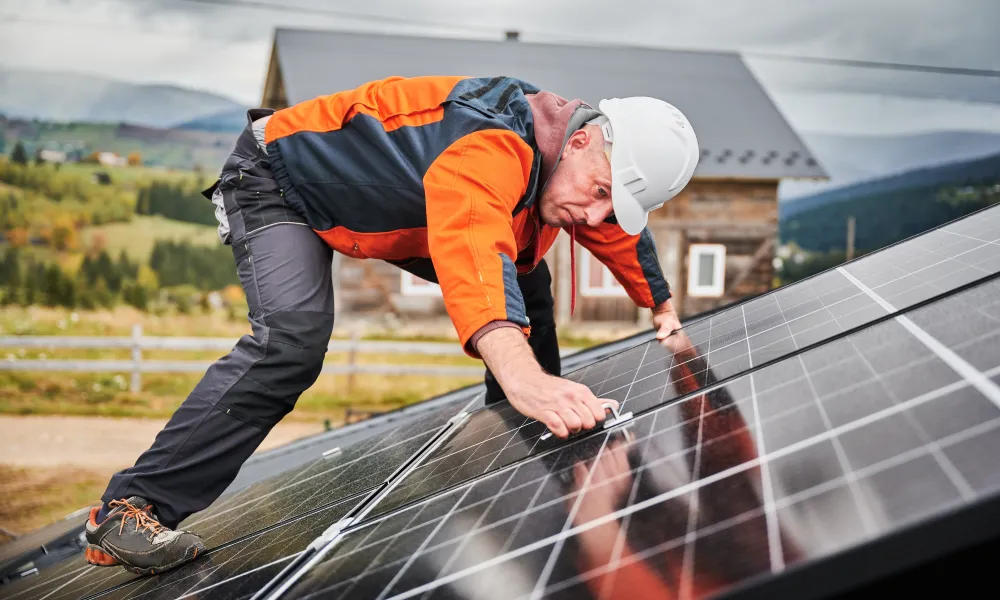
After one or more of the above investments are implemented, the beneficiary will also be able to apply for a subsidy for the installation of a photovoltaic system and batteries for electricity storage.
The state will take over
Beyond the above subsidy scheme, another important innovation towards which the Ministry of Energy is oriented, according to Giorgos Tsiametis, concerns comprehensive energy upgrades for homes where energy-poor households reside, which will be carried out by the state.
In essence, households will not need to be involved at any stage of the construction or installation process, as was the case until today — after all, for energy-poor households this is prohibitive — but the state itself will undertake it for them through tenders from licensed experts, installers and technicians.
€1,000 tax deduction
As regards the rest of the population, Mr Tsiametis recalled that under the tax reform introduced in January this year, there is provision for tax deductions for energy upgrades of buildings for those whose income is taxable.
“So it is fully justified that incentives and subsidies will be directed to those who may not be taxed,” he noted.
According to the provisions of the legislation, the deductions to which taxpayers are entitled for capital expenditure on energy upgrading of a primary residence (individual measures) and installation of photovoltaic systems are as follows: a maximum deduction of €1,000 per tax year per taxpayer.
Millions expected from the new “Thaleia” programme
Significant funds for the renewable energy and energy efficiency sector are also being pursued by Cyprus within the framework of the EU’s new programming period 2028–2034, a topic to be discussed at the European Council next week.
The EU’s multiannual framework - with a total budget of €3 billion - will again focus on energy autonomy. The REPowerEU plan for gradual and full disengagement from Russian natural gas by 2028 remains in place.
Apart from diversification of liquefied natural gas supply and rapid expansion of renewable energy sources, a key pillar for the implementation of REPowerEU is energy saving, leading to reduced consumption through improved energy efficiency of buildings.
During the previous programming period 2021–2027, through the “Thaleia” programme, Cyprus received around €960 million. Together with national funds of €840 million, the total reached €1.8 billion, of which €312 million was allocated to building energy upgrading (public, private and school buildings).
In addition, under the Recovery and Resilience Facility 2021–2026, based on initial targets, 42% of resources were directed to the green transition. Within this framework, additional incentive schemes were introduced by the Ministry of Energy for the upgrading of existing homes and commercial/industrial premises to low energy consumption levels.
As emerges from the above, new programmes amounting to millions of euros will be introduced under the next multiannual framework, focusing on extensive energy upgrading of buildings.
New “Save and Upgrade” scheme
It is recalled that the Ministry of Energy recently announced that in September this year it will proceed with the third call of the “Save and Upgrade Homes” scheme, with a total budget of €20 million.
The scheme covers measures for the deep energy upgrading of existing energy-intensive homes, aiming at at least 60% savings in primary energy. It provides financial support with a maximum grant of up to €32,000 per residence, depending on the type of investment.
Particular emphasis is placed on supporting vulnerable households, homes in mountainous areas and refugee housing in government settlements. In these cases, the grant amount is increased by 20%.
The total budget of the scheme for the period 2021–2027 will reach €105 million (from an initial €85 million). It is noted that approximately 1,000 households benefit from the scheme annually since 2021, undergoing full renovation, reducing their energy costs and ensuring thermal comfort.
3,365 renovations per year
Energy upgrading of buildings does not concern only households. Accelerating the rate of energy renovations is necessary in order to meet Cyprus’s energy and environmental targets.
According to the revised National Building Renovation Plan 2026–2031 published in December, Cyprus must achieve a reduction in average primary energy use in residential buildings of 16% by 2030 and 20–22% by 2035, with 55% of total savings coming from 43% of the lowest-performing buildings.
It is estimated that around 3,365 major residential renovations per year will be required between 2026 and 2030.
As highlighted in the report, the majority of existing buildings are of low energy performance, with around 85% constructed before minimum energy efficiency requirements were introduced.
Residential buildings, around 500,000, half of which are detached houses, are estimated to account for 21% of final energy consumption.
The National Building Renovation Plan adopts the principle of “energy efficiency first,” prioritising the reduction of energy demand through renovations and energy-saving measures before the installation of additional energy infrastructure.