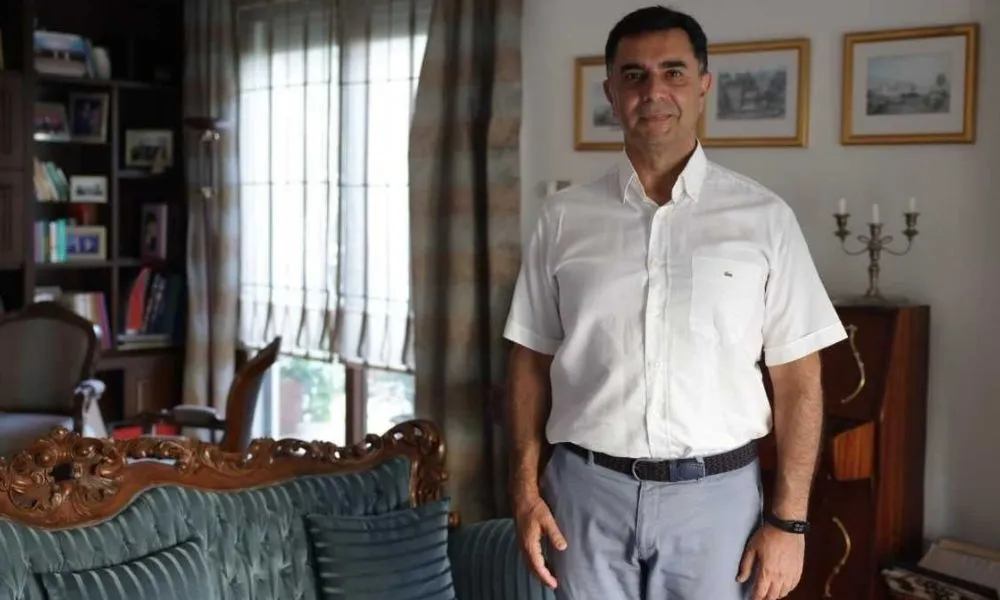
Former Turkish Cypriot negotiator Ozdil Nami has expressed strong reservations over the way the emerging UN initiative on the Cyprus problem appears to be taking shape, warning that it risks leading to a new deadlock.
Speaking on a television programme in the north, Nami referred to the visit of the UN Secretary-General’s personal envoy for Cyprus, Maria Angela Holguin, as well as the new initiative by Antonio Guterres. He argued that, at this stage, the main issue lies not so much in the substance of a solution, but in the “architecture” of the negotiating process itself.
‘Absence of method is the problem’
Nami said an article published in Politis on new ideas surrounding the process had heightened his concerns. The primary problem, he argued, is the absence of a clear method. In his view, the Cyprus issue is not hindered by an inability of the sides to agree on key points, since “the agreement is on the table”. What is lacking, he said, is the appropriate methodology to overcome the final obstacle.
This structure, he added, is not accidental but the product of long experience in Cyprus negotiations, designed precisely to lead to a settlement.
‘We must preserve the structure’
That negotiating architecture, he argued, collapsed when the Turkish side stepped outside the agreed timetable, rejecting the established basis for talks. At the time, there was also a cost element: if the process had concluded within the timetable and the outcome had been rejected, Cyprus not joining the European Union would have imposed a cost on both sides.
‘We must preserve this structure. We must rediscover it and put it back in front of us,’ he said, insisting that the real problem lies in procedure rather than substance.
‘The problem is not substance’
‘There is no longer a problem between the sides on substance,’ Nami said, adding that if the information reported in Politis is accurate, what is missing is precisely the necessary architecture of the process.
He made particular reference to reports of new ideas on power-sharing, dismissing them outright. ‘This cannot be done,’ he said, stressing the need to protect convergences already achieved. He also recalled that both leaders have stated they want talks to resume from where they left off.
‘I do not understand the logic of introducing a problem that does not exist,’ he said, noting that in the emerging format under discussion there is no timeline, no arbitration and no cost element. Without these, he warned, a negotiation cannot succeed.
He also referred to an approach that appears to involve granting certain benefits to the sides over a period of two or three years, adding that such benefits would have a permanent character.
The ‘Tymbou – Varosha’ scenario
According to Nami, the most prominent scenario involves opening Tymbou airport to international flights in exchange for reopening Varosha under UN control to allow former residents to return.
Explaining the rationale, he said the idea is that the Greek Cypriot side could better appreciate the benefits of a solution environment, while perceptions that ‘Turkish Cypriots gain political equality from day one while we get nothing’ could be addressed through territorial gains.
On the Turkish Cypriot side, the prevailing view is that such a trade-off could ease aspects of isolation, he added. However, if a future referendum were to result in a ‘no’ vote, this would leave the Greek Cypriot side with territorial gains and the Turkish Cypriot side with benefits related to airports and ports.
‘A new no would freeze a solution for decades’
Nami said he does not agree with this approach. He warned that a new rejection in a referendum under such conditions could effectively freeze any solution to the Cyprus problem for decades.
He argued that in such an environment, the prospect of a future settlement would become almost impossible. ‘I cannot imagine what a Greek Cypriot side that had secured Varosha as territory would then demand in order to say yes in a subsequent referendum,’ he said.
In conclusion, Nami warned that such a trajectory would have no end, as the Greek Cypriot side would continue to seek further gains. If this path is followed, he said, the overall solution of the Cyprus problem risks being abandoned, with the north heading towards a process of ‘Taiwanisation’.